
The Bigger Fish, the Buying Decision, and the Gold Beneath the Surface
The Bigger Fish, the Buying Decision, and the Gold Beneath the Surface
Why struggling to gain traction doesn't mean you have nothing valuable to offer.
I had a fascinating conversation with a group of marketers recently.
Some were experienced. Some were extraordinarily knowledgeable. Others were newer to the game, but certainly no less committed. And quite a few were getting seriously frustrated.
The subject was something that seems to be coming up more and more often: Why is it getting so difficult to convince someone to spend even a few dollars?
We're not necessarily talking about thousand-dollar coaching packages or elaborate business investments. We're talking about small, affordable offers. The kind that should, in theory, make it easy for someone to take a chance on getting a little help.
Except it isn't that easy anymore.
People have seen the promises. They've downloaded the guides, attended the webinars, bought the courses, and collected enough tips and tricks to fill a small library.
Some of those resources were probably excellent.
But how many actually changed anything?
How many are still sitting unopened in somebody's inbox, quietly gathering digital dust?
And how many times does that have to happen before even a $7 offer starts feeling like another gamble?
That's what we were wrestling with.
Not just how to sell more effectively, but how to earn enough trust that someone who's already been disappointed will consider giving us another chance.
And somewhere in that conversation, I remembered a swimming pool.
Well, technically, a triathlon.
There's Always a Bigger Fish
Back in my high school and college years, I was a very good swimmer.
Good enough that when I decided to enter a triathlon, I figured the swimming portion would be where I'd get out ahead of the pack.
That seemed reasonable.
I knew how to swim. I knew I was fast. I'd put in the work.
What could possibly go wrong?
Well, for starters, I began somewhere in the middle of the pack.
And when the race started, I discovered something about competitive swimming that all my previous experience hadn't quite prepared me for.
Apparently, everyone else also knew how to swim.
Some of them were considerably better at it than I was.
And a whole lot of them seemed perfectly comfortable trying to swim through me.
Arms were flailing everywhere. People were practically climbing over one another. Every time I tried to settle into a proper stroke, somebody was beside me, on top of me, or doing their level best to occupy the same piece of water.
It was a meat grinder.
I couldn't get any meaningful traction.
Now, I could have kept trying to swim the way I'd trained. I could have fought harder, kicked more aggressively, and hoped that eventually I'd break free.
Instead, I dove.
I went beneath the chaos, switched to a frog kick and underwater swimming, and started making progress where the crowd wasn't.
Every so often I'd surface, grab some air, and promptly be reminded why I'd gone underwater in the first place.
Then down I'd go again.
It wasn't the way I'd expected to swim that race.
But it worked.
I got through that portion fairly quickly, not because I'd suddenly become the best swimmer in the water, but because I'd found a different way to use the abilities I already had.
And that memory came rushing back during our marketing discussion.
What If You're Not a Bad Swimmer?
There's something particularly discouraging about being good at something and discovering that being good isn't enough.
You can have a worthwhile product, genuinely useful knowledge, years of experience, and a sincere desire to help people.
You can work your tail off trying to communicate all of that.
And still find yourself getting nowhere.
Meanwhile, somebody else seems to be sailing along effortlessly, attracting Customers, building an audience, and making sales.
Of course, we don't always see how much work went into getting them there. We don't see the years of experimentation, the failed campaigns, the existing relationships, or the advantages they started with.
We just see them swimming ahead of us.
And before long, a dangerous little conclusion begins to form.
Maybe I'm just not good enough.
But here's something I wish more entrepreneurs understood:
Struggling to gain traction is not, by itself, evidence that your business has nothing valuable to offer.
Read that again if you need to.
There's a tremendous difference between having something valuable to contribute and having discovered how to communicate that value to the right people, under the right circumstances, in a way they can believe.
Those are two separate achievements.
Being a good swimmer didn't magically create space for me in that crowded water.
And being good at what you do doesn't automatically create space for you in a crowded marketplace.
Sometimes you need to find a different way through.
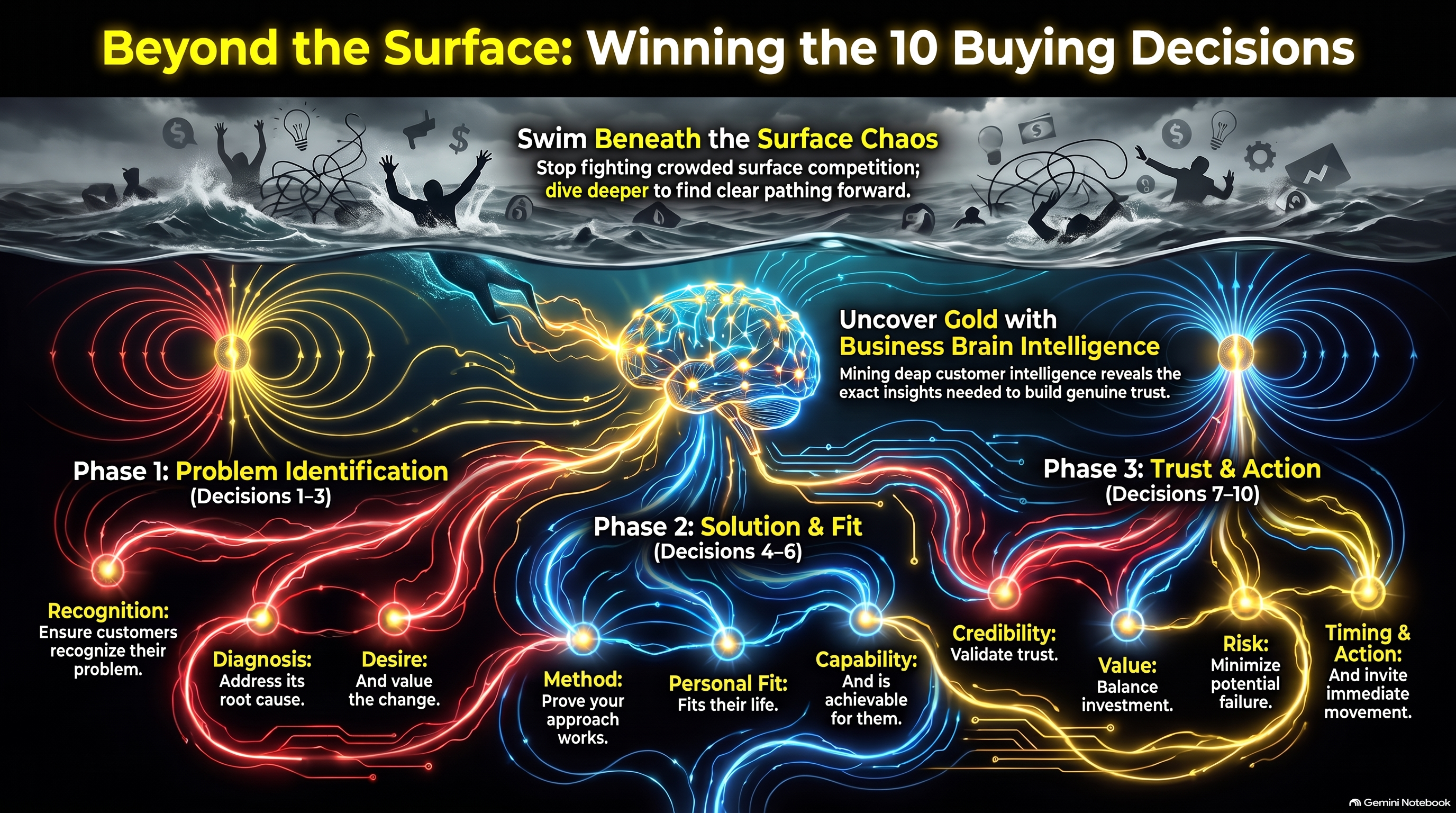
The Ten Decisions Nobody Can Make for Your Customer
One of the most interesting conclusions from our discussion was that a Customer doesn't simply look at an offer and decide whether the price is reasonable.
There's a much bigger conversation going on inside their head.
Sometimes they're conscious of it. Sometimes it's a vague feeling that something doesn't quite add up.
But before someone is comfortable pulling out their card, there are a number of important decisions they may need to resolve.
Here are ten worth considering.
1. Recognition — Do you actually understand my problem?
Does your message describe something they're genuinely experiencing? Or does it sound like another generic promise written for everybody and nobody?
2. Diagnosis — Are you addressing the real problem?
This is a big one.
Your Customer may already have a collection of solutions for the symptoms. They're looking for a reason to believe you've identified something deeper.
3. Desire — Is the improvement important enough to pursue?
A product can be interesting, informative, and affordable without offering a change the Customer cares enough about to act on.
4. Method — Does your approach make sense?
They need to understand how your proposed treatment could reasonably produce the improvement you're promising.
5. Personal Fit — Is this actually for someone like me?
Not everyone with the same problem is in the same situation. Your Customer needs to recognize that your solution fits their circumstances.
6. Capability — Can I really do this?
Here's one that gets overlooked.
A Customer might believe your product is excellent and still doubt they'll have the time, knowledge, tools, or discipline to get the intended result.
7. Credibility — Can I trust you?
Not merely whether you seem likable, but whether your claims are believable, your experience is relevant, and your promises have substance behind them.
8. Value — Is the likely improvement worth what this will cost me?
And the cost isn't just the price on the button. It's their time, attention, energy, and the opportunity to spend those resources elsewhere.
9. Risk — What happens if this doesn't work out?
Will they feel foolish? Waste another weekend? Lose money they needed for something else? Be stuck with another product they can't use?
10. Timing and Action — Is this the right next step for me, right now?
Even when everything else makes sense, a Customer may have perfectly legitimate reasons to wait.
Think of these as ten doors between your Customer and the purchase. They don't necessarily open in order, and some may already be wide open. But if even one important door remains firmly shut, the Customer may never reach the checkout—no matter how beautifully we've decorated the hallway.
Now, these aren't ten scientifically ordained steps that everyone marches through in exactly the same order.
They're a practical framework for examining the questions that influence a buying decision.
And here's why they matter so much.
You can do a wonderful job answering nine of those questions and still lose the sale because the tenth remains unresolved.
Maybe your Customer understands the problem, trusts your expertise, likes the method, and sees tremendous value.
But they've already purchased four courses they never finished.
They don't doubt you.
They doubt themselves.
If your sales page never addresses their concern about actually implementing what they'll learn, you may have missed the very thing standing between them and a confident purchase.
And no amount of shouting about your bonuses is going to solve that particular problem.
Stop Treating Every Lost Sale With Another Headline
This is where the discussion gets particularly interesting for those of us building the Business Brain.
When an offer isn't converting, what's the usual advice?
Rewrite your headline.
Change the button color.
Add urgency.
Throw in another bonus.
Try a bigger discount.
Now, sometimes those changes help. A confusing headline really can be a problem. A difficult checkout can absolutely cost you sales.
But what if none of those things is the underlying issue?
What if the Customer doesn't believe your treatment addresses the real cause of their problem?
What if the offer seems designed for somebody with more experience than they have?
What if they've heard the same promise from fifteen other businesses and can't see anything that makes yours meaningfully different?
Those aren't necessarily copywriting problems.
They're problems of understanding.
And we've been working on something that can help us investigate them.
Enter the Business Brain
Throughout the Business Brain Builder, we've been collecting something much more valuable than a collection of answers to marketing questions.
We've been developing an increasingly detailed understanding of a business.
Who are the Customers we're best positioned to help?
What do they experience? What do they want? What have they tried? What might they misunderstand about their own problems?
What can our business actually deliver?
What transformation can we responsibly promise, and what evidence do we have to support it?
We've even been distinguishing between the symptoms Customers notice and the deeper causes that may be producing them.
All of that intelligence has a purpose.
When we reach the point of presenting our Small Paid Transformation, we don't have to begin with a blank page and ask AI to write something persuasive.
We can ask a much more powerful question:
Given everything we know about this Customer and this treatment, which buying decisions are most likely to remain unresolved—and what can we truthfully communicate to help them make those decisions?
That's an entirely different approach to creating a sales page.
Our Business Brain can examine the offer through the perspective of our primary Customer Archetype. It can identify where the explanation of our method is weak, where our credibility needs evidence, where a practical concern deserves attention, and where we're making assumptions that still need to be tested.
It can help us distinguish a persuasive claim from an unsupported one.
It can even help us recognize when the offer itself needs improvement, rather than simply finding prettier words to describe it.
And this is where those ten buying decisions become particularly useful.
The goal isn't merely to generate answers to all ten questions. It's to discover which questions matter most to our particular Customer, which we've answered convincingly, and which still need attention.
One Customer Archetype might be especially concerned about whether the method will work. Another might believe the method is sound but worry about finding the time to implement it. A third may need more convincing that the underlying diagnosis is correct.
They could all be looking at exactly the same offer.
But they aren't necessarily having the same internal conversation.
A human coach can certainly help us recognize these differences, sometimes brilliantly.
But a well-developed Business Brain offers us something especially useful: the ability to repeatedly bring together a large body of accumulated Customer, Brand, and Offer intelligence, examine it from different angles, and preserve what we learn for the next attempt.
Not magical mind-reading.
Not guaranteed conversions.
A much more informed starting point.
And the opportunity to keep getting smarter.
Don't Sell Another Bandage When the Customer Needs a Treatment
This brings us back to something we've been exploring throughout the Small Paid Transformation process.
Imagine someone whose business is struggling to convert leads.
They've tried better headlines. They've downloaded email templates. They've collected social media tips.
And yet opportunities keep slipping away.
Perhaps the deeper problem is that they don't have a reliable process for following up with interested prospects.
Another collection of clever email subject lines might help a little.
But a focused treatment that helps them identify and correct a specific weakness in their follow-up process could deliver something much more meaningful.
Not the whole farm.
Not a promise to fix every marketing problem they'll ever have.
Just a real, achievable improvement that moves them closer to solving the underlying problem.
That distinction matters enormously.
Because the Customer isn't necessarily looking for more information.
They may be looking for a reason to believe this time will be different.
And we can't manufacture that reason with clever language alone.
The treatment has to deserve their confidence.
Our job is to understand what confidence requires, and then communicate the truth about what we're offering.
There's Gold Beneath All That Water
I know. I've mixed my metaphors.
We've gone from swimming through a triathlon to diagnosing diseases, and now we're prospecting for gold.
Bear with me. There's a reason.
Online marketing has become something of a gold rush.
Everybody's heard the stories. Somebody discovered a brilliant approach, found an eager audience, and built a thriving business.
Naturally, thousands of others followed.
And eventually, the place where that first entrepreneur struck gold became awfully crowded.
Sound familiar?
But here's the thing about prospecting.
Finding a little nugget doesn't necessarily make you rich.
What it can do is tell you where to look next.
Maybe you discover that one particular Customer Archetype responds unusually well to your explanation of the problem.
Maybe you realize that your strongest selling point isn't the feature you've been emphasizing, but the fact that your treatment is achievable in a single afternoon.
Maybe Customers keep telling you that your honesty about what the product won't accomplish is precisely why they trust you.
Those are nuggets.
Clues.
Little discoveries that might point toward something considerably more valuable.
And when you find one, you investigate.
You test it. You look for supporting evidence. You see whether it works again.
Perhaps you've found the beginning of a vein.
Perhaps you've just found a shiny rock.
Either way, you've learned something.
And if you're building your Business Brain as you go, that learning doesn't have to disappear when you move on to your next campaign.
It becomes part of the intelligence guiding the next decision.
That's the opportunity I find so exciting.
Not that AI can promise to make every business successful.
It can't.
But it can make the process of learning, refining, experimenting, and discovering considerably more accessible to entrepreneurs who couldn't possibly afford an entire team of specialized researchers, strategists, and coaches.
And for someone who's been struggling to find traction, that matters.
A lot.
Keep Swimming
I think back to that triathlon occasionally.
Especially when I find myself working hard at something and wondering why the progress doesn't seem to match the effort.
There were better swimmers in that water.
Some were faster, stronger, and better positioned than I was.
I couldn't change any of that.
What I could change was how I responded.
I could stop trying to force my way through the same crowded space and find another route forward.
That's not a guarantee of winning.
And building a Business Brain isn't a guarantee of business success, either.
Sometimes the market really is too crowded for a particular offer. Sometimes the treatment needs more work. Sometimes our assumptions about the Customer turn out to be wrong.
But those are things we can investigate.
Things we can learn from.
Things we can change.
The worst conclusion we can draw from a difficult stretch is that our lack of progress must mean we have nothing worthwhile to contribute.
It might mean we haven't found our people yet.
It might mean we haven't answered the question that's keeping them from buying.
It might mean we're swimming in the wrong part of the lake.
Whatever the reason, the next step isn't necessarily to work harder at doing what everybody else is doing.
It's to get curious.
Learn more about the Customers you can genuinely help. Understand the decisions they're trying to make. Build treatments that earn their trust. Pay attention to the evidence.
And keep adding what you discover to your Business Brain.
Because somewhere out there may be a group of people with exactly the problem you're particularly well equipped to solve.
You don't need everybody.
You need enough of the right people to recognize that what you're offering could make a meaningful difference in their lives.
And if you find that little nugget, don't just celebrate it.
Start digging.
There might be a whole vein waiting beneath the surface.
──────── ⚡ ────────
P.S. I honestly don't remember where I finished in that triathlon. Running was always going to be my downfall, and it certainly didn't disappoint! I eventually became a better runner during my Army years, but I've never quite mastered all three disciplines.
My dad, on the other hand, completed an Ironman triathlon at 72, with a finishing time anyone his age could be proud of.
So perhaps there's another lesson here. There's always somebody better at something than we are. Sometimes they're even in our own family.
But that doesn't mean we've finished discovering what we're capable of.
I still remember those flailing arms, the feet, and the feeling of being pushed underwater. Most of all, I remember finding a way to keep moving.
Maybe that's the part that matters most.