
I Thought We Had an Understanding!
I Thought We Had an Understanding!
Why the Most Expensive Business Agreements Are Often the Ones Nobody Wrote Down
There's an old joke about a husband who tells his wife, "I thought we agreed that I make all the big decisions, and you make the little ones."
She replies, "That's right, dear. And in thirty years of marriage, we haven't had a big decision yet."
The joke works because there's something wonderfully familiar about it. Two people can share a perfectly clear understanding of an arrangement while interpreting its terms in completely different ways.
And the remarkable thing is that neither one necessarily believes they're being dishonest.
Welcome to the fascinating world of human agreements, where what was said, what was heard, what was meant, and what was remembered can be four entirely different things.
In business, those differences can get expensive.
The Agreement Nobody Knew They Were Making
Imagine hiring someone to build a website.
You explain what you want, they nod enthusiastically, you agree on a price, and everybody leaves the conversation feeling wonderful about the arrangement.
Three weeks later, the website is ready.
You look at it and say, "Great! Now we just need to make a few changes."
The designer says, "Certainly. I'll send you an estimate."
An estimate?
For changes?
You thought revisions were included. The designer thought the agreed price covered the original design and one round of corrections. Neither of you remembers discussing a revision limit.
You remember the designer saying, "We'll make sure you're happy with it."
The designer remembers saying, "I'll make sure the design matches what we discussed."
Both statements can be perfectly sincere.
They are also two very different promises.
Now the relationship has a problem that might have been avoided by a single sentence explaining what the price included.
Not fourteen pages of legal language. Not a dramatic ceremony involving three witnesses and a notary public.
Just one clear sentence.
And that brings us to something worth understanding about agreements.
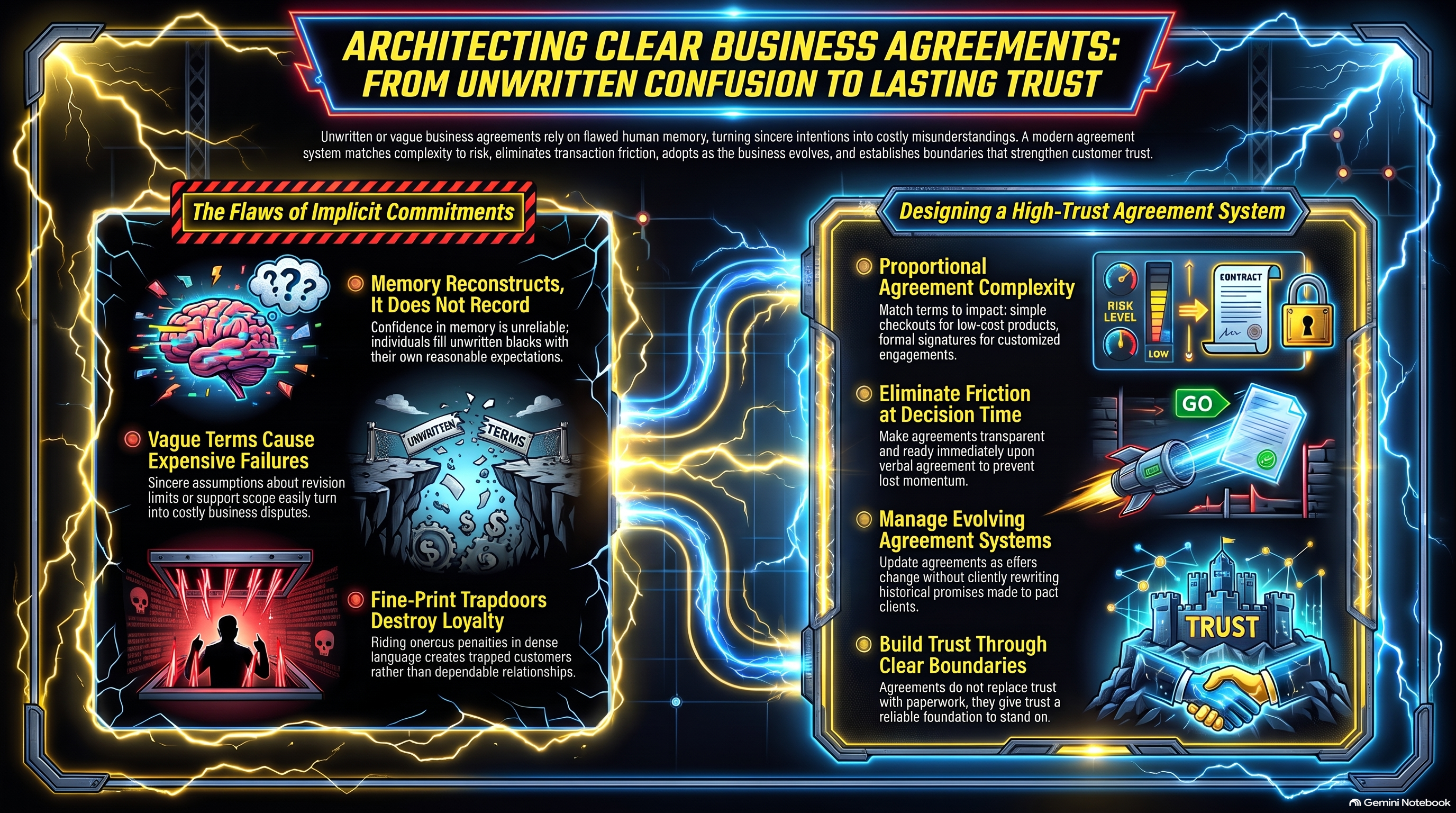
The most important job of an agreement isn't to establish what happens when somebody breaks a promise. It's to make sure everybody understands what the promise actually is.
The Trouble With the Human Memory Department
Human memory is an astonishing achievement of biological engineering.
It allows us to recognize faces, learn languages, remember childhood experiences, and somehow retain the lyrics to songs we haven't heard since 1987.
Unfortunately, it doesn't function like a security camera.
Memory is reconstructive. We don't simply retrieve a perfect recording of an event. We rebuild our recollection using fragments of information, expectations, emotions, and subsequent experiences.
That doesn't mean we're all constantly inventing things. It means our confidence in a memory isn't always a reliable measure of its accuracy.
And expectations have a way of slipping into that reconstruction.
A customer remembers being promised unlimited support because the salesperson enthusiastically described how much help would be available.
The salesperson remembers explaining that the program included six coaching sessions and access to a weekly group discussion.
A contractor remembers being asked to "help manage the marketing."
The business owner remembers hiring someone to handle Facebook ads, not rebuild the website, edit videos, write newsletters, and occasionally troubleshoot the office printer.
The problem isn't necessarily dishonesty.
It's that each person has been filling in the blanks with what seemed reasonable to them.
A good agreement gets those blanks onto the table before they become arguments.
The $10 Product That Doesn't Need a Signing Ceremony
Now, this is where businesses can overcorrect.
Having discovered the dangers of vague expectations, someone decides that every transaction requires a formal contract.
Suddenly, buying a $10 digital guide involves a twelve-page agreement, an electronic signature, three confirmation emails, and a verification process normally reserved for launching satellites.
Congratulations. You've protected the business from a hypothetical misunderstanding by making the customer reconsider whether they wanted the guide in the first place.
There is a difference between protecting a transaction and complicating it.
A simple online purchase can often be handled with clearly presented terms, appropriate disclosures, and a straightforward acceptance process.
A customized $5,000 coaching engagement, on the other hand, may involve individualized services, scheduling commitments, payment arrangements, cancellation terms, and obligations that deserve a more deliberate agreement.
The distinction isn't strictly about money.
A low-cost subscription that renews automatically still needs clear billing and cancellation terms. A more expensive standardized product may not require an individually signed document.
The agreement process should be proportional to the relationship, its obligations, and its consequences.
That principle is surprisingly liberating.
It means you don't need to make every customer jump through the same hoops simply because your business uses contracts.
You need to choose the right hoops.
Preferably as few as possible.
The Moment Between Yes and Someday
There's another place where agreements become unexpectedly important: the moment someone decides to do business with you.
Imagine a prospective coaching client has spent forty-five minutes discussing their challenges, goals, and options with you.
You've answered their questions. They've examined the offer. They understand the price and what the program includes.
Finally, they say, "You know what? Let's do it."
Wonderful!
You respond, "Excellent! I'll have someone prepare an agreement and email it to you tomorrow. Then we'll send the payment information once that's signed."
Tomorrow arrives.
Your email competes with forty-seven others. The customer gets distracted by a meeting. Their child comes home sick. The car needs repairs. The dog eats something that requires an emergency veterinary appointment.
By Friday, the enthusiasm of Wednesday's conversation has been buried beneath the ordinary chaos of life.
The customer may still want the program.
They simply haven't gotten around to completing the transaction.
Now, some salespeople respond to this problem by manufacturing urgency. They invent deadlines, imply opportunities will disappear, or pressure customers to commit before they've had time to think.
That's not the solution I'm suggesting.
The better approach is to make the business operationally ready when an informed customer decides to proceed.
Have the correct agreement prepared. Make the terms easy to review. Be ready to answer questions. Make payment authorization straightforward. Allow the customer to complete everything during the conversation if they choose.
And if they want more time, respect that.
Make it easy to say yes, safe to say no, and unnecessary to say "I'll get around to it" when the decision has already been made.
That's not a pressure tactic.
It's good service.
The Fine Print Shouldn't Be a Trapdoor
Of course, agreements have another reputation.
They're where businesses hide the things they don't particularly want customers to notice.
The enormous cancellation penalty. The mysterious automatic renewal. The refund exception that effectively eliminates refunds. The clause that appears to suggest the customer has surrendered every legal remedy short of appealing to the Supreme Court.
These provisions may be buried under enough dense language to make an ordinary person wonder whether they're purchasing a service or unknowingly signing up for the Human Centi-pad program.
This approach misunderstands what makes a business relationship valuable.
A customer who feels trapped is not necessarily a loyal customer.
A contractor who discovers unexpected obligations isn't necessarily a dependable contractor.
An employee who learns that important expectations were never explained isn't necessarily going to feel invested in the organization.
And a business owner who relies on intimidating language instead of clear expectations may discover that the contract doesn't provide the protection they imagined.
Agreements should establish fair responsibilities and legitimate remedies for both sides. They should also respect applicable legal rights, including protections that cannot simply be signed away.
The goal isn't to make every disagreement impossible.
That's beyond the power of any document.
The goal is to reduce preventable disagreements and create a reasonable framework for handling the ones that remain.
Agreements Have an Expiration Problem, Too
Suppose you create a beautifully written subscription agreement today.
It accurately describes your services, billing arrangements, support schedule, cancellation process, and customer benefits.
You have it professionally reviewed. You implement it properly. Everything works.
Then your business grows.
Six months later, you change your coaching schedule.
Three months after that, you introduce a new membership tier.
You change payment providers, revise your cancellation process, and add a new benefit that wasn't part of the original offer.
Meanwhile, the agreement sits quietly in the corner, looking very official and becoming increasingly inaccurate.
This is a surprisingly common problem with business documents.
We tend to treat agreements as things we finish.
But a business is not a finished thing.
It evolves.
That means the system supporting its agreements must evolve as well.
A useful approach is to establish a simple change-review process: whenever a material business policy, offer, or billing practice changes, ask which agreements and customer disclosures might also need attention.
And once a year, conduct a broader review of the entire system.
Modern AI can help identify inconsistencies, compare documents against current business practices, organize potential legal questions, and research developments that may deserve professional attention.
It cannot replace a qualified attorney or guarantee that an agreement is legally enforceable.
But it can make the maintenance process considerably more manageable.
There's one particularly important safeguard: changing today's agreement must not silently rewrite yesterday's promises.
The terms a customer accepted last year should remain preserved as part of that transaction's history. If existing relationships require changes, those changes may need appropriate notice, consent, or formal amendment.
Your business should always be able to answer a simple question:
"What did we actually agree to at the time?"
The Real Value of Putting It in Writing
We often think of agreements as defensive instruments.
Something to pull out when a relationship goes wrong.
And yes, they can serve that purpose.
But that perspective overlooks their greatest value.
An agreement is an opportunity to think clearly before making a commitment.
When you sit down to describe exactly what your business promises, you may discover that some of those promises are vague, some are unrealistic, and others have never been properly defined.
That's valuable information.
It gives you an opportunity to improve the offer, clarify the service, establish reasonable expectations, and make sure your operational systems can support what you're selling.
In other words, the process of creating a good agreement can make the business itself better.
And there's something almost philosophical about that.
Trust isn't created by the absence of boundaries.
Often, trust becomes stronger when people understand where those boundaries are, what each person can expect, and how they'll treat one another when circumstances change.
The purpose of writing things down isn't to replace trust with paperwork.
It's to give trust something reliable to stand on.
So the next time someone says, "I thought we had an understanding," consider the possibility that they did.
They just might not have had the same one.
And that's a problem worth solving before the invoice arrives.
At Magnetix Marketing, we believe that a well-designed business should make its promises clear, its commitments manageable, and its customer relationships easier to maintain. That's why our Business Brain Builder helps business owners turn scattered decisions into connected systems they can actually use.
Permanent Progress. Not Permanent Preparation.