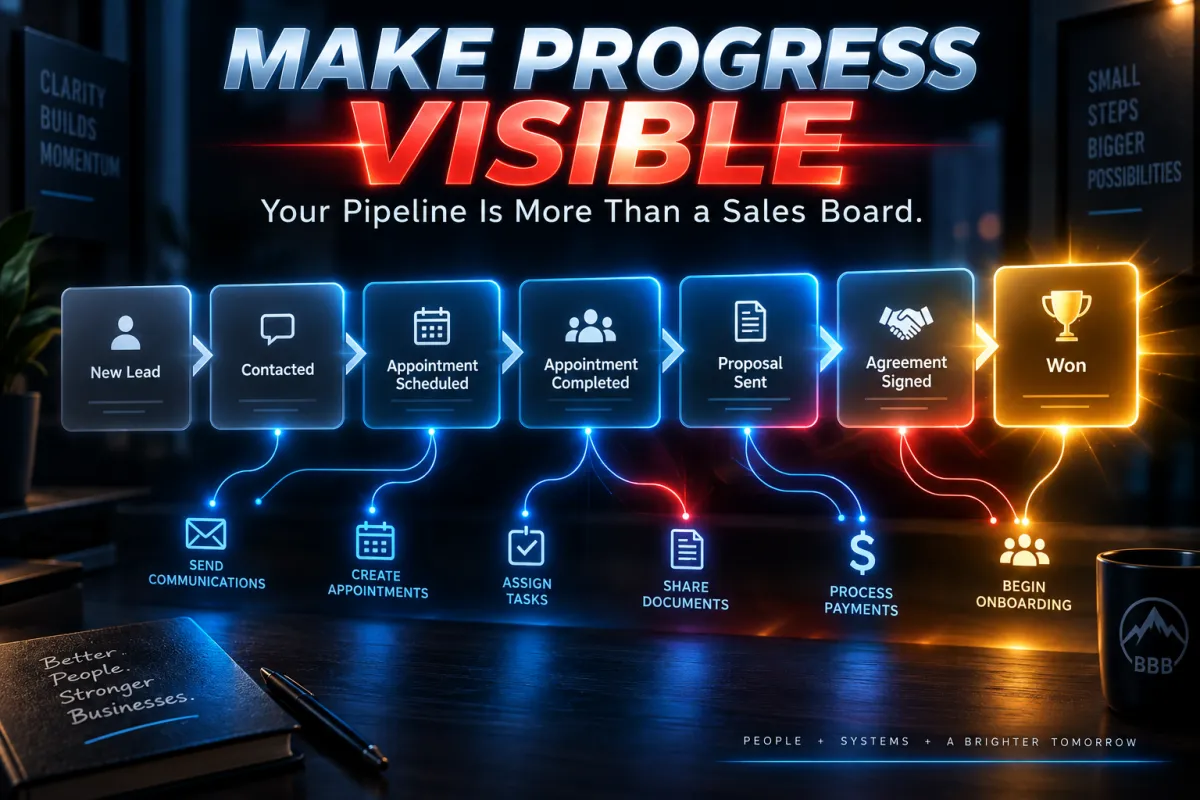
Your CRM Pipeline Is More Than a Sales Board
Your CRM Pipeline Is More Than a Sales Board
There are features in software you can use for years without ever really understanding why they're there.
CRM Pipelines can easily become one of them.
You open the Pipeline and there are columns. Maybe they say:
New Lead → Contacted → Appointment → Won
People move cards from one column to another. Someone occasionally checks how many are sitting in each one. If you're feeling particularly sophisticated, perhaps there are some automations attached.
It works.
But the moment those columns represent meaningful changes in what's actually happening with a customer, the Pipeline becomes something much more useful.
Now it can help the business recognize what changed, what matters next, what should stop happening, what could happen automatically, and eventually where progress is breaking down.
A Pipeline isn't really a collection of columns.
It's a way to make meaningful progress visible.
──────── ⚡ ────────
The Columns Aren't the Important Part
Imagine someone contacts a martial arts school because they're interested in training.
At first, all we really know is that they're interested.
Then they schedule an introductory lesson.
Something has changed.
They haven't become a customer yet, but the business now knows something it didn't know before. There's an appointment to prepare for. A confirmation might need to go out. A reminder might become appropriate.
Then they attend.
Something changes again.
Appointment reminders aren't useful anymore. Perhaps now there's an enrollment conversation. Maybe an agreement becomes relevant. Maybe there's a starter program.
Eventually they enroll.
Another meaningful change.
Prospect communication can stop. Customer communication can begin. Payment, onboarding and training can take over.
The Pipeline gives us a way to see those changes.
That leads to a question I've come to think is far more useful than simply asking what columns a Pipeline should have:
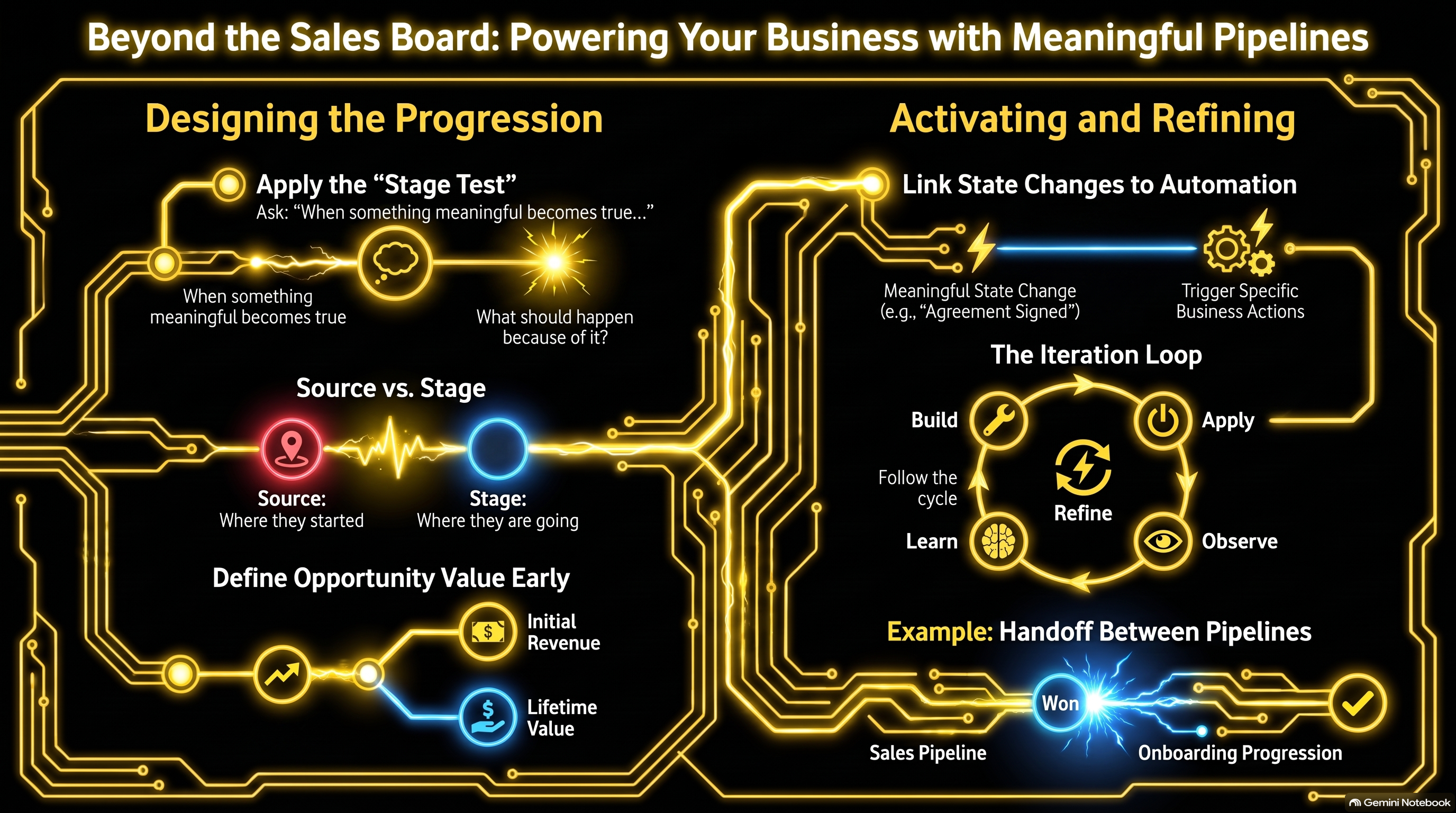
When something meaningful becomes true, what should happen because of it?
That's where Pipelines start getting interesting.
──────── ⚡ ────────
A Stage Should Mean Something
One of the easiest mistakes to make when setting up a CRM is creating a Stage for everything you can track.
Facebook Lead.
Referral Lead.
Website Lead.
Called Once.
Called Twice.
Left Voicemail.
Downloaded Guide.
Las Vegas.
Premium Program.
Needs Financing.
Before long, you've created something impressive enough to require its own cartographer.
The problem is that most of those things aren't really stages of progress.
A Facebook lead didn't necessarily progress by becoming a Facebook lead. That's where they came from.
Someone needing financing is useful information, but it may be an attribute of the Opportunity rather than a new point in its progression.
So I've found a better test:
What becomes meaningfully different when someone enters this Stage?
Maybe the business needs to communicate differently.
Maybe responsibility changes.
Maybe a document becomes relevant.
Maybe payment is now due.
Maybe fulfillment can begin.
Reporting might now mean something different.
An automation might eventually need to start or stop.
Sometimes it's simply a state important enough that the business needs to know someone has reached it.
But something should have changed.
That's why:
Source tells us where they came from. Stage tells us where they're going.
That distinction alone can clean up a surprising number of Pipelines.
──────── ⚡ ────────
Pipelines Aren't Even Necessarily About Sales
This was one of the realizations that changed how I thought about them.
A sales Pipeline is simply the most obvious example.
A loan officer might have something closer to:
Application → Documents Received → Processing → Underwriting → Conditions → Clear to Close → Funded
There's a successful outcome, and there are meaningful states along the way.
A service business could have:
Agreement → Intake → Production → Review → Delivery → Complete
A B2B software company might track implementation:
Contract Signed → Account Provisioned → Data Connected → Team Onboarded → First Value Reached → Live
None of those software implementation Stages represents another sale.
They make customer activation visible—and potentially show the business where customers repeatedly get stuck before receiving the value they purchased.
A martial arts school could eventually track student progression:
White Belt → Yellow Belt → Orange Belt → Green Belt → ...
You could even zoom further in and track progression toward a particular advancement:
Skills Introduced → Practicing → Demonstrated → Test Ready → Belt Test → Passed
Now the Pipeline isn't describing a sale at all.
It's describing progress.
And there's another useful consequence hiding inside that idea:
Making progress visible also makes stalled progress visible.
Once you understand that, you begin seeing potential Pipelines everywhere.
That's also where a little restraint becomes useful.
Just because you can see them doesn't mean you need to build all of them Tuesday afternoon.
──────── ⚡ ────────
One Progression Can Hand Off to Another
Seeing Pipelines this way creates another useful possibility.
If different kinds of progress deserve different Pipelines, we no longer have to force an entire customer relationship into one enormous progression.
It's tempting to make one Pipeline describe every state someone will ever occupy in relation to the business.
A prospect enters.
They schedule.
They buy.
They onboard.
They receive the service.
They renew.
They refer someone.
They achieve enlightenment and become a Supreme Being of Light.
Apparently the Pipeline is now responsible for their entire mortal existence.
There is an easier way.
A commercial Pipeline might end:
Enrollment Decision → WON
And another progression might begin:
New Student → Orientation → Active Training → First Milestone
Or a service business might move from a successful sale into:
Agreement Signed → Intake → Production → Review → Delivery → Complete
The successful conclusion of one process can become the beginning of another.
That keeps each Pipeline understandable because it has a coherent job.
A Pipeline should represent a coherent progression, not every state a person will ever occupy in relation to the business.
Suddenly the CRM starts looking less like one giant board and more like a collection of useful maps.
──────── ⚡ ────────
The Dollar Amount Needs to Mean Something Too
Once we're clear about what a Pipeline is tracking, some of the other information attached to an Opportunity starts making more sense too.
There's a little box in many CRMs that can quietly become nonsense if nobody agrees about what it means:
Opportunity Value.
Suppose a contractor has a signed project worth $7,500.
Easy enough.
The Opportunity Value might be $7,500.
But imagine a martial arts school charges $199 to enroll and then $149 per month.
What should the Opportunity be worth?
$199?
$1,987 because someone multiplied the first payment plus twelve months?
An estimated lifetime value?
Some other number?
There isn't necessarily one universal answer.
The more important question is whether the business has decided what the number means.
If one Opportunity represents initial enrollment revenue, another represents estimated annual revenue and another represents somebody's optimistic guess about lifetime value, adding them together doesn't suddenly turn them into useful business intelligence.
It just gives the confusion a dollar sign.
Choose what Opportunity Value means before relying on what Opportunity Value tells you.
And if you don't know enough yet to estimate lifetime value reliably, that's okay too.
A CRM giving you a field doesn't obligate you to pretend you know what belongs in it.
──────── ⚡ ────────
This Is Where Automation Starts Making More Sense
Once the Pipeline's states have meaning—and the information attached to them has a consistent meaning too—the CRM has something much more useful to work with.
That's where automation starts becoming less about sending things and more about responding to what actually happened.
I spend a lot of time working with automation, and Pipelines become much more powerful once you stop thinking of automation as a giant collection of messages.
Instead, we can start with state.
Appointment Scheduled.
What should happen because that's now true?
Perhaps confirmations and reminders.
Appointment Completed.
What should stop happening because that is now true?
Probably those appointment reminders.
Agreement Signed.
What becomes appropriate now that wasn't appropriate five minutes earlier?
Perhaps payment instructions or onboarding.
Won.
What prospect communication should stop?
What customer experience should begin?
This doesn't mean every Stage needs six workflows hanging from it.
It means meaningful state gives automation something meaningful to respond to.
That's a much better starting point than opening an automation builder and wondering what clever thing we can make it do.
──────── ⚡ ────────
And Then Reality Gets a Vote
Of course, we can still design the wrong Pipeline.
We might create two Stages that sounded meaningfully different while planning them, only to discover that real Opportunities always move through them together.
Maybe there's a state we completely missed.
Perhaps the progression works differently than everyone remembered when we drew it on paper.
That's not failure.
That's evidence.
The trick is not to respond by endlessly redesigning the Pipeline every time someone thinks of another possibility.
Build something coherent.
Use it.
Let real Opportunities move through it.
Then look again.
Which Stages actually mattered?
Which didn't?
Where did people repeatedly stall?
What meaningful situation occurred that the Pipeline couldn't represent?
Did anything we assumed about the business turn out to be wrong?
Don't revise because time passed. Revise because experience taught you something.
That's when the CRM stops merely storing information and starts helping you learn from how the business actually operates.
──────── ⚡ ────────
Make Progress Visible First
There's an enormous amount we can eventually attach to a Pipeline.
Emails.
Texts.
Appointments.
Documents.
Payments.
Tasks.
Reporting.
Follow-up.
Onboarding.
Fulfillment.
But I think there's value in resisting the temptation to start there.
First understand the progression.
What are we tracking?
What does success look like?
When does an Opportunity actually begin?
What meaningful states does it pass through?
What becomes different at each one?
Once those answers are reasonably clear, all those clever things we can build around the Pipeline have something solid to attach themselves to.
And we don't need to know everything before beginning.
Sometimes designing the progression reveals that we haven't actually decided what an offer includes, what happens after an introductory appointment, or how a particular commitment works.
That's useful too.
The Pipeline can reveal work without automatically creating work.
We can preserve the question and keep moving until answering it becomes necessary.
That's increasingly how I think good business systems should work.
Not by demanding that we solve every possible future problem before we're allowed to proceed, but by making enough of reality visible that we can recognize what matters next.
And sometimes that begins with something as unassuming as a few columns on a screen.
So the next time you open your CRM, don't start by asking whether you need another Stage.
Pick one you already have and ask:
What becomes meaningfully different when someone reaches this Stage?
Then ask the question that follows naturally:
When that becomes true, what should happen because of it?
If you can't answer the first question, you may not need the Stage.
If you can answer both, you may have just discovered why your Pipeline is far more useful than it looked.
──────── ⚡ ────────