
Five Stars, One Star, and the Truth Somewhere in Between
Five Stars, One Star, and the Truth Somewhere in Between
Henderson had a credibility problem.
Not the sort that comes from doing poor work, disappointing customers, or making promises he couldn't keep. Quite the opposite. Henderson was reasonably competent at what he did, and he'd spent years accumulating experience that might have been genuinely reassuring to prospective clients.
Unfortunately, he had decided that credibility was primarily a matter of presentation.
His office now featured three framed certificates, a glass trophy, and an impressive-looking gold seal on his website proclaiming him an International Leader in Strategic Business Excellence.
The seal was particularly impressive. Henderson had designed it himself.
He was currently working on a second version with laurel leaves.
When a colleague suggested that prospective customers might be more interested in seeing examples of his work, Henderson looked genuinely wounded.
"But the seal is embossed."
His colleague asked whether any customers had actually said something nice about working with him.
"Of course!" Henderson replied.
"Then why don't you show them that?"
Henderson considered this for a moment before asking the question that would eventually consume the rest of his afternoon.
"How many stars should I give myself?"
──────── ⚡ ────────
The Strange Business of Being Believed
We live in an age when almost every purchasing decision comes with an invitation to examine someone else's opinion.
Restaurants have ratings. Contractors have reviews. Books have reader reactions. Software has comparison sites, testimonials, and video demonstrations. Even a relatively inexpensive purchase can send us wandering through a collection of strangers' experiences before we're willing to commit.
This is useful, at least in principle.
We're trying to reduce uncertainty. We want some indication that the product works, the service provider knows what they're doing, and the experience we're imagining bears a reasonable resemblance to what we'll actually receive.
But we've also learned to be suspicious.
Five stars can mean excellent service. They can also mean a tiny sample of unusually enthusiastic customers, an incentive we don't know about, or a collection of reviews that doesn't tell us very much about our particular needs.
A page filled with praise might be reassuring. It might also feel suspiciously polished.
Which brings us to one of the more entertaining reviews I've encountered.
A friend of mine, an author, deliberately included a one-star review among the reactions he displayed for his books.
The review was magnificently brief:
⭐☆☆☆☆ — "Very Juvenile."
Now, I don't know about you, but depending on the book, that might be the most persuasive review on the entire page.
If I'm looking for a serious examination of economic policy, "Very Juvenile" probably isn't encouraging.
But if I'm looking for irreverent humor, absurd characters, and the sort of comedy that makes respectable people pretend they aren't laughing?
Well, now you've got my attention.
The reviewer might have been expressing genuine disappointment. Yet for someone with different tastes, the same criticism could be an accidental recommendation.
That's the peculiar thing about credibility.
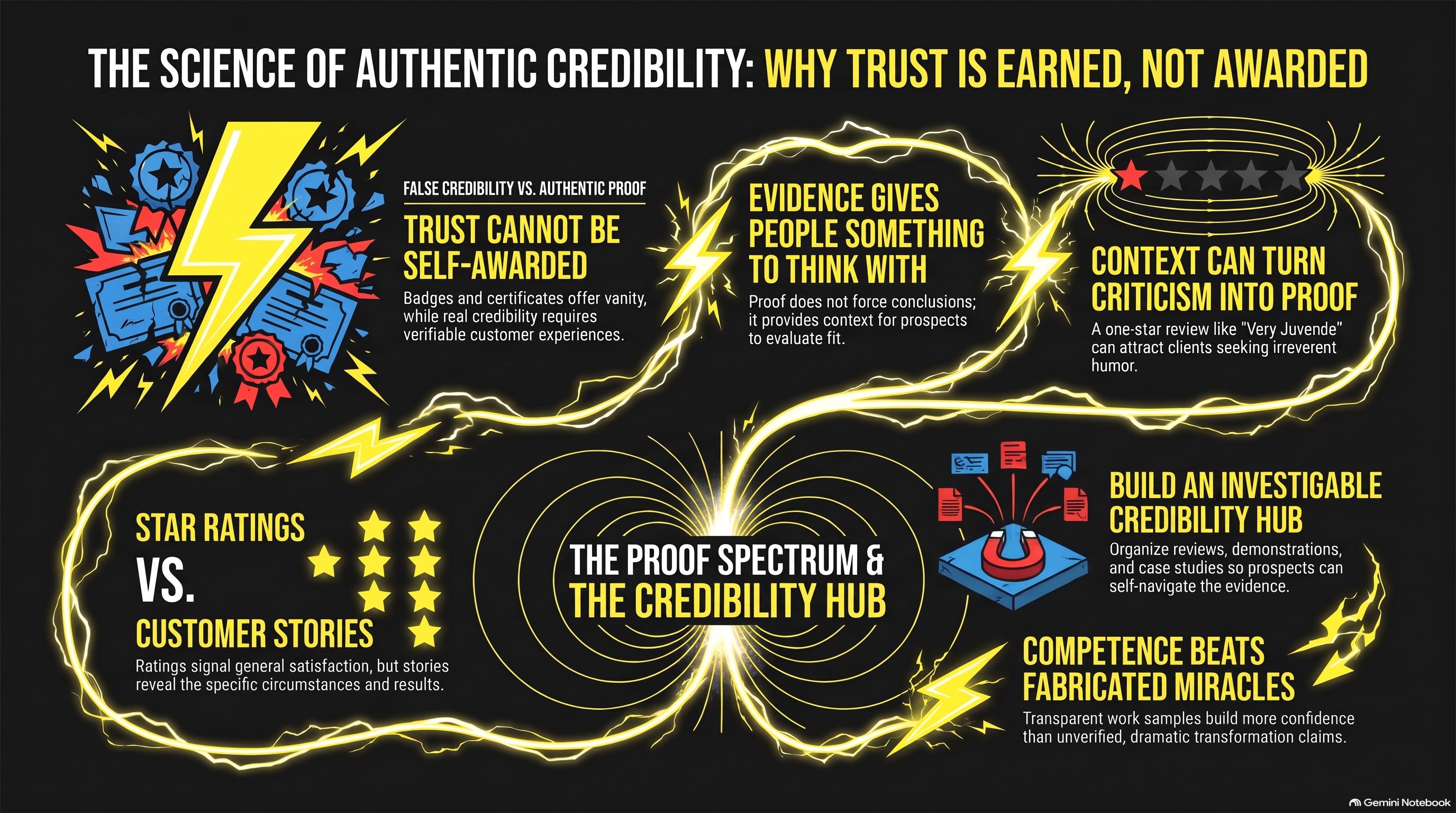
Evidence doesn't tell everyone what to think. It gives people something to think with.
And sometimes the most useful evidence isn't the most flattering.
What Does a Five-Star Review Actually Tell Us?
Imagine you're considering hiring someone to build a website.
You discover that they have thirty-seven five-star reviews.
That's encouraging. Thirty-seven people apparently had positive enough experiences to leave favorable ratings.
But what do you actually know?
Were those customers buying the same service you're considering? Were their projects comparable in complexity? Did they appreciate the finished design, the communication, the speed, the price, or the business results?
You might reasonably infer that customers have been satisfied. But you don't yet know why.
Now imagine you find a written testimonial.
"We needed a website that our staff could update without calling a developer every time we changed something. The team explained the system clearly, trained us to use it, and made the handoff much easier than we expected."
Suddenly, you know considerably more.
If you're a business owner worried about being dependent on a developer for every little change, that testimonial speaks directly to your concern.
But suppose your greatest concern is whether the new website will generate more inquiries.
That same testimonial doesn't answer your question.
It's still genuine, still useful, and still favorable. It simply supports a different conclusion.
This is where businesses often make an innocent but consequential mistake. We collect praise and assume it supports everything we want to say about ourselves.
It doesn't.
A customer who loved our communication isn't necessarily evidence that our product increases revenue. A beautiful portfolio doesn't establish improved conversion rates. A professional qualification doesn't automatically prove that every client achieves a particular outcome.
These things can all contribute to credibility.
They just need to be allowed to do their own jobs.
The Difference Between a Compliment and a Story
Let's return to our hypothetical website designer.
A five-star rating tells us someone was pleased.
A specific written testimonial tells us something about the experience.
But now imagine a customer sitting down for a short video conversation.
She explains that her previous website was difficult to maintain. Every update required a support request, and she often postponed changes because the process was frustrating. She describes what she hoped to accomplish, why she chose the designer, what the transition involved, and how her team now handles routine updates independently.
We can hear her enthusiasm, certainly. But something more important is happening.
We're learning the circumstances behind it.
We can compare her original problem with our own. We can decide whether the solution sounds relevant. We can understand what the designer actually contributed rather than simply accepting a flattering adjective.
That's what makes a good customer story different from a generic endorsement.
It gives us enough context to evaluate the praise.
Video can be especially effective because people communicate through expression, timing, tone, and personality as well as words. A customer doesn't have to deliver a polished commercial to be convincing. Sometimes the natural pauses and little details are precisely what make the account feel human.
But video isn't automatically better.
A clear, specific written review can be more useful than a beautifully produced video that never explains what happened. A documented case study can provide evidence that a heartfelt testimonial cannot. And a quick star rating may be exactly what someone needs when they're comparing several familiar products.
The question isn't which format looks most impressive.
It's which one helps the prospective customer understand something that matters.
The Case Study That Didn't Need a Miracle
There's another problem lurking in the way businesses talk about proof.
We've become accustomed to dramatic success stories.
Revenue doubled. Productivity tripled. An impossible problem was solved in forty-eight hours. Somewhere, presumably, a customer is standing on a mountain holding a laptop while inspirational music plays.
Those stories can be compelling when they're true, properly documented, and presented with enough context to understand them.
But extraordinary outcomes aren't the only outcomes worth discussing.
Suppose a consultant helped a small business organize its customer follow-up process. Before the project, messages were scattered across email accounts and spreadsheets. Afterward, the team had a functioning CRM, a consistent method for tracking inquiries, and clear responsibilities for following up.
That's a worthwhile story.
It doesn't need an invented claim about doubling revenue to become interesting.
We can describe the original situation, what the business wanted to improve, the work that was performed, and the changes that can actually be verified.
If the client later measures improved response times or increased appointments, those results might strengthen the case study. Until then, the completed system and the client's documented experience can stand on their own.
The same principle works for almost any business.
A contractor can demonstrate workmanship. A baker can show the finished product and explain the ingredients and process. A designer can walk visitors through a completed project. A teacher can demonstrate how a lesson works.
Not everything needs to be turned into a miraculous transformation.
Sometimes competence is remarkable enough when people can actually see it.
But What If You're Just Getting Started?
This is where conversations about testimonials and case studies can become uncomfortable.
Someone tells a new business owner to build a credibility page, and the owner looks around at a business that hasn't yet had the opportunity to accumulate much evidence.
No customer reviews. No impressive portfolio. No collection of video testimonials.
What are they supposed to do?
The answer isn't to invent a track record.
Nor is it to apologize endlessly for being new.
A business doesn't need to be established to begin establishing credibility.
Perhaps the owner has relevant experience from previous employment. Perhaps they've completed training or hold qualifications that genuinely matter to their work. Maybe they've built a demonstration, created a sample project, or developed a process they can explain and show.
Those things don't prove customer satisfaction or long-term business results.
But they may demonstrate preparation, competence, judgment, or capability.
And those are perfectly legitimate things for a prospective customer to evaluate.
A new website designer might show a sample website and explain the decisions behind it. A new automation specialist might demonstrate a working follow-up sequence. A new educator might offer a short lesson that allows visitors to experience their teaching style.
Each example gives the visitor something concrete to examine.
As the business grows, real customer experiences can be added. Demonstrations become completed projects. Projects become stories. Stories may lead to reviews, referrals, and richer case studies.
Credibility becomes a body of evidence that develops alongside the business.
The trick is to start with what you can honestly show, rather than waiting until you can pretend to have everything.
A Page That Helps People Investigate
Bringing all of this together requires something more functional than a trophy room.
Not a wall of five-star graphics interrupted by buttons demanding that visitors book a call.
Something more useful.
A place where someone can learn what your business claims to do and examine the evidence behind those claims.
Perhaps the page begins with a brief explanation of your experience and approach. Then visitors can explore completed work, read customer accounts, watch a demonstration, or examine a detailed case study.
They might encounter reviews collected through a reputation-management system, along with an opportunity for current and former customers to share their own experiences.
A particularly relevant testimonial could link back to the service it describes. A case study might show what happened during a project and explain what was measured, what was observed, and what remains uncertain.
Different visitors could follow different paths through the evidence.
Someone concerned about your technical ability might head straight for demonstrations. Someone worried about customer service might read the reviews. Someone considering a substantial investment might spend time with a detailed case study.
This is what we mean by a Proof & Credibility Hub.
It's not simply a page designed to announce that you're trustworthy.
It's a page designed to help people investigate whether you are.
And there's an additional advantage: the evidence doesn't have to remain trapped there.
A relevant customer story can strengthen an offering page. A demonstration might help explain a complicated service. A review from someone facing a familiar challenge might be particularly valuable on a page describing who you serve.
The central hub becomes the organized home for the evidence, while selected pieces can appear wherever they genuinely help someone make a decision.
The Living Evidence of a Growing Business
There's something appealing about the idea of credibility as a living collection rather than a finished marketing asset.
A review system can help invite feedback from customers and display genuine public reviews. A completed project might be documented while the details are still fresh. A customer who has an interesting story to tell might be invited to participate in an interview, with appropriate permission.
Not every satisfied customer needs to become a case study. Not every review needs to be five stars. And not every piece of criticism should be dismissed as evidence that someone wasn't the right customer.
Sometimes feedback reveals a real problem.
That's useful too, although it may be more useful for improving the business than for decorating its website.
An honest credibility system should be capable of learning from what customers say, not merely collecting the most flattering sentences.
That means resisting a few temptations: inventing reviews, selectively requesting public ratings only from customers expected to praise us, presenting exceptional outcomes as typical, or editing customer accounts until they no longer represent what the customer actually meant.
The goal isn't to accumulate the largest possible number of compliments.
It's to make an increasingly accurate picture of the business available to the people considering it.
And that picture should become richer as the business develops.
Henderson's Final Award
By late afternoon, Henderson had abandoned his plan to award himself five stars.
His colleague had convinced him to locate a few actual customer comments, and the results were surprisingly encouraging.
One customer praised his patience in explaining complicated ideas. Another appreciated the detailed preparation he brought to a difficult project. A third had written, "Henderson certainly leaves no stone unturned."
He was particularly pleased with that last one.
He printed it in gold lettering and placed it beneath his trophy.
Then his colleague asked whether he could show prospective customers an example of the work that had inspired the comment.
Henderson hesitated.
"Wouldn't the quotation be enough?"
"Enough for what?"
"To establish that I'm thorough."
"Possibly. But if someone wants to know whether your thoroughness would actually help them, wouldn't it be better to show them?"
Henderson looked at the trophy, then at the customer quotation, and finally at the folder containing several completed projects he'd never thought to put on his website.
For once, he didn't immediately reach for PowerPoint.
He opened the folder.
──────── ⚡ ────────
We often approach marketing as though trust were something we could produce through sufficiently persuasive language.
Find the right headline. Arrange the right testimonials. Display enough stars. Add an impressive seal. Perhaps a little gold trim.
But trust doesn't really work that way.
People bring their own experiences, priorities, doubts, and expectations to every decision. What reassures one person may mean very little to another. What looks like a weakness to one customer may be exactly the characteristic another has been searching for.
Our job isn't to eliminate that independence of judgment.
It's to respect it.
We can make our work visible. We can explain what we've accomplished, what we've learned, and what we can genuinely demonstrate. We can invite customers to describe their experiences and allow prospective customers to decide how relevant those experiences are.
We can even acknowledge the occasional one-star review that tells a more interesting story than the five-star ones.
Because the purpose of credibility isn't to make disagreement impossible.
It's to make an informed decision possible.
Trust isn't something a business gets to award itself. It's something other people decide it has earned.
P.S. Henderson has now added a new section to his website titled "Independent Recognition." It contains three customer testimonials, two completed projects, and his original gold seal. When asked why the seal remains, he explained that it represents his commitment to continuous improvement. His colleague has decided to consider that progress.