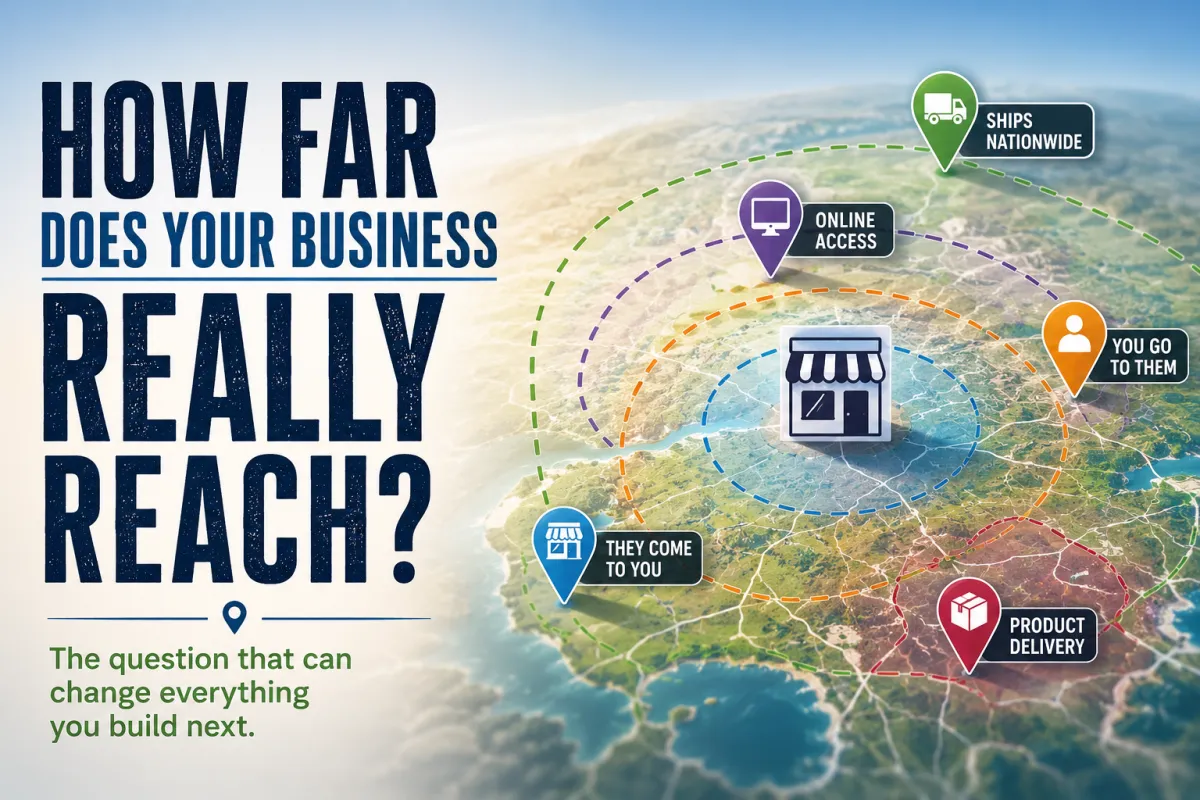
How Far Does Your Business Really Reach?
How Far Does Your Business Really Reach?
The Question That Can Change Everything You Build Next
One of the easiest questions to overlook when building a business is also one of the most consequential:
Where can you actually serve your customers?
It sounds almost too obvious to ask.
A local plumber serves local customers. An online course can reach people anywhere. A restaurant serves people willing to come to the restaurant.
Easy.
Until it isn't.
A business might provide onsite services within 30 miles, sell products that can ship throughout the country, offer consultations online, and eventually provide education to customers almost anywhere.
Now try answering:
“What's your service area?”
Suddenly, drawing one circle on a map doesn't quite cover it.
And there's another question hiding underneath that one:
Just because you can serve someone, does that mean you actually want to?
That distinction can change almost everything that comes later.
Capability Isn't Strategy
Imagine a service business capable of accepting customers throughout an entire state.
Technically, that's the market.
Except the owner doesn't want to spend three hours a day driving.
They want a compact local business with predictable appointments, short travel times, and enough customers nearby to build a comfortable living.
An AI—or a marketing consultant—might look at the technical capability and conclude:
Great! We can advertise statewide.
The owner might look at the same plan and think:
Absolutely not.
Neither answer tells us what the business can do.
The disagreement is about what business we're actually trying to build.
That's why understanding reach requires more than geography.
──────── ⚡ ────────
Start With Where
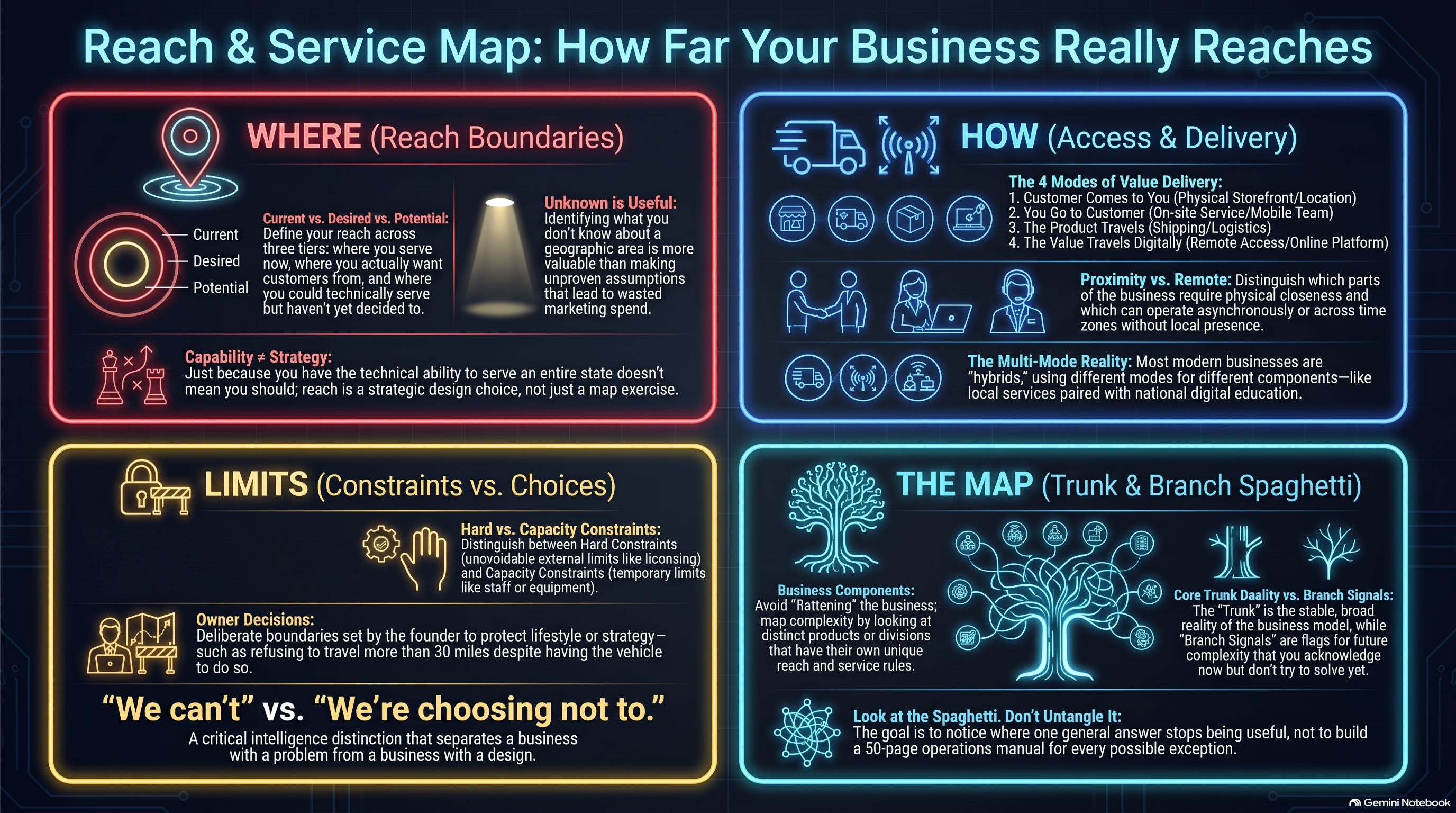
The first useful distinction is between three things:
Where you currently serve.
Where you want to serve.
Where you could theoretically serve.
Those answers don't have to match.
Maybe you currently serve one city but want to expand across the metro area.
Maybe you could ship nationally but have deliberately decided to remain regional.
Maybe you have no idea yet whether interstate expansion is practical.
That's fine too.
UNKNOWN is useful information.
It's considerably more useful than quietly turning an assumption into a business decision.
Then Ask How
Geography still doesn't tell us how the customer actually receives the value.
Sometimes the customer comes to you.
Think restaurants, studios, retail stores, clinics, or venues.
Sometimes you go to the customer.
Contractors, mobile services, catering, home care.
Sometimes the product travels.
Shipping, delivery, equipment, physical goods.
And sometimes nobody goes anywhere.
Consultations happen online. Software is accessed remotely. Education is delivered digitally.
Many businesses do several of these at once.
That's where things get interesting.
A pet food company, for example, might offer local pickup for frozen products, deliver within a limited radius, ship shelf-stable supplements much farther away, and provide educational content online to virtually anyone.
Is that a local business?
Yes.
Is it a national business?
Possibly.
It depends which part you're talking about.
──────── ⚡ ────────
Don't Let One Answer Flatten the Whole Business
This is where we've started using the idea of Business Components inside the Business Brain Builder.
It's nothing fancy.
A Business Component is simply an important product, service, program, division, or other part of the business that may operate differently.
Most small businesses don't need an organizational chart worthy of NASA.
But they do need to notice when one answer stops applying to everything.
Suppose you have:
Onsite service — local because you have to physically be there.
Physical products — regional because they can be transported.
Digital education — national because physical proximity doesn't matter.
Trying to force all three underneath one universal “Service Area” loses useful information.
The better answer is:
The business has different reach depending on the component.
We don't have to solve every implication today.
We just need to notice it.
Some Limits Aren't Really Limits
This may be my favorite distinction in this exercise.
Businesses have real constraints.
Licensing can constrain you.
Shipping costs can constrain you.
Perishable products can constrain you.
Staff capacity, facilities, equipment, suppliers, technology, and travel time can all constrain you.
But then there's:
“I could do that. I just don't want to.”
That's different.
And it matters.
An owner choosing not to spend half the week traveling isn't necessarily suffering from a transportation constraint.
They may be making a business design decision.
Likewise, someone who wants a lifestyle business shouldn't automatically be pushed toward maximum geographic expansion merely because expansion is technically possible.
“We can't” and “we're not building the business that way” are two very different pieces of intelligence.
A good Business Brain should know which one it's dealing with.
──────── ⚡ ────────
Look at the Spaghetti. Don't Untangle It.
Eventually, most businesses become a little messy.
Different customers.
Different products.
Different delivery methods.
Different geographic limits.
Different dependencies.
Different rules.
Our instinct is often to solve all of it at once.
Don't.
At this stage, we're looking for something much simpler:
Where does one general answer stop being useful?
Maybe most of the business follows one basic model.
That's the trunk.
Then you discover one component with substantially different reach or delivery requirements.
That's a Branch Signal.
We don't need to build the branch yet.
We just mark it.
That lets us continue building the core Business Brain without pretending every part of the business works identically—and without turning one discovery exercise into a 47-page operations workbook.
Think First. Then Bring in AI.
There's another important part of this process.
Before asking AI:
“Where should my business serve customers?”
answer a few questions yourself.
Where do you serve now?
Where do you actually want customers to come from?
What parts of the business work differently?
What limits you?
What do you simply not want to do?
Get your answers down first.
Then let AI compare them with everything else you've already learned about the business.
Why?
Because AI is remarkably good at generating plausible possibilities.
That's useful—until a plausible possibility quietly replaces something you already knew.
If you tell AI first that you own a business capable of serving an entire state, it may happily begin reasoning around statewide expansion.
If you'd already written:
“I deliberately want to stay within 25 miles,”
the conversation starts somewhere very different.
That's the idea behind the Owner's Moment in the Business Brain Builder:
Human observation first. AI assistance second. Human decision last.
──────── ⚡ ────────
The Goal Isn't a Bigger Map
It's a more accurate one.
You don't need every ZIP code.
You don't need every shipping rule.
You don't need to know every operational exception your business might encounter five years from now.
You need enough understanding that the next thing you build isn't based on something obviously wrong.
Because your service area affects advertising.
Your delivery model affects offers.
Physical proximity can affect funnels.
Capacity can affect promotions.
Owner preferences can affect growth strategy.
And differences between parts of the business can eventually require entirely different branches of planning.
So before we keep building, we're asking:
WHERE
Where can we serve—and where do we actually want to?
HOW
How do the customer and the value meet?
LIMITS
What materially constrains that relationship?
MAP
Where does one answer stop working and a branch begin?
Then:
SAVE.
Preserve what matters.
Leave the twigs alone.
Back Toward the Brand
This question took us farther into the underlying business than we originally expected when we began building the Business Brain.
That's turned out to be useful.
Because before choosing the identity that will represent a business, it's worth knowing what that business actually is, who it serves, what those people are trying to accomplish—and now, how the business can realistically reach them.
We don't need every branch figured out.
We finally know enough to recognize that the branches exist.
And that puts us much closer to returning to the visual identity work we've deliberately kept waiting.
But first:
How far does your business really reach?
And perhaps the more important question:
How far do you actually want it to?