The Customer Archetype Map
Business Brain Builder — Packet 004
The Customer Archetype Map
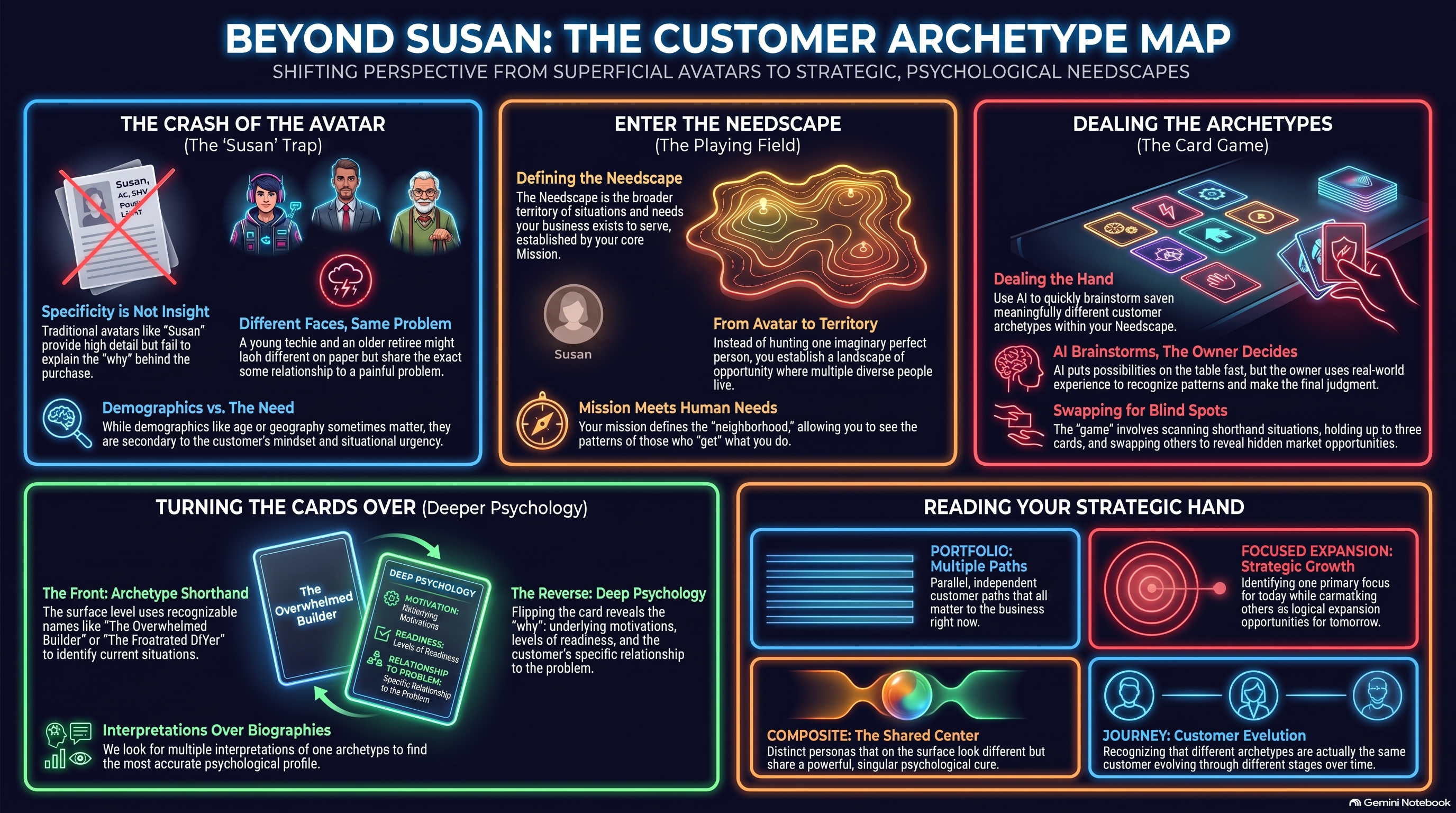
Your mission has already given us the playing field. It defines the broader territory of people your business exists to help and the kinds of outcomes you hope to help create.
Think of that territory as your Needscape.
Now let's see who's actually standing in it.
Different kinds of people can need exactly what you provide for very different reasons. They may arrive with different experiences, motivations, expectations and levels of readiness, even while sharing the same fundamental need.
We're going to meet some of them.
And we're going to play this one a little like a card game.
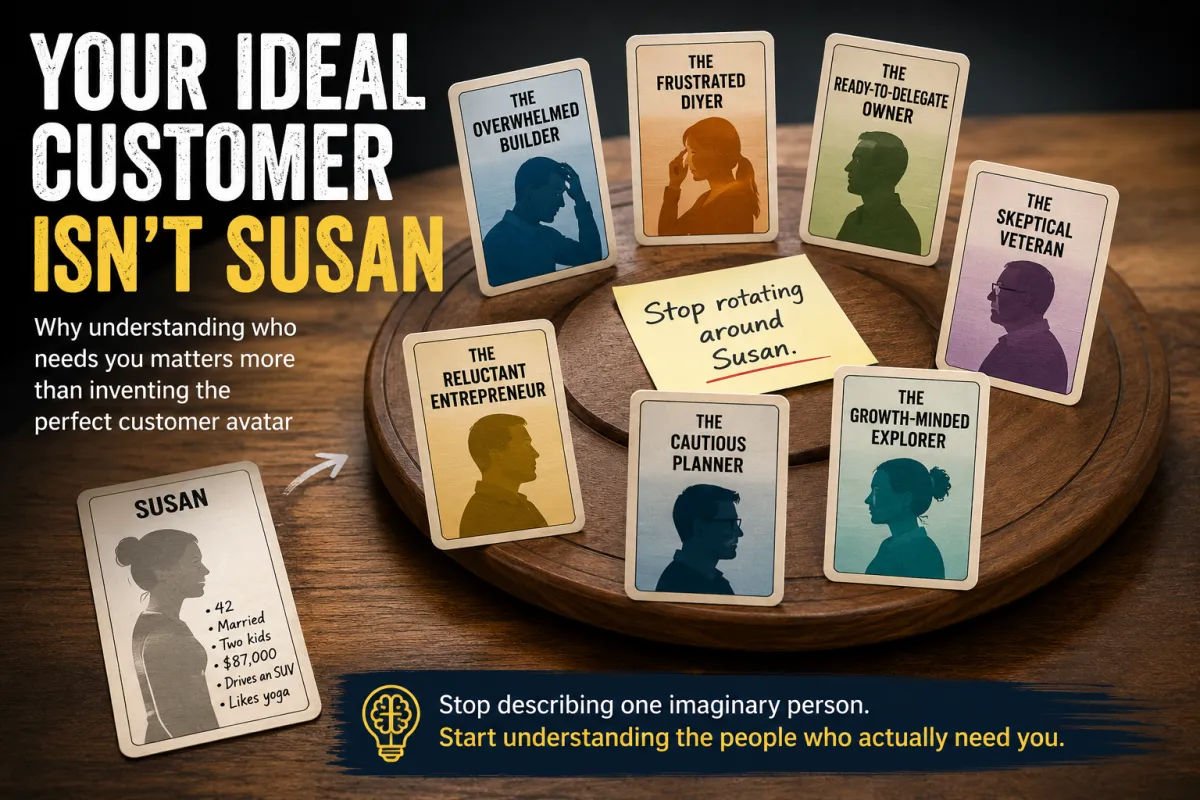
Why We're Not Building “Susan”
You may have done an Ideal Customer Avatar exercise before.
It often goes something like this:
Susan is 42, married, has two children, earns $87,000 a year, drives an SUV, enjoys yoga and spends Saturday mornings at the farmers market.
Fine.
But does any of that explain why Susan needs you?
Sometimes demographics matter enormously. Age can matter. Geography can matter. Income, profession, family structure, company size and experience can all matter.
When they change someone's need, perspective, readiness, decisions or outcome, we want to know about them.
When they don't, piling on detail doesn't create understanding. It creates a more detailed imaginary person.
Meanwhile, a 28-year-old single man and a 63-year-old grandmother could share exactly the psychological situation that makes your business relevant to both of them.
We're interested in what actually matters.
What situation are they in?
What do they want?
How do they see the problem?
How ready are they to do something about it?
What has shaped the way they're approaching it?
Those recurring combinations of situation, mindset, motivation, readiness and perspective are what we'll call Customer Archetypes.
So Susan can keep the SUV.
We're looking for the person underneath it.
Before We Deal
AI can help us spot patterns, but you've probably spent considerably more time around your customers than it has.
Bring that experience to the table.
Don't turn these questions into homework. A few sentences, examples or gut reactions are plenty.
Who have you already helped?
Think about real customers, clients, members, students, patients, buyers or users. What kinds of people or situations seem to show up repeatedly?
Who seems naturally drawn to what you do?
Who tends to “get it”? Have certain kinds of customers responded particularly strongly to your approach?
Who do you feel especially equipped to help?
Whose situation, ambition, frustration or attitude seems especially well matched to what you're good at?
Who could you serve but don't particularly want to pursue?
Being capable of helping someone doesn't mean you want to build your business around finding more of them.
What differences among your customers actually seem to matter?
Forget the standard avatar worksheet for a moment.
Think about experience, urgency, motivation, beliefs, readiness, frustration, ambition, expectations, resources or anything else that changes what people need from you.
If demographics genuinely affect that equation, include them too.
Put whatever you know on the table.
Now we'll deal.
Deal the First Seven
Bring your observations together with what we've already established about your Mission, voice and perspective, then let AI deal seven meaningfully different Customer Archetypes from within your Needscape.
These aren't biographies. They're cards.
Each one only needs enough detail for you to recognize what you're looking at:
A recognizable shorthand — something useful for talking about the archetype, even if the customer would never use the label themselves.
Their situation — where are they when your business becomes relevant?
Their orientation — how are they approaching that situation?
What they appear to want — don't dig all the way into their pain yet; we'll get there.
Why they belong in your Needscape — where does your Mission connect with them?
What makes them distinct — why does this card deserve to exist separately from the others?
🃏 Play This Hand
Copy the message below into your AI conversation. If you're continuing in the same conversation where you've been building your Business Brain, it should already have much of the context it needs.
Using my Business Brain so far, especially my Mission, voice and perspective, along with the customer observations I just completed, deal me seven meaningfully different Customer Archetypes from within my Needscape.
Keep each one concise enough that I can easily compare all seven. For each archetype, show me:
a recognizable shorthand name;
their current situation;
their general orientation or mindset;
what they appear to want;
why they fit the Needscape established by my Mission; and
what makes them meaningfully different from the other archetypes.
Don't build demographic profiles unless a demographic characteristic genuinely changes the customer's need, perspective, readiness, decisions or outcome. I want psychologically and situationally distinct archetypes, not seven variations of the same customer.
Don't choose for me yet. Deal the seven and let me react to them.
Read all seven before deciding anything.
Some will probably feel familiar immediately. One may remind you of a particular customer. Another might make you wonder why anyone thought you wanted more of those.
Then you may hit one that makes you stop.
Huh. I hadn't thought about them.
Leave it on the table.
Hold Up to Three
Which cards are you most curious to understand better?
Hold up to three.
You're not choosing your three Ideal Customers. You're not excluding everyone else, and you're certainly not committing the future of your marketing to something you just read five minutes ago.
You're saying:
There's something here worth looking at more closely.
Card I'm Holding #1
What caught my attention:
Card I'm Holding #2
What caught my attention:
Card I'm Holding #3
What caught my attention:
If you only want one or two, hold one or two.
Don't fill your hand just because there are empty spaces.
🃏 Play This Hand
Once you've chosen, tell AI what you're holding. Replace the bracketed sections with your own choices and reactions.
I'd like to hold these Customer Archetypes for deeper exploration:
[ARCHETYPE]
[ARCHETYPE — if applicable]
[ARCHETYPE — if applicable]
What caught my attention about them:
[ARCHETYPE]: [YOUR REACTION]
[ARCHETYPE]: [YOUR REACTION]
[ARCHETYPE]: [YOUR REACTION]
Don't lock these in as my final Customer Archetype Map yet. I'm holding them because I want to understand them better before deciding.
Now look at the hand you've chosen.
Do you want to turn those cards over?
Or does something still feel missing?
Want Another Draw?
Happy with the territory you've seen?
Keep your hand and move on.
Feel like something is missing?
Deal five more.
This time we're looking for blind spots. The new cards shouldn't be renamed versions of the first seven; look elsewhere within the Needscape for different situations, motivations, perspectives, readiness levels or relationships to the problem.
🃏 Play This Hand — Optional Second Draw
If you want more possibilities, send:
Before I commit to this hand, deal me five more Customer Archetypes.
Look specifically for blind spots in the first seven. Don't rename, lightly remix or subdivide archetypes we've already considered just to give me five more.
Search elsewhere within my Mission-defined Needscape for meaningfully different situations, motivations, perspectives, readiness levels or relationships to the need my business serves.
Keep these concise too. I want genuinely new cards to compare with the ones already on the table.
Lay the new cards beside the old ones.
Swap anything you want.
If the problem isn't that you need more cards—AI simply isn't seeing someone you know belongs on the table—tell it directly:
I think we're missing an important kind of customer. Here's what I recognize from my own experience:
[DESCRIBE THE PERSON, SITUATION OR PATTERN IN YOUR OWN WORDS.]
Help me explore whether this represents a genuinely distinct Customer Archetype within my Needscape rather than forcing it into one of the existing cards.
Your experience is part of the deck.
Once you've made any swaps, tell AI which cards remain in your hand:
My current hand is:
[ARCHETYPE]
[ARCHETYPE — if applicable]
[ARCHETYPE — if applicable]
These are the archetypes I want to turn over and explore more deeply.
Turn the Cards Over
So far, we've only seen enough of each archetype to decide whether it deserves a closer look.
Now it does.
Take the first card in your hand and look beneath the shorthand description.
🃏 Play This Hand — One Card at a Time
Start with your first archetype:
Let's turn over [ARCHETYPE NAME].
Show me five deeper interpretations of what may make this person psychologically and situationally distinct.
I want possibilities to compare, not one final profile yet. Use what you already know about my business, Mission, voice, customers and Needscape, but make the five interpretations meaningfully different from one another.
Help me notice differences in things like perspective, motivation, readiness, expectations, experience or relationship to the need without jumping ahead into a full pain-point analysis. We'll do that separately later.
Compare what comes back.
One interpretation may feel superficial. Another may exaggerate something that only occasionally matters. Two may contain pieces that clearly belong together.
And one might make you think:
There. That's the person I've been trying to describe.
Use what fits. Correct what doesn't. Combine pieces when reality refuses to cooperate with neat categories, and add what your own experience knows that AI couldn't.
Talk naturally here. You don't need a special prompt for every reaction.
“Number 2 is close, but they're usually more experienced than that.”
“Combine the motivation from 1 with the attitude in 4.”
“You're missing the fact that they've usually already tried to solve this themselves.”
That's exactly the kind of information we want.
When the card feels right, close it out with:
That's the understanding of [ARCHETYPE NAME] I want to keep for now. Summarize what survived our discussion into a clear archetype profile so we can use it later when we compare my final hand.
Then repeat the same process for each card you're holding.
Still Like Your Hand?
You know these cards better now.
Would you still hold the same ones?
If yes, keep them.
If not, change them.
Bring something back from the table. Swap one out. Reconsider a card from your second draw.
You aren't being graded on whether you defend your first choices. If learning more changes your mind, the process worked.
🃏 Play This Hand
When you've explored all of your held cards, send:
Now that we've explored my held archetypes more deeply, compare them side by side.
Don't rank them for me yet.
Show me:
the strongest reason each deserves to remain in my hand;
any meaningful overlap between them;
anything that may make one less distinct or strategically useful than it first appeared; and
any important tradeoff I should notice before deciding.
I want the comparison. I'll make the final choice.
Then make it.
If you swap a card, explore the replacement before moving forward.
Once the hand feels right, decide which card leads.
Which Card Leads?
Your Primary Customer Archetype is the customer perspective that deserves the greatest strategic attention right now.
Primary Customer Archetype
If you're holding others, preserve them too.
Secondary Customer Archetype
Tertiary Customer Archetype
Primary means priority. It does not mean exclusive.
Your Secondary Archetype isn't automatically less profitable, less valuable or less important. Your Tertiary Archetype isn't a consolation-prize customer.
We're deciding where your attention belongs now.
Businesses change. Markets change. Customers surprise us. Later evidence may reshuffle the hand.
That's why we're building a Business Brain instead of carving answers into stone.
🃏 Play This Hand
Tell AI what you've decided:
I'm ready to establish my current Customer Archetype priorities.
Primary: [ARCHETYPE]
Secondary: [ARCHETYPE — if applicable]
Tertiary: [ARCHETYPE — if applicable]
Treat these as my current strategic priorities, not permanent or exclusive definitions of everyone my business can serve.
Preserve the deeper understanding we've already developed for each one. Don't change the rankings unless I explicitly revisit them later.
Now we know which cards we're holding.
There's still another question hiding in the hand.
What Kind of Hand Are You Holding?
Put your surviving cards beside one another.
How are these people related?
Three Customer Archetypes can look like three different kinds of customers until you notice the pattern connecting them.
Focused Expansion
One card clearly deserves your attention first, while the others represent territory you could deliberately grow into later.
Your hand looks something like:
Focus here → expand there → explore there.
Portfolio
All of the cards matter now, but treating them as the same person would weaken your ability to communicate with them.
One Mission. One Needscape. Multiple customer paths.
Composite
The cards look different on the surface, but something deeper keeps repeating.
Perhaps the circumstances change while the same motivation, desire, worldview or psychological need keeps showing up underneath.
That shared center can eventually help you speak across the Needscape without pretending everyone inside it is identical.
Journey
Maybe you're not holding three different people at all.
You could be looking at substantially the same person at different stages.
Someone arrives as one archetype, grows or changes into another and eventually resembles the third.
If so, those aren't simply three audiences.
You may be holding the beginnings of a customer journey.
Hybrid
And sometimes the hand is messy.
Two cards may share a psychological center while the third represents future expansion. Two may be stages of a journey while another follows a parallel path.
Good.
Reality wins.
These patterns aren't boxes for stuffing customers into. They're ways of seeing what the cards may be telling you.
Read the Hand
Now let's see what happens when we stop looking at the cards individually.
🃏 Play This Hand
Send:
Look at my final Customer Archetype hand as a whole.
Deal me five meaningfully different interpretations of how these archetypes may relate strategically.
Consider possibilities such as:
Focused Expansion — one deserves focus now while others represent later territory;
Portfolio — several matter now but deserve distinct approaches;
Composite — different archetypes share an important psychological center;
Journey — they may represent stages of substantially the same customer's development;
Hybrid — more than one relationship is operating at once.
Don't force my customers into those categories. If another relationship better explains what we've discovered, include it.
Give me five interpretations to react to rather than choosing the answer for me.
Compare the possibilities the same way you've compared everything else in this packet.
Which one explains something you recognize?
Which one feels forced?
Could pieces of two belong together?
Did AI spot a relationship you hadn't noticed—or did putting the cards beside one another make the real relationship obvious to you?
Talk it through until the relationship makes sense.
Then tell AI:
That's the relationship I want to preserve for now. Summarize what survived our discussion, including any important nuance that doesn't fit neatly into a single category.
That relationship can eventually influence which audience gets a lead magnet, whether several audiences deserve different offers, where paid advertising should focus, what organic content should explore, how nurture paths divide and even which parts of your visual identity need to speak across the entire Needscape.
We don't need those answers today.
We need the hand.
Try Playing It Both Ways
Imagine writing one message meant equally for every archetype you're holding.
What would you have to generalize?
What meaningful differences would disappear?
Now imagine speaking only to your Primary Archetype.
What becomes sharper?
What shared territory gets left behind?
Neither approach is automatically right.
But from now on, when you're creating something, you can begin asking a much more useful question:
Am I speaking to the whole Needscape, to something these archetypes share, or to one particular archetype within it?
That's considerably more useful than:
Would Susan like this?
If something important occurs to you here, tell AI. Otherwise, there's nothing you need to submit before moving on.
The Cards You Didn't Play
Leave the unused cards on the table.
We're not going to deeply develop all of them. That would turn curiosity into analysis paralysis and defeat the purpose of choosing where to focus.
But interesting possibilities don't need to disappear just because they didn't make today's hand.
We'll put them on the Discovery Bench.
They aren't active strategic priorities. They're possibilities worth remembering.
Maybe they never matter.
Maybe six months from now you start attracting customers who look suspiciously like one of them.
If that happens, your Business Brain can remember that we've seen this card before.
Save the Hand
Your experience and judgment did the choosing. Now your Business Brain gets to do what it's good at:
remember.
🃏 Play This Hand — Save Point
Send:
We've reached the Save Point for Packet 004.
Build my Customer Archetype Map — Version 1.0 from what survived our discussion.
Include:
my Mission-defined Needscape;
Primary Customer Archetype;
Secondary Customer Archetype, if applicable;
Tertiary Customer Archetype, if applicable;
the expanded understanding we developed for each;
any Shared Psychological Center we discovered;
the Strategic Relationship among the archetypes;
Current Strategic Focus;
Parallel or Future Opportunities;
Relevant Customer Characteristics;
the unused but interesting archetypes on my Discovery Bench;
Known Unknowns; and
our current confidence in the map.
Clearly separate what we've settled from anything we're still treating as provisional.
Then show me the complete Save Point for review before we treat it as the current Business Brain record.
Read the result.
This is the moment to correct anything that doesn't sound right. The Save Point should represent what you actually concluded, not merely everything AI said along the way.
Once it does, you've built:
Customer Archetype Map — Version 1.0
That version number matters because this is the best understanding we've earned so far.
Implementation will eventually give us evidence.
Customers will surprise us.
A supposedly Secondary Archetype may respond far more strongly than expected. Something sitting on the Discovery Bench may become increasingly important. Your Primary Archetype may turn out to be three stages of a journey we haven't discovered yet.
When reality teaches us something better, the Business Brain should learn too.
Look What We Can Ask Now
We started with the Needscape established by your Mission.
Now we can ask:
Should a future lead magnet speak primarily to your Primary Archetype?
Does another archetype deserve one of its own?
Could paid advertising concentrate on one perspective while organic content puts feelers into several?
Should your core visual identity appeal to something shared across the hand while individual campaigns lean harder toward a particular card?
We're not answering those questions yet.
But now they're worth asking.
Coming Next: What Hurts?
We know who we're looking at.
Next we're going to stand on their side of the table.
What do they believe iand on their side of the table.
What do they believe is wrong?
What are they actually experiencing?
Which symptoms have become painful enough that they're looking for change?
And here's where things can get especially interesting:
Is the problem they think they have the same problem you see from your side of the table?
We'll deal with that next.