
If You Build It, They Won't Necessarily Come
If You Build It, They Won't Necessarily Come
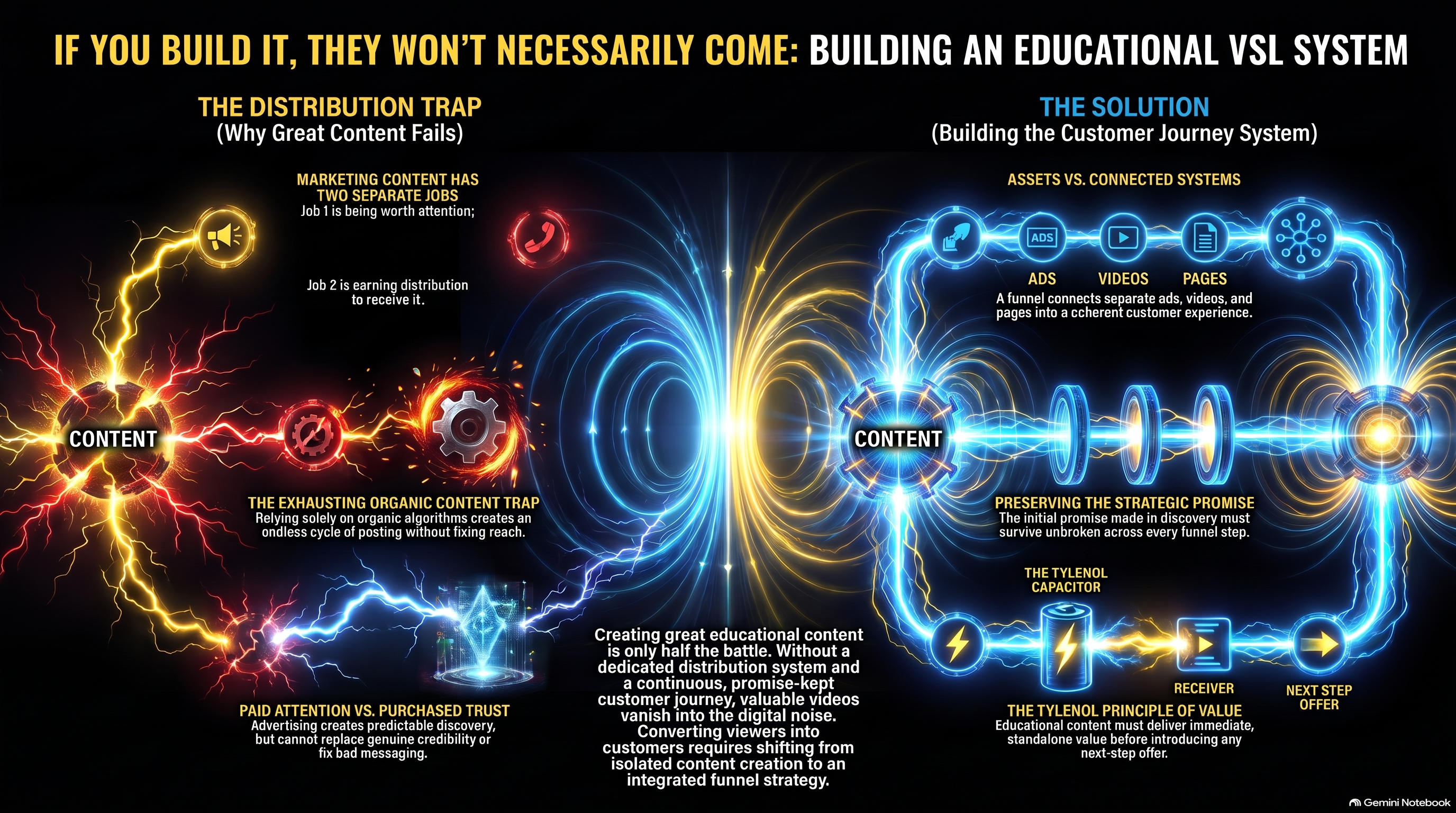
Why great content can disappear into the digital cornfield—and why getting it seen is a different job from making it worth seeing.
In the 1989 film Field of Dreams, Kevin Costner's character hears a mysterious voice whisper, "If you build it, he will come."
So he builds a baseball diamond in the middle of an Iowa cornfield.
And, against all reasonable expectations, the players show up.
It's a wonderful movie. It's also a terrible marketing plan.
Every day, entrepreneurs build their own little fields of dreams. They write a thoughtful blog, record an educational video, create a helpful lead magnet, or spend a weekend polishing a social media post until it's just right.
Then they publish it, step back, and wait.
Sometimes a few people show up. Sometimes nobody does.
And after a while, the silence starts to feel personal.
Maybe the content wasn't good enough. Maybe the message wasn't compelling. Maybe the business isn't as interesting as they thought. Maybe they just aren't cut out for this whole marketing thing.
Or maybe they built a perfectly good baseball diamond in a cornfield where nobody knew there was a game.
──────── ⚡ ────────
The Myth of Free Attention
Organic marketing has an appealing promise: create valuable content, share it with the world, and let interested people find you.
No advertising budget required.
And it can work. Organic content can build trust, strengthen relationships, establish credibility, and attract customers over time. Some businesses have built enormous audiences without relying heavily on paid advertising.
But there's an important distinction between possible and predictable.
Organic reach is influenced by algorithms, audience behavior, platform competition, timing, existing relationships, and countless other factors that a business owner cannot fully control.
Even excellent content can reach very few people.
That's not necessarily evidence that the content failed. It may simply mean that the distribution system never gave it much of an opportunity.
The problem becomes particularly frustrating when entrepreneurs start treating organic success as a moral achievement.
Paying for advertising feels like cheating. If the content is genuinely valuable, shouldn't people naturally discover it? Shouldn't the algorithm recognize its brilliance? Shouldn't word of mouth do the rest?
Unfortunately, the internet has no universal department responsible for recognizing brilliance.
And there's no rule that says the most useful content gets the most attention.
Two Jobs, Not One
Marketing content has two separate jobs.
The first is to be worth someone's attention.
The second is to earn an opportunity to receive that attention.
Those jobs overlap, but they're not interchangeable.
A genuinely helpful educational video might answer a question your ideal customer has struggled with for months. It might give them a practical tool, introduce a useful perspective, or help them avoid an expensive mistake.
That's the value of the content itself.
But if the video never reaches that customer, its value remains unrealized.
Imagine a brilliant teacher preparing the most useful lesson of her career, then delivering it to an empty classroom.
The lesson might be excellent. The teaching might be extraordinary.
But somebody still needs to tell the students where the classroom is.
That's distribution.
And distribution deserves as much deliberate thought as production.
──────── ⚡ ────────
The Organic Trap
Here's where things get especially interesting.
Many entrepreneurs begin with organic marketing because it's the only practical option. They have more time than money, so they invest their time creating posts, videos, articles, and other content.
Perfectly reasonable.
But over time, a practical starting condition can quietly become a permanent business philosophy.
I started with organic because I couldn't afford advertising becomes I should be able to succeed without advertising.
Those are very different statements.
The first describes a resource constraint. The second creates an expectation that may have little relationship to how attention actually works.
And once that expectation takes hold, the entrepreneur can find themselves trapped in an exhausting cycle.
Publish more. Post more often. Try a different hook. Change the thumbnail. Follow the latest platform advice. Record another video. Try harder.
Some of those adjustments may be useful. But if the underlying problem is that the content isn't reaching enough of the right people, producing more content may simply create a larger library of things nobody sees.
It's a little like responding to an empty restaurant by adding twelve new items to the menu.
Maybe the menu really does need work.
But perhaps somebody should check whether anyone knows the restaurant exists.
Paid Attention Isn't Purchased Trust
This is usually the point where someone says, "So the answer is Facebook ads?"
Not exactly.
Advertising can help solve a distribution problem. It cannot automatically solve a relevance problem, a credibility problem, or a weak customer experience.
Paying to put an unhelpful message in front of more people doesn't make the message helpful.
It just makes the disappointment more expensive.
But a well-designed advertising test can do something organic distribution may struggle to accomplish: deliberately introduce an educational experience to people who don't already know your business exists.
It also creates opportunities to learn.
Which message attracts attention? Which problem seems to resonate? Are people interested enough to visit the page? Does the page make the educational promise clear? Do viewers take the next step?
The answers aren't always simple, and advertising data is far from perfect. But a measured test can reveal useful patterns that are difficult to see when a post reaches seventeen people, three of whom are relatives.
The point isn't that every entrepreneur should immediately start spending money on ads.
The point is that paid distribution is a legitimate business tool, not an admission that organic marketing has failed.
You can build trust organically and introduce yourself to new people through advertising. You can use a small paid test to learn what resonates, then apply those lessons to future organic content. You can build an audience over time while occasionally paying to reach beyond it.
These approaches can complement each other.
The real question isn't, "Should I succeed organically or pay for attention?"
It's, "What's the most sensible way to help the right people discover something genuinely useful?"
──────── ⚡ ────────
Getting Them to the Field Is Only Half the Game
There's another trap waiting for the entrepreneur who finally figures out how to attract visitors.
They get the click.
Then what?
Someone sees an intriguing post about a problem they're struggling with. They follow the link, expecting a useful educational video.
Instead, they're confronted with a confusing page, a dozen form fields, an unrelated sales pitch, or an invitation to schedule a consultation before they've received any of the help they were promised.
The visitor leaves.
The business owner concludes that the traffic was poor.
But perhaps the problem wasn't the audience or the advertising. Perhaps the journey stopped making sense.
This is why an educational video needs more than a promotional strategy. It needs a coherent customer experience.
The message that attracts the visitor should match the promise on the landing page. The video should deliver the educational value that was advertised. The next step should feel like a natural continuation of the lesson, not a surprise change of subject.
And the experience should be no more complicated than necessary.
Sometimes that means an open-access video and one clear invitation.
Sometimes it means a registration page, a helpful follow-up sequence, and a consultation offer.
Sometimes it means something in between.
There isn't one universally correct funnel.
There is, however, a useful principle:
Every step should make it easier for the right person to receive the promised value and decide what to do next.
If a step doesn't help accomplish that, it deserves scrutiny.
The Promise Has to Survive the Journey
One of the most common ways a marketing campaign loses its way is by gradually changing the promise.
The original educational video was created to help a particular kind of customer solve a particular problem.
Then somebody writes an ad designed to attract as many clicks as possible.
The headline becomes broader. The pain point becomes more dramatic. The promised outcome gets bigger. The landing page follows the ad's new direction, and the follow-up emails drift further still.
By the time someone watches the video, they're expecting something it was never designed to deliver.
This is why a coordinated campaign needs a strategic reference point.
Who is this for? What problem are we helping them understand or address? What immediate benefit will they receive? What meaningful next step are we offering?
Those questions should be answered before the campaign is produced—and checked again when the pieces are assembled.
Think of it as the marketing equivalent of checking that the baseball diamond is still in Iowa before printing ten thousand invitations.
A consistent promise doesn't guarantee a successful campaign.
But an inconsistent one can undermine trust before the relationship has even begun.
──────── ⚡ ────────
The Difference Between an Asset and a System
A video is an asset.
A blog is an asset.
An advertisement is an asset.
A landing page is an asset.
Each can be useful on its own. But none automatically creates a reliable customer journey.
A system connects them.
It establishes how people discover the educational experience, what they encounter when they arrive, what value they receive, what happens afterward, and how the business learns from the results.
It also recognizes that different businesses need different degrees of complexity.
An established business with a substantial audience may already have most of the distribution it needs.
A newer business may have excellent educational content but almost no existing reach.
Another may have plenty of visitors but a confusing conversion experience.
The answer isn't to prescribe the same funnel to all three.
It's to identify which part of the journey needs attention and build accordingly.
And that's where the work becomes much more interesting than simply generating another headline.
Because we're no longer asking, "What should we post?"
We're asking, "How do we create a useful experience that the right people can actually find, understand, and act upon?"
That's a much better question.
Build the Field. Then Invite People to Play.
There's nothing wrong with building something remarkable and hoping people will appreciate it.
In fact, creating something worth appreciating is where the whole process should begin.
But hope isn't a distribution strategy.
Neither is publishing repeatedly and assuming the platform will eventually reward your persistence.
Sometimes organic marketing is enough. Sometimes paid advertising can accelerate discovery. Often the most practical answer involves some combination of both.
Whatever approach makes sense for your business, the objective remains the same: connect a real customer problem with a useful educational experience, then provide a clear and appropriate path forward.
Build something worth visiting.
Make sure people can find it.
Give them what you promised.
And when they're ready for the next inning, make it easy for them to stay in the game.
Because unlike the movies, the customers probably aren't going to emerge mysteriously from the cornfield.
You're going to have to invite them.
──────── ⚡ ────────
From Content to Customer Journey
This is the thinking behind Packet 051 of the Business Brain Builder: Launch the Educational VSL Funnel.
After creating a valuable educational video, the next challenge is to design the experience surrounding it: how prospective customers discover it, how they access it, what happens afterward, and how the business can measure and improve the journey.
The workshop brings those decisions together into a coordinated, implementation-ready campaign—without assuming that every business needs paid advertising, an elaborate funnel, or a complicated technology stack.
Because making something valuable is the beginning.
Helping the right people discover that value is what turns it into marketing.