
The Library of Everything and the Map to Nowhere
The Library of Everything and the Map to Nowhere
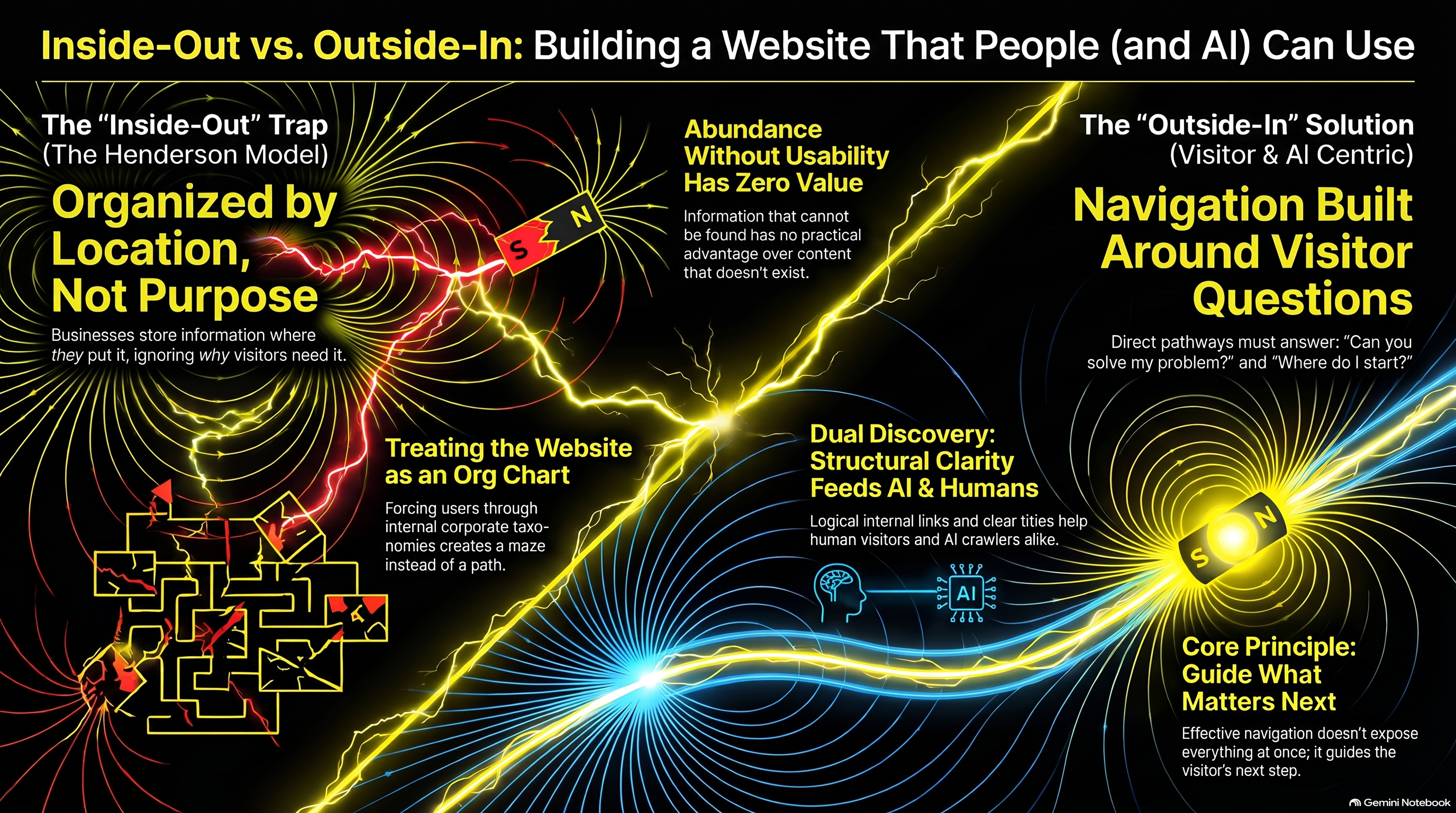
Why having all the answers doesn't help when nobody can find them
Henderson was tremendously proud of his new website. It contained everything: every service his company offered, every product he'd ever considered offering, every article he'd written (including several he no longer agreed with), every downloadable guide, instructional video, webinar recording, customer testimonial, frequently asked question, and company announcement dating back to the invention of the internet.
He'd even included a page explaining the history of the company coffee machine, which he considered an important contribution to corporate transparency.
There was just one problem.
Nobody could find anything.
His colleague discovered this when she tried to locate the company's introductory business planning guide.
"Where's the guide?" she asked.
"In the Resources section," Henderson replied.
"Where's Resources?"
"Under Knowledge."
"Where's Knowledge?"
"In the Information Center."
"And where's the Information Center?"
Henderson looked mildly offended.
"Under Corporate."
She stared at him.
"Why would a customer looking for business planning advice click Corporate?"
"Because that's where we put it."
And there, in seven words, Henderson had explained one of the most persistent problems in website design.
Businesses organize information according to where they put it. Visitors look for information according to why they need it.
Those two systems don't always agree.
──────── ⚡ ────────
The Difference Between Having Information and Making It Useful
We've entered an age in which producing information has become astonishingly easy. Businesses can generate articles, videos, downloadable guides, presentations, courses, and entire libraries of educational material faster than ever before. Artificial intelligence has dramatically reduced the time and effort required to create and refine much of it.
Which sounds wonderful, until you consider what happens when everybody can produce more information than anybody has time to consume.
The challenge changes. When information was scarce, possessing it was valuable. When information becomes abundant, helping people find, understand, and apply the right information becomes increasingly valuable.
This isn't an entirely new problem. Libraries have been solving versions of it for centuries.
Imagine a library containing a million books arranged in the order they were purchased. The librarian proudly announces that the collection includes virtually everything a reader could want. Unfortunately, the books about gardening are scattered between medieval philosophy, automotive repair, marine biology, and nineteenth-century French poetry.
A visitor asks for a book about growing tomatoes.
The librarian replies, "We definitely have one."
"Where?"
"Somewhere between shelves one and twelve thousand."
Technically, the librarian has answered the question. Practically, the visitor is still going to buy tomatoes at the grocery store.
Information that cannot be found has surprisingly little practical advantage over information that doesn't exist.
And while most business websites aren't quite that chaotic, many have a smaller version of the same problem. Their owners know where everything is because they watched the website grow. Their visitors arrive without that history, unfamiliar with the internal terminology, the organizational logic, or why a particular page was placed inside a particular menu.
They're simply trying to accomplish something.
──────── ⚡ ────────
Henderson Invents the Master Directory
Henderson, being a man who rarely allowed a problem to remain uncomplicated, decided his website needed a directory.
Not just any directory.
A Master Directory of All Available Information, Resources, Services, Opportunities, and Associated Materials.
He was especially pleased with the acronym.
"MD-AIRSOAM," he announced.
His colleague blinked.
"That doesn't spell anything."
"It doesn't have to. It's proprietary."
The directory contained 417 entries, arranged alphabetically according to Henderson's preferred terminology. The introductory business planning guide was listed under Strategic Foundational Operational Readiness Materials, while a visitor looking for information about pricing would need to know that Henderson classified it under Revenue Optimization and Monetary Exchange Considerations. The contact page was listed under Interpersonal Communications and Inquiry Facilitation.
"Why don't you just call it Contact?" his colleague asked.
"Because that wouldn't convey the full sophistication of the process."
She considered this.
"Could you at least put a link to Contact in the main menu?"
"That would undermine the directory."
The new directory went live on Tuesday. By Wednesday, Henderson had discovered another problem: visitors couldn't find the directory.
His solution was immediate. He created a directory of directories, followed by a navigation guide explaining how to use it, a short instructional video about the navigation guide, and finally a Frequently Asked Questions page answering questions about where to find the Frequently Asked Questions page.
By Friday, he'd announced plans for a certification program.
His colleague quietly restored the Contact link to the main menu. Customer inquiries resumed almost immediately.
──────── ⚡ ────────
A Website Is Not an Organizational Chart
Here's the more serious lesson hiding beneath Henderson's architectural achievements.
Businesses naturally see themselves from the inside out. They have departments, product categories, operational processes, internal names, service divisions, and systems that make perfect sense to the people running them.
Customers usually don't arrive thinking about any of those things. They arrive with questions.
Can you solve my problem? How much does it cost? How does this work? Can I trust you? Where do I start? What happens next?
A useful website helps people move from those questions toward meaningful answers. Sometimes that means organizing resources by topic, sometimes by the audience they're intended to help, and sometimes by the outcome someone wants to achieve.
And sometimes, especially for a small business, it means resisting the temptation to organize everything into elaborate categories at all.
A website with five important pages probably doesn't need a comprehensive directory. It needs five pages that are easy to find. A business with hundreds of articles, multiple educational programs, downloadable resources, and specialized services may benefit enormously from a carefully designed resource library.
But the purpose of that library isn't to demonstrate how much information the business possesses. It's to make that information accessible.
The difference sounds subtle. In practice, it changes nearly every organizational decision.
──────── ⚡ ────────
The Search Engines Are Visitors, Too. Sort Of.
There's another reason to care about how information is organized.
Search engines don't experience websites quite the way human visitors do, but they still need to discover pages and understand how those pages relate to one another. Internal links, clear navigation, descriptive titles, and meaningful content can help automated crawlers discover important information and recognize connections between topics.
That doesn't mean creating a directory will magically improve your Google rankings, nor does it mean adding every conceivable internal link to every page. A page containing hundreds of poorly organized links may be considerably less useful than a handful of thoughtfully chosen pathways.
There's also a distinction worth understanding between the visitor-facing directory and the technical XML sitemap. An XML sitemap is primarily a discovery aid for search-engine crawlers, while a visitor-facing directory helps people browse important destinations. They can complement one another, but they perform different jobs.
And now AI-powered search and answer systems introduce another dimension.
These systems may discover or retrieve information through search indexes, automated crawlers, and other retrieval mechanisms. Their methods vary, and no special website trick guarantees that an AI assistant will recommend your business.
Still, the underlying principle remains sensible. If your website clearly explains what you do, who you help, what resources you offer, and how those pieces connect, you're making your information easier to understand and potentially easier to discover.
Not because you've discovered a secret formula for persuading machines, but because you've made your website more coherent.
Which, conveniently, also benefits the humans you're trying to serve.
──────── ⚡ ────────
The Map Is Not the Destination
There's a temptation in business to confuse sophistication with usefulness.
More pages must mean more value. More categories must mean better organization. More navigation options must mean greater accessibility. More information must mean better-informed customers.
But none of those conclusions necessarily follows.
A map with every possible road, alley, driveway, footpath, parking entrance, and utility corridor may be extraordinarily complete. It may also be a terrible map for someone who simply wants to find the nearest hospital.
A good map doesn't merely contain information. It helps someone orient themselves, recognize relevant choices, and move toward a destination.
A good website should do much the same, particularly when we're trying to help people make decisions.
Someone considering a service may need a clear explanation of the problem it solves. Someone comparing options may need examples, pricing information, or credible evidence. Someone who's ready to act may need a straightforward way to book a conversation or make a purchase. Someone who isn't ready may benefit from a useful article, guide, or educational resource.
These visitors aren't necessarily looking for the same thing. Forcing them all through the same maze doesn't make the business more persuasive; it simply makes the maze more crowded.
The best navigation isn't the navigation that exposes everything. It's the navigation that helps people discover what matters next.
──────── ⚡ ────────
The Curious Case of the Missing Answer
There's one more consequence of poor organization that's easy to overlook.
Sometimes a business already possesses the answer to a customer's question. It may have spent hours developing an excellent article, recording a helpful video, or preparing a genuinely useful guide. The answer exists, the expertise exists, and the value exists—but the customer never encounters it.
Instead, they leave the website believing the business doesn't address their concern.
This is more than a missed opportunity for engagement or conversion. It's a communication failure.
The business knows something that could help. The customer needs something the business knows. And the connection never happens.
We tend to think of marketing as the art of getting people's attention, but attention is only the beginning. Once someone arrives, the experience must help them understand where they are, what they can accomplish, and how to move forward.
Otherwise, we've successfully attracted a visitor to a building with no useful signs, then wondered why they left.
──────── ⚡ ────────
The Final Henderson Improvement
A week later, Henderson's colleague found him studying a new diagram.
"What are you working on?"
"A revolutionary website navigation system."
She sighed.
"How does it work?"
"Visitors tell us what they're looking for."
"Okay."
"Then we show them the most relevant options."
"That sounds reasonable."
"And we provide clear links to related information."
"Good."
"Without forcing them through unnecessary categories."
She narrowed her eyes.
"Henderson, that's just good website navigation."
He looked disappointed.
"I was hoping to patent it."
She studied the diagram.
"What's that enormous box at the bottom?"
He brightened.
"Premium Directory Access."
"What does it do?"
"For $19.95, visitors can bypass the directory."
"And go where?"
"Directly to the page they wanted."
She reached for the diagram.
Henderson moved it out of reach.
"It's an optional upgrade!"
Some lessons take longer than others.
──────── ⚡ ────────
A Final Thought
As artificial intelligence makes information increasingly easy to create, we may discover that one of the most valuable things a business can offer isn't simply more information. It's clarity about the problem, the available choices, what matters, and what someone can do next.
That's why organizing a website deserves more thought than deciding where to put a few links. It's an expression of how we understand the people we're trying to help.
Do we expect visitors to learn our internal system before they can benefit from what we know? Or do we build the experience around the questions they bring with them?
A well-organized website doesn't need to impress visitors with the size of its library. It needs to make them feel that someone anticipated what they came looking for.
Because the real value of a library isn't how much knowledge it contains. It's how much knowledge people can actually use.
──────── ⚡ ────────
From Magnetix Marketing — where we believe better marketing begins with understanding the people on the other side of the screen.