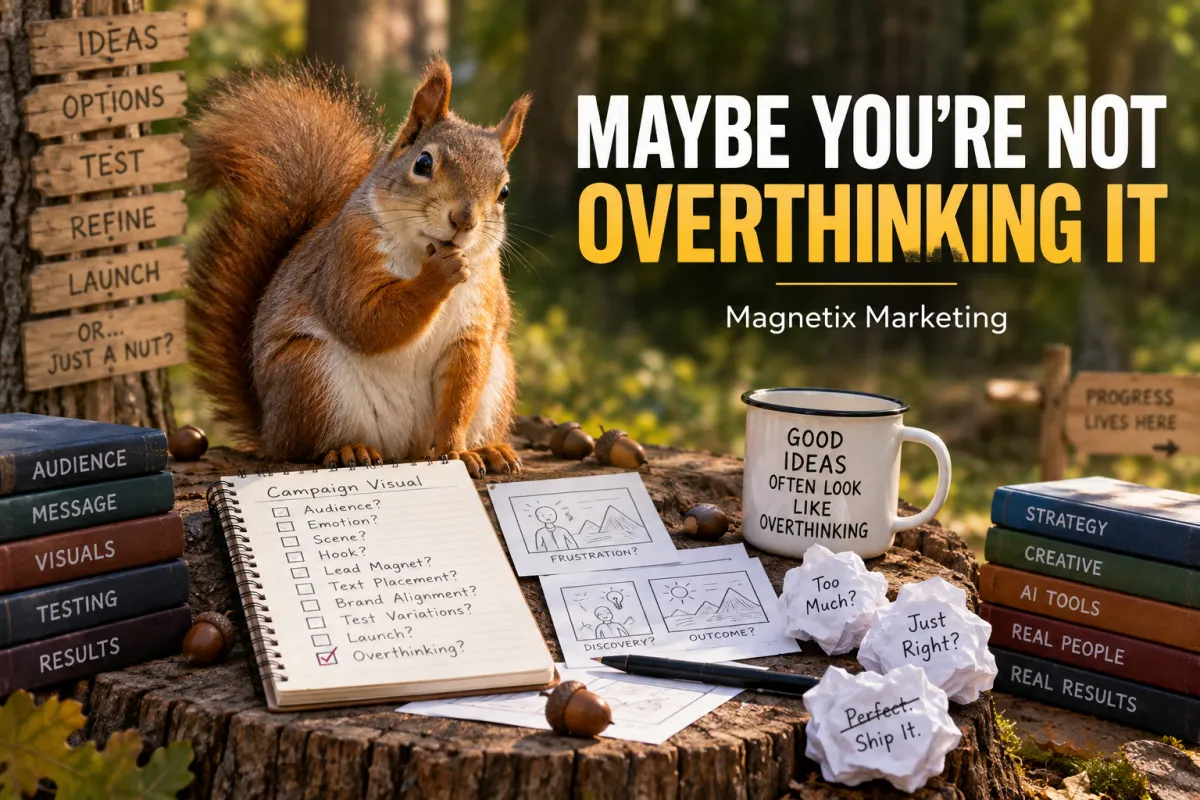
Maybe You're Not Overthinking It
Maybe You're Not Overthinking It
There is such a thing as overthinking. I've certainly done enough of it to recognize the neighborhood.
But lately I've started wondering whether we use that word for two very different things.
Sometimes overthinking means continuing to reopen a decision after you've already learned enough to make it.
Other times, you're not creating complexity at all.
You're discovering the complexity that was already there.
We ran straight into that while working on something that sounded almost embarrassingly simple:
Make an ad image.
How much thought could that possibly require?
Quite a bit, apparently.
Not because an ad needs to become a philosophical dissertation with a logo in the corner, but because the moment we started asking what the image was actually supposed to do, one decision revealed another.
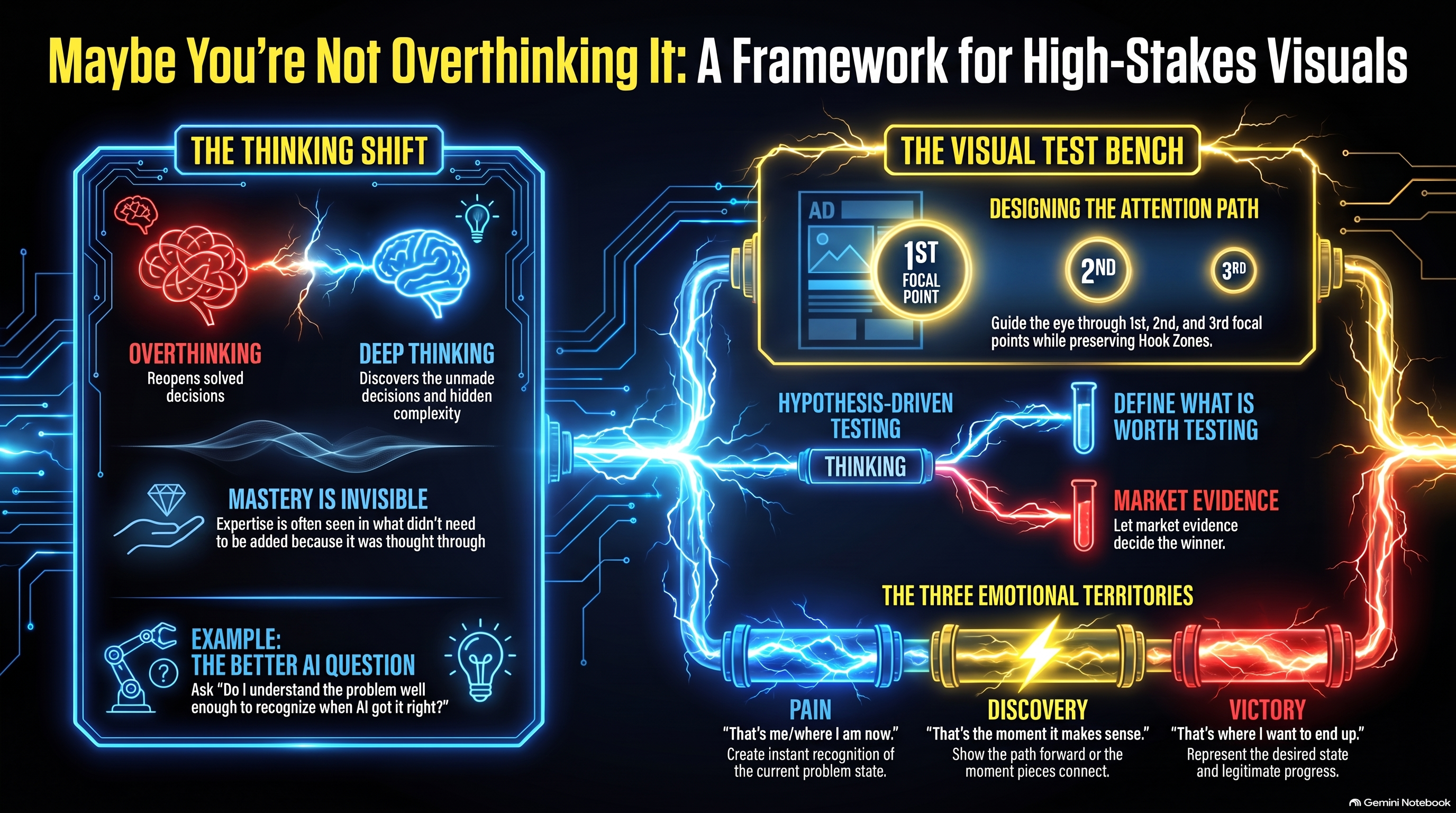
Who should recognize themselves in it? What should they notice first? Are we showing the frustration they're living with, the moment something begins to make sense, or the outcome they're hoping for? Where does their eye go next? Does the person in the image help direct that attention? Should the Lead Magnet appear? Where will the words go? Does the image leave room for them? Does it still look like our brand? Does it imply something the offer never promised?
And then comes the particularly humbling question:
Does any of this still work when the image isn't sitting beautifully by itself on our screen, but is shoved into a feed between somebody's vacation pictures, a political argument, three memes and a video of a dog refusing to get out of a bathtub?
That's not necessarily overthinking.
That's discovering the job.
──────── ⚡ ────────
I think that's where the distinction becomes useful.
Overthinking keeps reopening decisions that are already sufficiently solved. Deep thinking discovers the decisions that haven't been made yet.
The goal isn't to think forever. Eventually the ad has to leave the workshop and meet an actual human being.
In fact, that's one of the reasons I like testing so much. Thinking can tell us what deserves a fair shot. It can't tell us what the market will actually choose.
At some point, the numbers get a vote.
But sending something out to be tested doesn't mean the thinking before the test was wasted. Quite the opposite. Good thinking helps us know what we're testing.
If I throw six random images into an advertising campaign and one performs better, I've learned that one random image performed better.
If I deliberately create one image around frustration, another around discovery and another around the desired outcome, I've asked the market a question.
Now the result can teach me something.
──────── ⚡ ────────
Maybe that's why some very skilled people can make difficult work look deceptively simple.
We see the finished logo, photograph, advertisement, landing page, presentation or sales conversation.
We don't see the hundreds of little judgments that disappeared into it.
The expertise isn't always visible in what was added. Sometimes it's visible in all the things that didn't need to be added because somebody already thought them through.
And AI makes this distinction even more interesting.
It can now produce something plausible before we've made half of those decisions ourselves. That's extraordinary. It can also make it much easier to mistake having an output for having solved the problem.
The better question may not be:
“Could AI make this for me?”
It obviously can make a lot of things for us.
The better question is:
“Do I understand what I'm trying to make well enough to recognize when it got it right?”
That's a very different skill.
Perhaps that's the useful boundary.
Think deeply enough that action becomes easier.
Then act before thinking becomes a substitute for action.
Anything beyond that and, well...
You might actually be off your tree. 🌳