
Meet the People
Meet the People
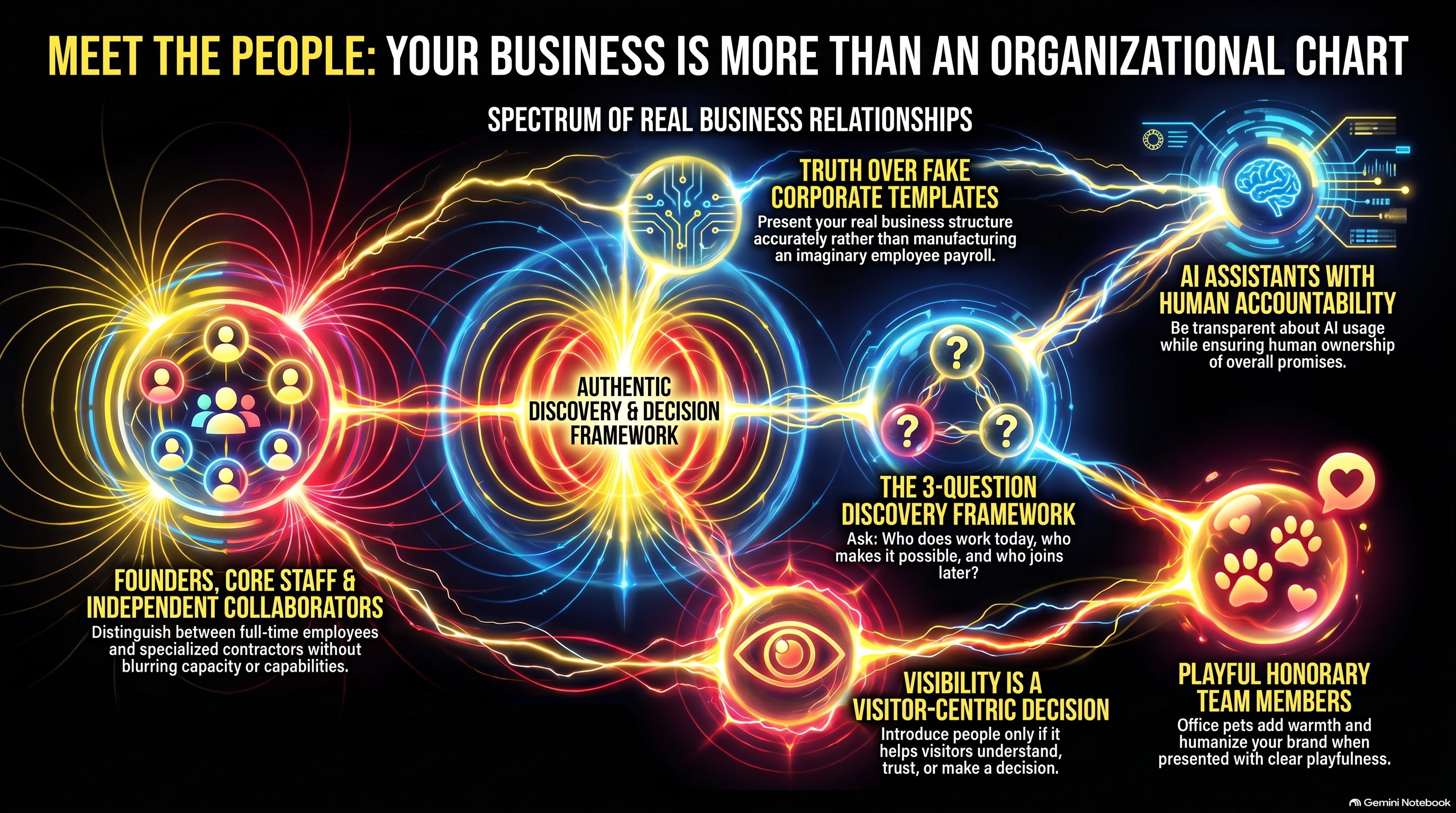
Your Business Is More Than an Organizational Chart
There's a particular kind of awkwardness that comes with building a business website when you're the entire staff.
You reach the part where the template says Meet Our Team, complete with a cheerful photograph of six impossibly well-rested professionals gathered around a conference table.
Meanwhile, your actual team consists of you, a laptop, a coffee mug that's seen better days, and perhaps a dog who has attended every strategy meeting without contributing a single useful suggestion.
What are you supposed to do with that?
You could remove the section. You could write a third-person biography that makes your one-person operation sound like a multinational corporation. Or you could start inventing job titles until the page looks sufficiently impressive.
There's another option, though.
You could tell the truth—and discover that the truth is often considerably more interesting.
The Team You Have Versus the Team You're Supposed to Have
For years, business websites have followed a familiar formula. A company introduces its founder, its leadership team, and perhaps a handful of employees, each accompanied by a photograph and a short biography.
For some businesses, that's exactly what customers need.
But the way businesses operate has changed, and the old organizational chart doesn't always tell the whole story.
A solopreneur might rely on a trusted bookkeeper, an independent designer, a fulfillment partner, and a specialist who steps in when a project calls for expertise outside the owner's own. A small agency might coordinate an extended network of contractors without employing any of them. An educator might work alongside mentors, community moderators, or affiliates who introduce new learners to the program.
And increasingly, businesses are using AI assistants to help with research, administration, content development, and customer-facing workflows.
None of these relationships automatically makes someone an employee. Nor does every relationship deserve a photograph and a biography on the company website.
But they raise a useful question:
Who actually helps this business work?
That's a better starting point than asking how many smiling faces you can fit into a website template.
Your Customers Aren't Conducting a Headcount
Imagine you're hiring someone to renovate your kitchen.
You visit two websites.
The first proudly announces that it has a large, dynamic team of dedicated professionals. There are plenty of photographs, impressive titles, and reassuring claims about excellence.
The second introduces the owner, explains that they personally manage every project, and describes the licensed specialists they bring in for particular kinds of work.
Which one would you trust?
You don't have enough information yet to know. The first company might be outstanding, and the second might be hopelessly overcommitted.
But the second has given you something useful to investigate: how the work actually gets done.
You can ask who will be responsible, which tasks are handled by specialists, and what happens if something goes wrong.
That's the real purpose of introducing the people behind a business. It isn't to prove that the company is big enough to deserve attention.
It's to help a prospective customer understand the people, relationships, and responsibilities behind the promises being made.
A large team can be reassuring. So can direct access to an experienced owner. Neither is automatically better.
What matters is whether the arrangement serves the customer well.
Being Small Isn't a Confession
Somewhere along the way, entrepreneurs picked up the idea that appearing small was a marketing disadvantage.
So we learned to write we when we meant I. We borrowed the language of corporate departments. We hid the fact that the person answering the phone was also the person doing the work, managing the books, and remembering to order printer paper.
Sometimes we is perfectly appropriate. A business can operate through a genuine team or network without putting everyone on payroll.
The problem begins when the language creates an impression the business can't support.
There is nothing inherently embarrassing about being a one-person operation.
In fact, some customers actively prefer working with the person responsible for the outcome. They appreciate continuity, personal attention, and knowing exactly whom to call.
Other customers need the capacity, availability, or specialized coverage that a larger organization provides.
Neither preference makes the other wrong.
Your job isn't to persuade everyone that your business has the ideal structure. It's to help the right people understand the structure you actually have.
And if you're building something that will eventually require more people, you can say so without pretending those people are already there.
Ambition is wonderful.
An imaginary payroll is less useful.
The People Behind the Promise
When you begin thinking about the people connected to your business, the possibilities extend beyond employees.
There's the founder whose experience shaped the company's approach. The contractor whose specialized skills make certain projects possible. The supplier whose reliability matters to the finished product. The mentor who helped the owner develop better judgment.
There may also be partners, affiliates, community contributors, or future collaborators.
These are different relationships, and it's important not to blur them.
A trusted contractor isn't necessarily a member of your permanent staff. A referral partner isn't automatically endorsing every service you offer. A mentor who once gave you excellent advice hasn't necessarily agreed to be featured on your website.
And someone you'd love to hire someday isn't part of your current delivery capacity.
That doesn't mean these relationships have no place in your business story.
It means you should introduce them for a reason.
A prospective customer may benefit from knowing that you work with a qualified specialist when a project requires one. They probably don't need to know the name of every software vendor you pay each month.
A potential collaborator might appreciate learning how your partnerships work. A customer looking for a service may have no interest in that information at all.
The question isn't simply, Who matters to my business?
It's Who would it help my visitors to meet, and why?
What About the Robots?
So far, we've been talking about the people and relationships that help a business deliver on its promises. But modern businesses increasingly combine those human relationships with software systems that take on some of the work.
Which brings us to the robots.
AI assistants are becoming part of how many businesses operate. They can help organize information, draft communications, support research, and carry out carefully designed workflows.
Some businesses even give them names and personalities.
That can be useful. It can also be fun.
But an AI assistant isn't a human employee, and a friendly name shouldn't create confusion about what it is.
If customers interact with an AI-powered assistant, they should understand that they're dealing with AI, what it can reasonably help with, and how to reach a responsible human when necessary.
The same principle applies behind the scenes.
Using sophisticated tools doesn't automatically mean a business has greater expertise or unlimited capacity. The business remains responsible for the quality of its work and the commitments it makes.
Technology may change how the work gets done.
It doesn't erase accountability.
And Yes, the Office Dog Can Stay
Not every introduction needs to carry the weight of a professional credential.
Sometimes a little personality is exactly what makes a business memorable.
A rescue dog who supervises the office. A cat who believes the keyboard is a heated throne. A goldfish with an honorary executive title and absolutely no authority over company finances.
These details can remind visitors that there are real lives behind the business.
They work best when they're presented with a wink rather than used as substitutes for meaningful information.
If the company promises a complicated service, customers still need to know who's qualified to deliver it.
But once that confidence is established, learning that the founder's dog has a habit of interrupting video calls might make the company feel a little more approachable.
There's room for professionalism and personality on the same page.
You just have to know which one is doing which job.
Not Every Business Needs a Meet the Team Page
Here's something website templates rarely tell you:
You might not need a separate People page at all.
If you're a solopreneur, a thoughtful introduction on your About page may be enough. If your collaborators matter primarily to how you deliver a particular service, those relationships might make more sense on the service page.
If your business includes a large team, individual profiles and a dedicated page could be genuinely valuable.
And if you're building a community, training program, or partnership network, you might eventually want separate spaces for contributors, instructors, or prospective collaborators.
The right structure follows the visitor's questions.
Who will I work with? Who is responsible? What experience do they bring? How does this arrangement help me? What happens when I need support?
Answer those questions where the answers will be most useful.
A website isn't improved merely by having more pages. It's improved by making the important things easier to understand.
Start With the Relationships, Not the Headshots
Before you book a photographer or start writing biographies, try a smaller exercise.
Take a sheet of paper and consider three questions:
Who does the work today? Include yourself, employees, and anyone directly involved in delivering what you promise.
Who helps make that work possible? Think about specialists, collaborators, and relationships that genuinely affect your ability to serve customers.
Who or what might become involved later? Consider future hires, partnerships, learning opportunities, or tools you're exploring—but keep those possibilities separate from today's reality.
Now look at your answers through your customer's eyes.
Which relationships would help someone feel informed, confident, or better prepared to work with you? Which details are interesting but unnecessary? Which are important internally yet don't belong on a public page?
You may discover that your People page needs several profiles.
You may discover that one honest founder introduction does the job beautifully.
You may even discover that your most useful next step is clarifying who handles which responsibilities before you write a single word of website copy.
All three are worthwhile discoveries.
The People Make the Promises Real
A business isn't defined solely by the names on its payroll.
It's shaped by the people who make decisions, contribute expertise, maintain relationships, solve problems, and take responsibility when things don't go according to plan.
Those relationships can be simple or complicated. They can evolve as the business grows. Some belong in the spotlight, while others quietly make everything possible from behind the scenes.
The goal of introducing the people behind your business isn't to make the organization appear larger, busier, or more impressive than it is.
It's to make the business easier to understand and easier to trust.
Because ultimately, customers aren't just buying from an organizational chart.
They're placing their confidence in the people who stand behind a promise.
Build Your Business Brain, One Useful Discovery at a Time
Inside Magnetix Marketing's Business Brain Builder, Packet 041—Meet the People—helps you identify the relationships that make your business work, decide which ones matter to your visitors, and develop honest, useful introductions.
You can build a complete People page, add a founder introduction to an existing page, or decide that no standalone page is needed.
The point isn't to fill another website template.
It's to give the right people a clearer picture of the business they're considering trusting.
Keep making progress. The next useful step is usually closer than you think.