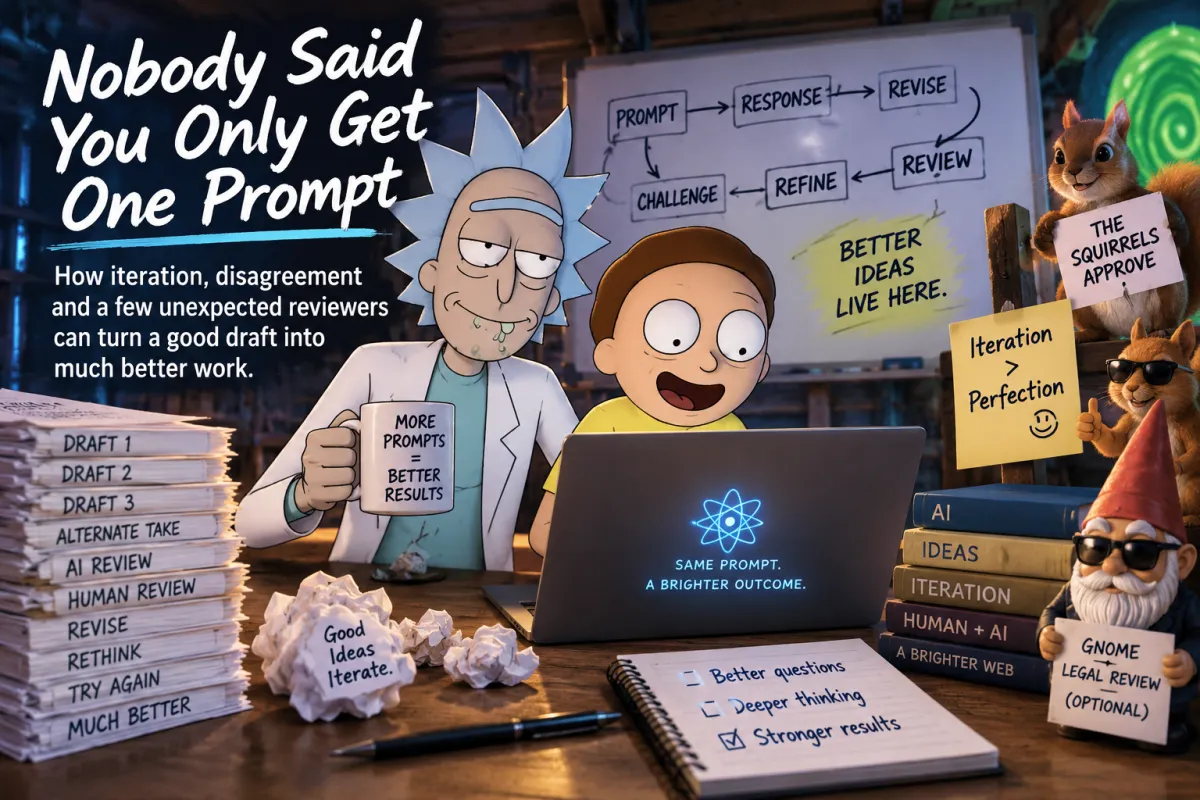
Nobody Said You Only Get One Prompt - The surprisingly human value of drafts, reviews and an editor with no ego to bruise
Nobody Said You Only Get One Prompt
The surprisingly human value of drafts, reviews and an editor with no ego to bruise
There's a strange standard we've apparently decided to hold AI to.
We give it a prompt. It gives us an answer. And then we stare at the answer as though that's the end of the transaction.
Well? Is it good or isn't it?
I'm not sure why. We never expected writing to work that way before.
Writers draft. Editors edit. Designers iterate. Movies have rough cuts. Software gets tested. Advertising concepts get reviewed, rejected, resurrected and occasionally discovered three weeks later to have been better before everybody started “improving” them.
Then AI showed up, produced something in fifteen seconds, and somehow we decided it should nail the landing on attempt number one. And if it doesn't, apparently we need a better prompt.
I've been thinking about this because I've been using AI lately to help edit some writing I originally did years ago, and I'm still a little stunned by how much better some of it has become.
Not because I finally discovered the magical prompt.
We kept messing with it.
The First Answer Is Just Something to Work With
There's no question that AI has done something remarkable to the blank page. Give it enough context and you can go from absolutely nothing to a surprisingly competent first draft before you've had time to reconsider whether you wanted to write the thing in the first place.
That's useful, but I'm starting to think we're leaving an enormous amount of AI's value on the table when we treat that first generation as the product.
The first answer is allowed to start the conversation instead of ending it.
Sometimes the first version is excellent. Use it. Sometimes it's almost right except for one paragraph, so fix the paragraph. Sometimes it has the right idea and completely the wrong voice. Tell it why.
And sometimes the AI changes something I deliberately wrote a particular way. That's when I'll explain why the original matters, and something interesting happens: it can reconsider the recommendation with that new information.
Maybe it agrees. Maybe it finds another way to solve the problem without losing what I cared about. Sometimes it convinces me that the sentence I was defending really isn't as good as I thought it was.
The value isn't merely that AI can generate another version. It's that we can keep thinking about the work.
An Editor Whose Feelings I Don't Have to Protect
AI makes for a remarkably ego-free editorial room.
Well, half of one anyway. My ego still shows up for work.
I can still become attached to a sentence because I wrote it. I can resist a suggestion because it changes something I liked. I can confuse this isn't what I wrote with this isn't as good.
The difference is that I only have one ego to manage.
A human editor can suggest a change and become attached to it too. They may notice something else but decide they've pushed hard enough already. I may dislike a suggestion but soften my response because another human being spent time developing it.
None of this makes either person unprofessional. It makes them human, and those little social negotiations are always somewhere in the room.
AI doesn't particularly care.
It can give me ten alternatives and I can tell it none of them work. Maybe number four is getting warmer, but it misunderstood why the original line mattered.
No awkward silence follows. I don't have to spend five minutes finding a diplomatic way to explain that its brilliant rewrite is worse than what we started with. It doesn't spend the afternoon wondering whether I respect its creative contributions.
More importantly, because the AI doesn't need its suggestion to win, I can spend more attention on the uncomfortable question on my side of the conversation:
Am I protecting the work, or am I protecting something because I wrote it?
We can just keep working. Nobody needs credit for the correction or vindication because their version survived.
The work gets to win.
Sometimes I Need a Sparring Partner
That's also changed the way I think about what I'm asking AI to do.
Sometimes I don't particularly need another writer. I need something to push against.
I can ask it why a paragraph doesn't work, challenge its assumptions, make it defend a criticism and then tell it why I think it's wrong. With that new information, it can reconsider the whole argument.
Sometimes the criticism survives. Sometimes my original survives. Sometimes neither does, because the disagreement exposes a third possibility that wasn't visible until we started arguing about the first two.
Nobody has to win the argument. We're using the argument to find out whether the work survives it.
That's a surprisingly useful kind of sparring partner to have sitting around.
Then I Started Letting Another AI Attack It
This has become one of my favorite parts of the process.
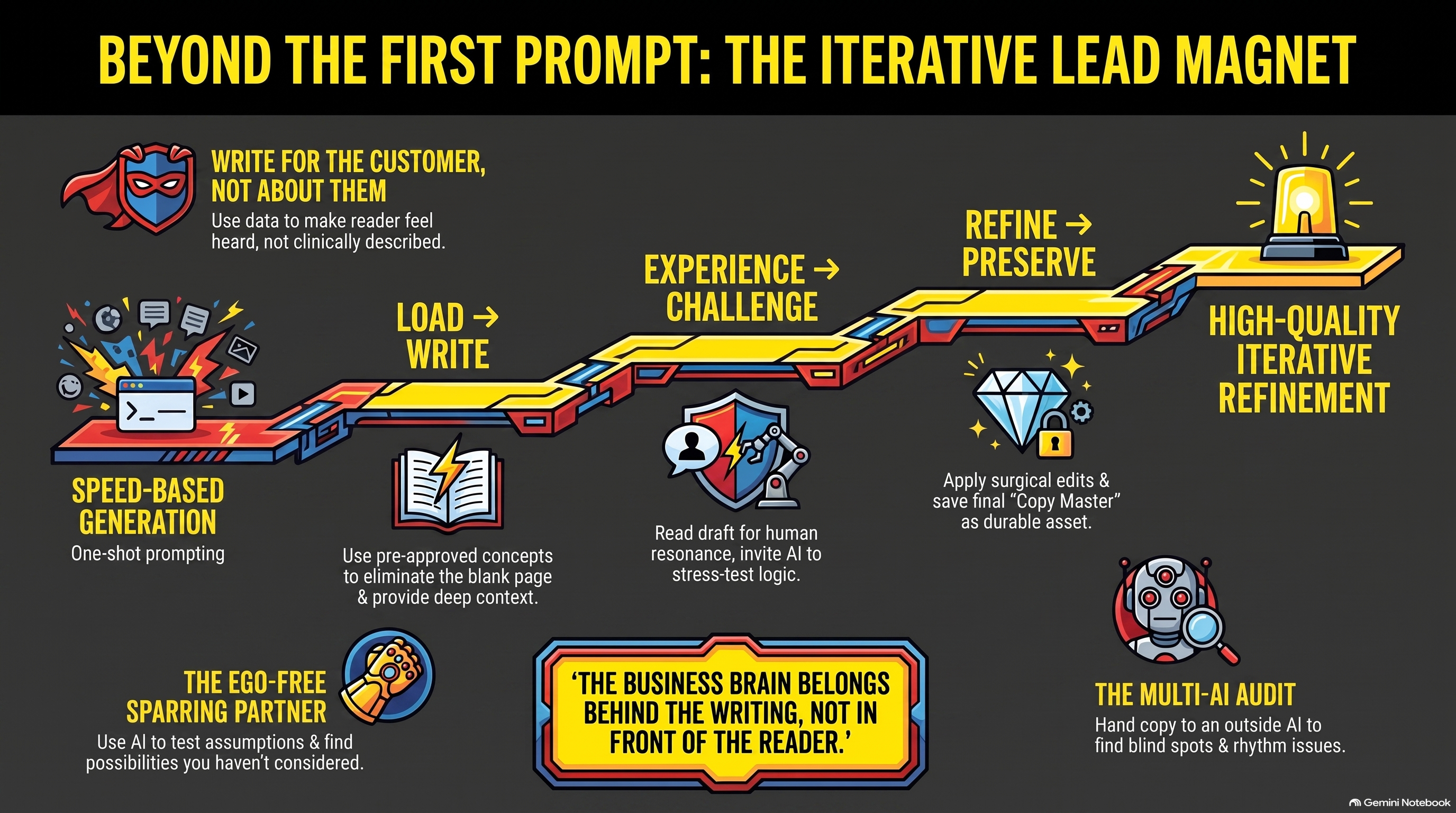
After we've worked something into pretty good shape, I'll sometimes hand the copy to another AI and ask it to review what we've done—not rewrite it, but look for weaknesses. Awkward rhythm. Repetition. Places where the tone changes. Things we've over-explained. Things that may be clear to us because we've been staring at the project for hours but aren't actually clear on the page.
Then I bring the review back.
We review the review.
That's where things get surprisingly interesting.
The second AI isn't necessarily smarter than the first one. That's not really the point. In fact, sometimes its greatest disadvantage is also its greatest advantage:
It wasn't in the room.
It doesn't necessarily know why we made a particular decision. It hasn't lived through all the earlier iterations or shared every assumption we've accumulated along the way.
So it can notice things we've stopped noticing.
It can also recommend “fixing” something that was deliberate.
That happened while I was working on some business-training material recently. We'd written a short line:
The Business Brain belongs behind the writing, not in front of the reader.
An outside AI reviewer thought the writing could use more breathing room and suggested expanding the thought into something closer to:
Think of the Business Brain as the foundation—it belongs firmly behind the writing, supporting the structure, rather than in front of the reader taking all the credit.
There was nothing grammatically wrong with that. It was perfectly reasonable editorial advice.
I liked the original considerably more.
But the useful response wasn't to dismiss the reviewer and move on. It had pointed toward a legitimate question. We'd been deliberately trying to eliminate the habit AI sometimes has of breaking everything into dramatic little declarations, so we looked at the sentence again.
Was it another unnecessary punchline, or had this particular thought actually earned the emphasis?
We decided it had.
The criticism was useful. The proposed solution wasn't.
That's an important difference.
When “Make It More Human” Starts Sounding Like AI
That same review process has exposed another little irony I've become fascinated by.
I've had AI reviewers recommend making something sound more human and then propose language that sounds more like AI than what we started with.
There's a peculiar little uncanny valley developing around “human” AI writing. Ask an AI to make something warmer and it will sometimes reach for the linguistic equivalent of putting a hand on your shoulder:
You've already done the hard work. Now let's take the next step together.
Nobody was upset. Nobody needed a hand on their shoulder.
We were trying to edit a paragraph. 😄
The advice isn't wrong because warmth is bad. Sometimes reassurance is exactly what the moment calls for. The problem is when the writing invents an emotional moment that isn't actually happening because that's what “human” writing is supposed to look like.
We've become pretty good at spotting robotic language. I think we're going to have to get equally good at spotting manufactured humanity.
Sometimes trying too hard to hide the machinery is exactly what makes the machinery visible.
Reviewers Aren't Authorities
One of the more useful habits I've developed while working with AI is separating the value of a criticism from the authority of the critic.
If another AI says a paragraph should be rewritten, I don't have to rewrite it. I can ask why. I can bring the criticism back to the AI that has much more context and ask whether it agrees. I can disagree with both of them, or try the revision and discover that I hate it before putting the original back.
Nobody has to win.
The goal of review isn't to obey the reviewer. It's to give your judgment better evidence.
That also changes what “iteration” means.
Iteration isn't continuing to change things until we're tired of changing them. Every revision doesn't automatically make the work better; anyone who has ever watched a committee edit a perfectly good sentence knows that.
Sometimes the correct editorial decision is to leave the thing alone.
The question is whether the change earned its place.
Five Passes Still Take Longer Than One
Of course five passes take longer than one. I'm not suggesting we spend forty-five minutes polishing every sentence that was perfectly serviceable at minute twelve.
Iteration isn't the goal. Better work is.
The strange thing is that AI has made serious iteration cheap enough that this is suddenly worth talking about. What once might have required several people, exchanged drafts, scheduled conversations and days of elapsed time can now happen astonishingly quickly.
A draft can be written, challenged, revised, handed to another set of eyes, brought back, argued over and refined while the original problem is still fresh in your head.
That doesn't mean every grocery-list email needs an editorial board. It means the work that actually matters can receive a level of attention that used to be much harder to justify.
That's a much more interesting value proposition to me than simply saying AI writes fast.
Maybe Prompting Isn't the Hard Part
There's an enormous amount of attention right now on learning how to prompt AI. That's reasonable. Better instructions usually produce better results.
But I wonder if we're placing too much emphasis on getting the perfect result from the perfect prompt, because there's another skill hiding immediately behind it:
Knowing how to keep working an imperfect answer.
Ask for the draft and read it. React to it. Tell the AI what worked and what didn't. Ask why it made a particular choice. Challenge the answer, try another version, keep the part that got better and put back the part that didn't.
Give the result to another set of eyes. Bring those notes back and challenge those too.
Eventually, you may find yourself somewhere considerably better than anything you could have described in the original prompt. That's certainly been my experience.
Something else happens along the way, too.
The more I have to explain why I prefer one version over another, the more clearly I have to understand my own judgment. I start asking why one sentence works while another sounds fake, why a supposedly “humanized” rewrite suddenly sounds less human, or why I'm fighting so hard to save a particular paragraph.
Am I defending it because it's good, or because I wrote it?
AI can generate alternatives all day, and that's part of what makes it so useful. I can consider another headline, another paragraph or another approach without worrying about how much time somebody spent producing the alternative. Most of those alternatives don't need to survive. They're there to give me something else to consider.
But having more choices creates another job.
I still have to know which one deserves to survive.
That's not replacing the writer. That's giving the writer one hell of a practice partner.
The Blank Page Was Only One Problem
AI has become remarkably good at answering the old question: What are you going to write?
That's worth celebrating. But once the words appear, another question replaces it:
What do you think?
Is it accurate? Is it useful? Does it sound like us? Would I actually say that? Did we make it better, or merely different? Is this finished?
Those questions aren't an unfortunate remainder of the work AI hasn't figured out how to eliminate yet. I'm starting to think they may be some of the most valuable parts of the work.
Producing words and understanding why those words deserve to survive are not quite the same skill. AI has made the first one astonishingly cheap.
It may be making the second one more important.
And maybe one of AI's greatest contributions to writing won't be its ability to produce a finished piece in fifteen seconds. Maybe it will be making the kind of iterative editorial attention that used to be expensive, slow or simply unavailable accessible whenever we need it.
Draft it, read it and argue with it. Ask why. Try something else. Let another set of eyes attack it, bring the notes back and keep what survives. Throw away what doesn't.
Somewhere along the way, stop worrying quite so much about which intelligence deserves credit for the sentence.
Keep the sentence that works.
Writers have been told for years that they need to learn how to kill their darlings. AI doesn't have any.
I've found that's pretty useful in an editor.
So give it something you actually care about sometime. Don't just ask it to rewrite the thing. Ask it to challenge you. Argue back. Let another AI review what you both came up with. Bring the review back and argue about that too.
You don't have to accept any of it.
Just see what survives.