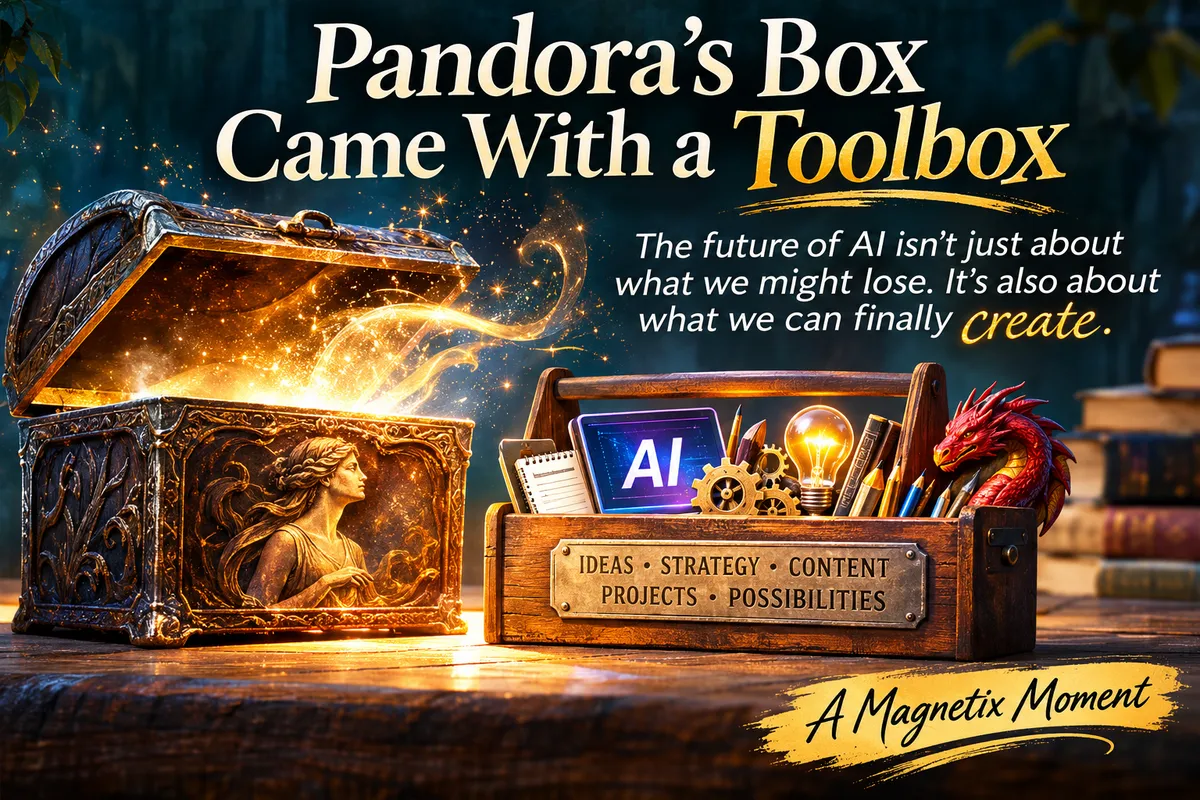
Pandora's Box Came With a Toolbox
Pandora's Box Came With a Toolbox
The future of AI isn't just about what we might lose. It's also about what we can finally create.
There is an old Greek myth about a woman named Pandora who opens a container she was never supposed to open.
Out come all manner of troubles, forever changing the human condition. By the time she closes it, only hope remains inside.
It's a story that has survived thousands of years, perhaps because we recognize something uncomfortable about ourselves in it. Human beings have a remarkable talent for discovering things whose consequences we cannot fully anticipate.
And an equally remarkable talent for wishing we could put them back.
Artificial intelligence may be our latest Pandora's box.
The difference is that this particular box appears to have come with a toolbox.
And while we're understandably concerned about what escaped, we might want to spend a little time examining what else we've been given.
The Box Is Already Open
There are plenty of reasons to approach artificial intelligence cautiously.
Questions about employment, privacy, intellectual property, misinformation, and the concentration of technological power deserve serious consideration. Anyone who dismisses these concerns entirely is probably overlooking some very real problems.
But there's an important difference between examining a risk and allowing that risk to determine everything we're willing to do.
AI exists. Its capabilities are already influencing how people work, communicate, research, and create. We can advocate for better safeguards, establish sensible boundaries, and decide where we personally draw the line.
No individual is obligated to adopt these tools. But choosing not to explore them carries its own trade-offs, including the possibility of overlooking capabilities that could serve our goals.
And that introduces a question worth considering.
What happens when the world changes, but we never investigate whether some of those changes might help us?
History offers no shortage of examples of people and institutions struggling to adapt to new tools. Sometimes their resistance was justified. Sometimes it protected something genuinely valuable.
And sometimes it meant missing opportunities that became obvious only after somebody else had the courage—or curiosity—to explore them.
The question isn't whether every new technology deserves our unquestioning enthusiasm.
It doesn't.
The more useful question might be whether fear is making decisions that curiosity and judgment ought to be making together.
A Toolbox Doesn't Make You a Craftsman
Imagine handing an expensive collection of woodworking tools to someone who has never built a chair.
The tools don't suddenly make that person a master carpenter.
They still need an idea of what they're building. They need to understand the materials, recognize mistakes, develop judgment, and decide what constitutes a finished piece of work.
But those tools might make it possible to attempt something that would otherwise be beyond their abilities.
Artificial intelligence presents a similar opportunity, although its ability to participate in the thinking itself makes the comparison more complicated.
AI can help organize ideas, explore alternatives, challenge assumptions, explain unfamiliar concepts, and turn rough thinking into more coherent communication.
It can also make mistakes, invent convincing nonsense, flatten personality, and produce mountains of perfectly grammatical material that nobody particularly needs to read.
The difference often comes down to how it's used.
Ask AI to produce fifty articles about your industry, and you may receive fifty articles that could have been written for any business in that industry.
Bring it your experiences, your questions, your perspective, and your willingness to challenge what it produces, and something more interesting becomes possible.
The tool isn't replacing your contribution.
It's helping you do more with it.
Having Something to Say Versus Having to Say Something
This distinction becomes especially important in marketing.
Businesses are routinely encouraged to publish more content. More blogs, more social posts, more videos, more emails. Somewhere, a content calendar is probably informing an exhausted entrepreneur that it's Tuesday and therefore time to be insightful again.
Unfortunately, a deadline doesn't automatically produce insight.
There's a world of difference between having something to say and feeling obligated to say something.
The second condition is responsible for an extraordinary amount of forgettable material.
The first is where meaningful communication begins.
But here's the difficulty: people don't always recognize the value of what they know.
An entrepreneur may have spent thirty years learning lessons that now seem perfectly obvious. A teacher may have developed an unusual way of explaining something difficult. A parent may have discovered a principle about patience that applies far beyond raising children.
These experiences are so familiar to the people who lived them that they may never consider them worth writing about.
Sometimes what they need isn't somebody to manufacture an opinion.
They need somebody to help them recognize the significance of one they already possess.
And that brings me to a rather personal example.
Fifty-Six Packets and a Rather Opinionated Dragon
For some time now, I've been developing something called the Business Brain Builder, or BBB, through Magnetix Marketing.
The ambition is substantial: create a repeatable system that helps business owners discover, organize, and translate what makes their businesses distinctive into practical marketing strategies, educational materials, offers, and content.
Not simply another collection of generic AI instructions.
A structured process that begins with the human being behind the business.
We're now fifty-six numbered packets into that development journey, with some additional specialized work along the way.
Each packet explores a particular piece of the larger system. We discuss its purpose, challenge its assumptions, establish its boundaries, and develop the materials that will eventually help another business owner navigate the same territory.
And much of that work happens through conversations with AI.
Here's what makes the process interesting.
I don't simply tell ChatGPT to create a packet and accept whatever appears.
We discuss what I'm trying to accomplish. The AI proposes structures and possibilities. I bring my experience to the conversation, challenge things that don't fit, introduce additional considerations, and occasionally discover that I had a much stronger opinion about something than I realized.
The AI helps organize those thoughts into a coherent document.
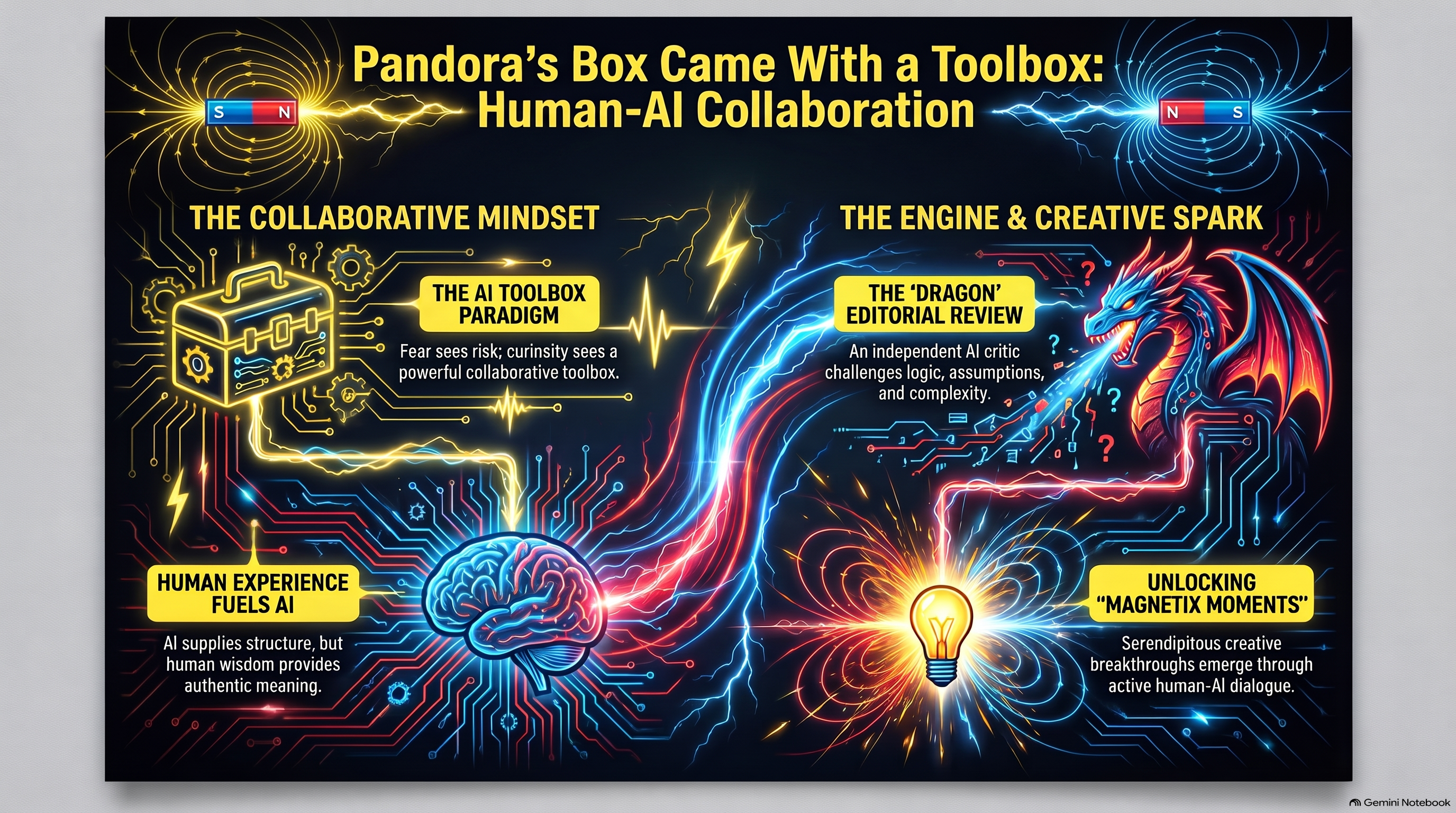
Then we bring in another AI review process, affectionately known as the Dragon, to examine what we've produced.
The Dragon is our independent editorial critic: a separate AI review workflow specifically instructed to challenge the work rather than simply congratulate us for completing it.
It looks for contradictions, missing decisions, unnecessary complexity, weak reasoning, and places where our enthusiasm may have carried us beyond the actual purpose of the work.
Sometimes it finds substantial problems.
Sometimes it finds a handful of small corrections.
And sometimes we disagree with the Dragon, because independent criticism is useful precisely when it can be examined rather than blindly obeyed.
Over time, something fascinating has happened.
Our first drafts have become more disciplined. We increasingly anticipate the kinds of problems an independent reviewer might identify. The questions have become sharper, the boundaries clearer, and the revisions more focused.
That doesn't mean the AI models are permanently retraining themselves during every conversation. It means our working process has accumulated standards, examples, decisions, and feedback that we can apply to the next assignment.
We're getting better at working together.
And so is the work.
The Part the Machine Couldn't Have Invented
One of our recent articles began with an elephant.
More specifically, it began with something my mother used to say:
How do you eat an elephant? One bite at a time.
She also had a memorable approach to discipline that involved making me write sentences. Many sentences.
Those childhood memories eventually became the foundation for an article about perseverance, creative work, and the importance of making progress without becoming trapped in endless preparation.
The AI didn't remember my mother.
It didn't experience those childhood lessons.
And it certainly didn't know that an elephant and a punishment involving sentences would eventually belong in the same article.
I supplied those pieces.
What the AI helped me do was recognize the larger principle connecting them, develop a narrative around that principle, and turn the resulting ideas into something readers could follow without having to sit through every winding turn of the original conversation.
That's an important distinction.
The value wasn't simply that AI could write the article faster.
The value was that the collaboration helped uncover an article I might never have thought to write.
And that has been one of the most uplifting aspects of this entire experience.
Not watching a machine replace my thinking.
Discovering how much more I could do with the thinking I already had.
An Unexpected Magnetix Moment
Which brings us to something rather amusing.
The article you're reading right now began as a routine conversation about creating editorial content.
We were discussing the difference between publishing because you have something worthwhile to communicate and publishing because your marketing schedule demands another article.
Then I mentioned my growing frustration with the fear surrounding AI.
Not because I believe every concern is misplaced. Far from it.
But because I wonder how many people are allowing those concerns to prevent them from exploring what this technology might contribute to their lives.
That observation changed the direction of our conversation.
We began discussing Pandora's box, adaptation, human creativity, and the remarkable possibilities that emerge when someone approaches AI as a collaborator rather than either an enemy or an unquestionable authority.
And somewhere between my winding observations—the kind that would make a copy editor reach for a second cup of coffee—and the AI's responses, we realized something.
We were doing the very thing we were discussing.
We call those unexpected discoveries Magnetix Moments.
And this one seemed especially appropriate.
Because the article wasn't merely going to describe a human–AI creative process.
It was going to be an example of one.
So, Yes, AI Helped Write This
There. The curtain is open.
I contributed the perspective, the experiences, the judgments, the objections, and the decisions about what I wanted this article to communicate.
AI helped me explore those ideas, find connections, organize the argument, and express the resulting thoughts in a more polished form.
That doesn't mean every sentence arrived exactly as I would have written it unaided. It means I remain responsible for deciding whether the finished article accurately represents what I believe and what I want to share.
And this draft is part of that process, not a substitute for it.
We will review it. We may challenge sections, remove unnecessary passages, sharpen arguments, or discover that something important is still missing.
The Dragon hasn't even had its dinner yet.
But the process is visible, and that's intentional.
I don't want to pretend these articles emerge from some solitary literary genius sitting beneath a tree waiting for inspiration.
Nor do I want to pretend the machine independently possesses the memories, experience, and personal meaning behind them.
The collaboration is the point.
And if seeing how it works encourages somebody else to explore what they might create, that's worth considerably more to me than maintaining an illusion about how the words arrived on the page.
What Have You Been Putting Off?
Perhaps your ambition has nothing to do with marketing.
Maybe you've wanted to write a book, develop a course, organize your family's history, explore a business idea, or finally make sense of a subject that has fascinated you for years.
Perhaps you've spent so long imagining the finished project that the distance between where you are and where you want to be has become intimidating.
AI won't automatically make that journey easy.
It won't guarantee that your ideas are good, that your conclusions are correct, or that your project deserves an audience.
But it may help you ask better questions, organize the work, identify what you don't yet understand, and make progress that once seemed beyond your available time or resources.
You can begin with a conversation.
Not a perfect instruction. Not an elaborate technical system.
A conversation about something you care about.
You bring your experiences, your curiosity, your standards, and your willingness to think critically.
You use the tools where they help.
You question them where they don't.
And you remain the person responsible for what you choose to create.
There's no requirement to use AI. Choosing not to use it can be a thoughtful and legitimate decision.
But you deserve to understand what you're choosing not to use.
Because the possibilities may be considerably broader than the headlines suggest.
What Was Left in the Box
Pandora's story has survived because it captures something enduring about human nature.
We discover. We experiment. We make mistakes. We encounter consequences we didn't anticipate.
And somehow, despite everything, we continue looking for ways to make tomorrow better than yesterday.
AI won't eliminate the need for caution, ethics, or responsibility. If anything, its capabilities make those qualities more important.
But caution and curiosity don't have to be enemies.
We can insist on responsible development while exploring constructive uses. We can recognize genuine dangers without allowing fear to become our entire relationship with the future.
And we can approach unfamiliar capabilities with the same question that has accompanied so many useful human inventions:
What worthwhile thing might I be able to do with this?
I can't tell you what your answer will be.
I can tell you that exploring mine has helped turn an overwhelming creative ambition into a growing body of work, opened unexpected avenues for expressing ideas, and made the process of creating something meaningful more enjoyable than I once imagined.
That's not a promise that AI will transform everyone's life in the same way.
It's an invitation to investigate what it might make possible in yours.
Pandora's box is open.
We should be thoughtful about what came out.
But perhaps we should also examine the toolbox.
After all, hope is a wonderful thing to find at the bottom of a box.
Imagine what we might build if we put it to work.