Reasons to Believe: The difference between looking credible and actually having something worth believing
Reasons to Believe
The difference between looking credible and actually having something worth believing
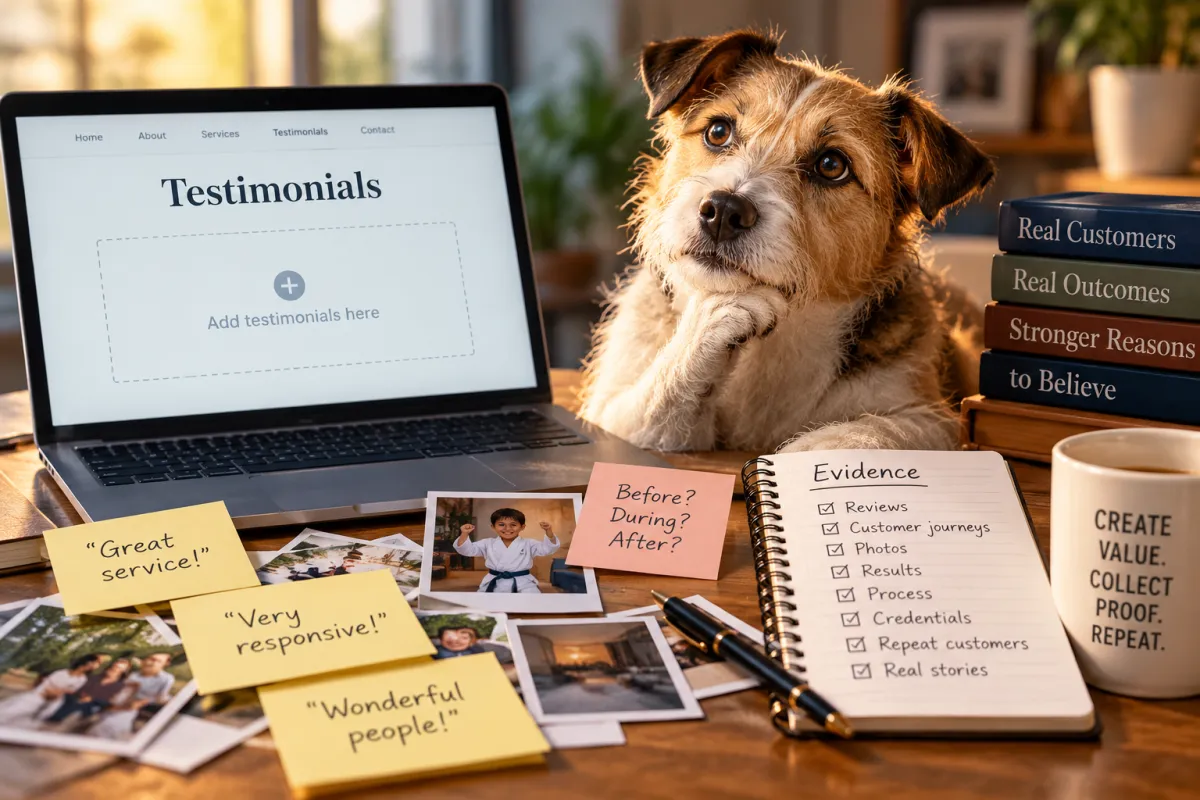
There's a familiar little problem that shows up when you're building a website or sales page.
You get to the testimonial section.
And stare at it.
Not because you necessarily doubt that you're good at what you do.
You just suddenly need to prove it.
And marketing has trained us to think that blank space needs to be filled.
Maybe you have three Google reviews somewhere. One says, “Great service!” Another says everybody was friendly. There's probably a really good email from a customer buried in your inbox from two years ago, but good luck remembering who sent it.
Or maybe you're newer and don't have much of anything yet.
That's usually when the temptation begins.
Not necessarily to lie. Most business owners aren't sitting around plotting elaborate testimonial fraud.
It's subtler than that.
The page has a hole in it, and we start trying to make the evidence we have fit the hole.
A customer said the staff was wonderful, so we put that next to a claim about how effective the program is.
Someone told us privately that they seemed happier after working with us, so eventually that observation starts sounding suspiciously like something the customer themselves said.
We know we've helped people. We know we're good at what we do.
We just don't always have the evidence organized well enough to show it.
And those aren't quite the same thing.
──────── ⚡ ────────
I started thinking about this differently while working on the Business Brain Builder.
Instead of asking:
“What testimonials do we have?”
I found myself asking:
“What gives somebody good reason to believe us?”
That's a much bigger question.
A testimonial can certainly be part of the answer.
So can ten years of relevant experience.
A demonstration.
A portfolio.
A credential.
A customer who came in unable to do something and can now do it.
A process that makes sense when somebody sees how it works.
A photograph.
A measurable result.
A customer who keeps coming back.
A business that's been quietly doing what it says it does for fifteen years.
These aren't interchangeable.
But they're all evidence.
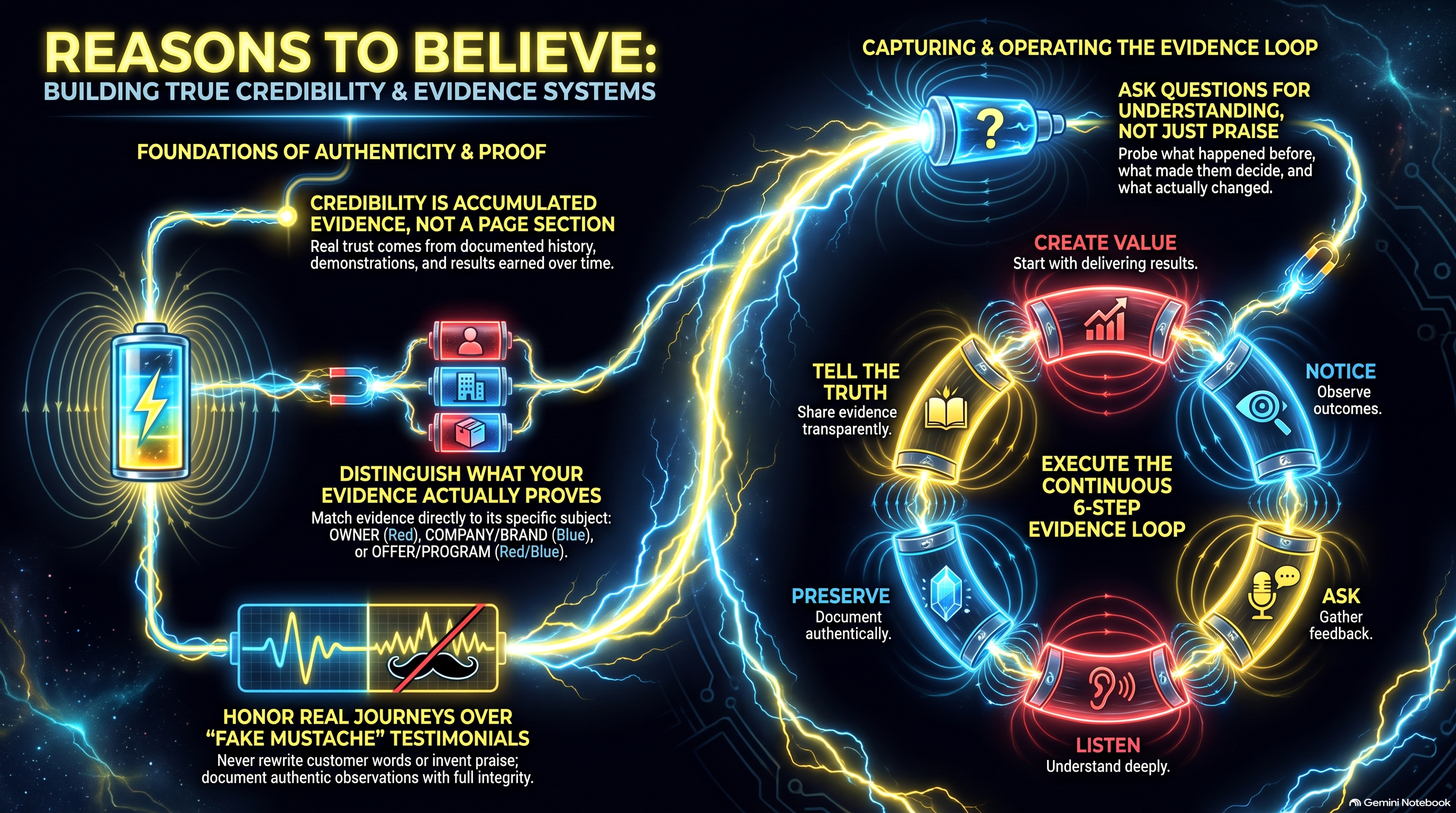
And that's when I realized the problem isn't really that the page has an empty testimonial section.
The problem is that we're treating credibility as a section of the page.
It isn't.
Credibility is something the business has been accumulating—or hasn't—long before somebody opens the website builder.
The page is just where we suddenly discover whether we've been paying attention.
──────── ⚡ ────────
What Are They Actually Believing?
Once I started looking at credibility that way, another distinction became obvious.
What exactly does the evidence prove?
A five-star review saying:
“Wonderful people. Very responsive. Highly recommended.”
is good evidence.
It tells me something useful about the company.
But suppose that company also sells a twelve-week program promising to help somebody accomplish a particular result.
That review doesn't tell me much about the program.
I'd much rather hear from someone who actually went through it.
What was happening before?
Why did they decide to try it?
What happened while they were doing it?
What changed?
What surprised them?
What happened afterward?
Now we're learning something different.
The first customer helped me believe the company.
The second may help me believe the offer.
Neither is inherently better evidence.
They're evidence for different things.
That's a distinction I don't think businesses make often enough.
──────── ⚡ ────────
Sometimes They're Believing You
There's another version of this.
Sometimes customers aren't really praising the company at all.
They're praising you.
“Sarah really listened.”
“Mike saw the problem immediately.”
“Working with Jennifer changed the way I think about this.”
Fantastic.
Unless you're trying to build a company that eventually doesn't require Sarah, Mike or Jennifer to personally handle everything.
Then you've learned something else.
Your credibility may still live primarily in the owner.
Again, that's not bad.
For a coach, consultant, educator, speaker, artist or other expert-led business, that may be exactly where you want it.
But perhaps you're building a team.
Perhaps the method should eventually become recognizable in its own right.
Perhaps you want customers saying:
“Their process works.”
rather than:
“Nobody can do this except Dave.”
Which becomes a particularly serious scalability problem when—
Dave's not here, man.
Sorry.
There was absolutely no responsible way for me to leave that alone.
The larger point stands.
You probably shouldn't rewrite the customer's words to solve that problem.
You should notice the problem.
That's what evidence is supposed to do.
It doesn't merely help us persuade customers.
Sometimes it teaches us something about our own business.
──────── ⚡ ────────
Then there's the really awkward situation.
You know a customer had a meaningful experience.
You watched it happen.
But you never asked them about it.
Imagine a martial arts instructor who remembers a student arriving almost afraid to participate.
Over time, the kid starts joining in.
Later, they're competing.
Eventually, they're helping newer students.
The instructor watched that happen.
That's real information.
But somewhere between remembering that story and building the website, it would be very easy for:
“I watched this student become much more comfortable participating.”
to mysteriously become:
“Martial arts gave me confidence and changed my life!”
— Anonymous Student
Except the student never said that.
The first version is an honest owner observation.
The second is a fictional testimonial wearing a fake mustache.
We don't need the fake mustache.
The real story was already interesting.
We just needed to be honest about what we knew, who knew it, and what we didn't know yet.
Maybe the next step is simply contacting the family.
“I'm remembering the progress I saw while your child was training with us. I'd love to know how you remember that experience.”
Now something even better can happen.
They might confirm what we saw.
They might tell us something we didn't know.
They might describe changes outside the school that we couldn't possibly have observed.
Or they might remember it differently.
All of those answers are useful.
Because we're not trying to manufacture proof.
We're trying to learn from reality.
──────── ⚡ ────────
Asking for More Than Praise
That also changes the way I think businesses should ask for feedback.
“Would you please leave us a review?” has its place.
Reviews help people understand what it's generally like dealing with a business.
But that's different from asking:
What was happening before you came to us?
What made you decide to do something about it?
What changed while you were working with us?
Was anything valuable that you didn't expect?
What would you tell someone who was where you were when you started?
Those aren't really requests for praise.
They're requests for understanding.
And sometimes the answer won't be the one we expected.
Good.
Maybe we've been emphasizing speed and customers keep talking about relief.
Maybe we've been selling convenience and they keep describing confidence.
Maybe we think the owner's expertise is the magic and customers keep talking about the process.
That's new business intelligence.
Customer feedback doesn't only help us market what we already know.
Sometimes it tells us what we didn't know.
──────── ⚡ ────────
Of course, there will still be blanks.
A customer you can't reach.
A result you remember but never documented.
A photograph you don't have permission to use.
A program that's too new to have meaningful customer stories yet.
I don't think those blanks need to stop us.
But I also don't think we're entitled to fill them with whatever would make the sales page look nicer.
Put a pin in them.
Keep moving.
If the customer responds six months from now, come back.
If the new program produces its first strong customer journey, preserve it.
If you discover that a value you've been promising isn't showing up in customer experience, pay attention to that too.
The goal isn't to build an increasingly impressive pile of testimonials.
It's to build an increasingly accurate understanding of why someone should believe you.
That's a very different project.
──────── ⚡ ────────
Maybe that's the part I've found most interesting.
A good evidence system doesn't just make marketing stronger.
It makes the business more capable of learning.
The business makes a promise.
A customer experiences the work.
Something happens.
We ask better questions.
We preserve what we learn.
And that new understanding changes what we say, what we build, what we measure, and perhaps even what we thought the value was in the first place.
The Business Brain gets a little smarter because reality got a vote.
I like that.
Because credibility shouldn't be something we paste onto the business after everything else is finished.
It should accumulate as the business earns it.
Create the value.
Notice what happened.
Ask.
Listen.
Preserve the evidence.
Then tell the truth as well as you possibly can.
Credibility isn't a section you add to your marketing. It's evidence your business accumulates by doing something worth believing.
That's a pretty good reason to believe.
──────── ⚡ ────────