
The Bell, the Bowl, and the Inbox
The Bell, the Bowl, and the Inbox
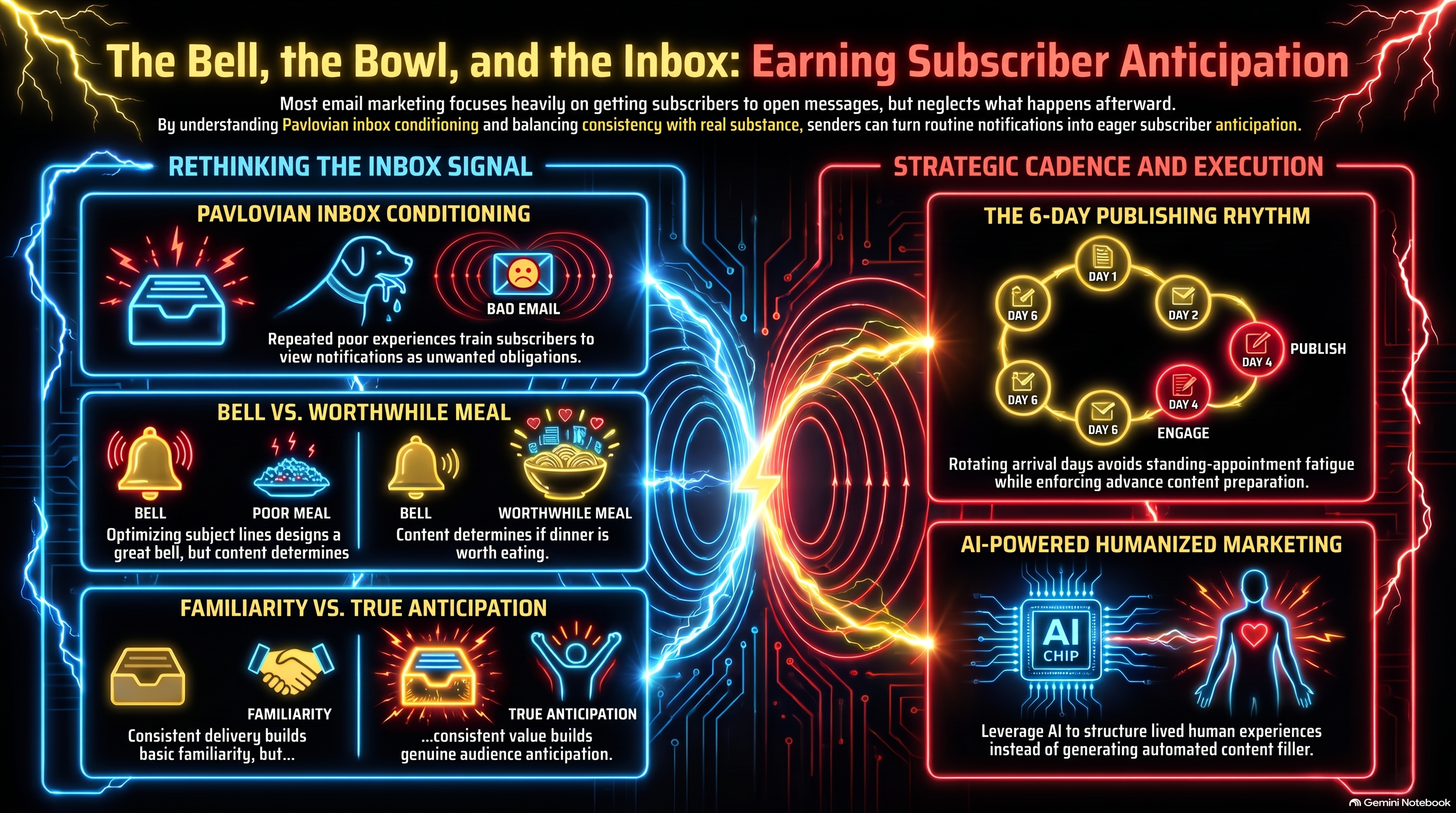
What Pavlov's dogs, a picky eater, and a mountain of unread emails can teach us about earning attention.
My dog has developed a rather sophisticated approach to dining.
When presented with a bowl of food containing kibble and something more appetizing, he carefully extracts the good stuff, leaving a trail of rejected kibble around the bowl. Then he looks at us with an expression suggesting that management has failed to meet its contractual obligations.
He knows perfectly well that we're eating something better.
What he doesn't know is that some of the things on our plates could make him sick. He doesn't understand onions, chocolate, or the various other ingredients that make human cuisine a potentially hazardous adventure for dogs.
He sees a class divide.
We're enjoying the good stuff at the big table, while he's expected to settle for whatever the kitchen staff has deposited on the floor.
Eventually, when it becomes clear that negotiations have stalled and no additional concessions will be forthcoming, he returns to the kibble.
Reluctantly.
I can't entirely blame him. I've been known to approach my own choices with a similar mixture of selective enthusiasm, questionable assumptions, and an abiding suspicion that somebody else got the better deal.
Apparently, both dogs and humans develop expectations about what happens when dinner is served. And as a certain Russian physiologist discovered, those expectations can become surprisingly powerful.
Which brings us, naturally, to email marketing.
Pavlov Has Entered the Chat
Most of us have heard about Ivan Pavlov and his famous experiments involving dogs.
Through repeated associations between a signal and food, Pavlov demonstrated that a previously neutral stimulus could eventually produce an anticipatory physiological response.
The bell became meaningful because of what followed it.
Now consider the modern inbox.
A notification appears. A familiar sender's name pops up. And before we've even read the subject line, we may already have an expectation about what comes next.
Sometimes it's pleasant anticipation.
More often, it's something closer to the emotional equivalent of discovering another parking ticket tucked beneath your windshield wiper.
Oh, wonderful. Another company that wants something from me.
The reaction isn't necessarily irrational. It may be the product of considerable experience.
We've opened the newsletters that promised fascinating discoveries and delivered three paragraphs of recycled advice followed by a sales pitch. We've clicked the irresistible subject lines only to discover that the astonishing revelation was a discount code.
We've endured the artificial urgency, the manufactured scarcity, the supposedly personal messages addressed to thousands of strangers, and the remarkable number of businesses that seem to believe their latest announcement deserves immediate priority over whatever we were doing.
Eventually, we learn.
Not necessarily in the literal, physiological sense of Pavlov's dogs. Human attention, expectations, and decisions are far more complicated than that. But repeated experiences do influence what we anticipate.
And every sender is contributing to those expectations.
We've Become Very Good at Ringing the Bell
Modern marketers have an extraordinary collection of tools for attracting attention.
We can test subject lines, personalize greetings, segment audiences, schedule messages, automate follow-ups, measure clicks, and experiment with almost every imaginable variation of a call to action.
We can even use artificial intelligence to produce more messages in less time than ever before.
All of this can be useful.
But there's an uncomfortable question hiding beneath the technology.
What happens when we become much better at getting people to open our emails than we are at giving them something worth opening?
It's rather like hiring a world-class chef to design the dinner bell while leaving an intern in charge of the food.
The bell is magnificent.
The meal is disappointing.
And after enough disappointing meals, people stop coming to dinner.
This is where I think many businesses, including some of my own earlier marketing efforts, have approached the problem backward.
We become preoccupied with frequency, consistency, and conversion. We want a reliable publishing schedule because consistency is supposed to build familiarity, and familiarity is supposed to build trust.
But consistency alone doesn't build trust.
It builds expectations.
Whether those expectations are favorable depends on what we've consistently delivered.
Don't mistake consistent delivery for consistently delivering something worthwhile.
There's a difference between being recognized and being welcomed.
The Great Inbox Cleanup
I suspect most of us have developed some variation of the same inbox ritual.
We open our email, scan the growing collection of messages, and begin making decisions almost automatically. A few deserve attention. Others are dismissed with barely a glance.
Click. Click. Click.
Sometimes we don't even read the subject lines. We recognize the sender, make a quick judgment, and move on.
A single unwanted email may cost only a few seconds. But multiplied across dozens of businesses, those seconds become minutes. Over weeks and months, they become a persistent tax on attention.
And there's another complication.
Email providers are increasingly sophisticated about filtering unwanted or suspicious messages. They evaluate sending practices, authentication, complaints, delivery failures, and other signals to determine what reaches the inbox.
A business may have something genuinely worthwhile to say and still struggle to reach the people who once expressed interest.
Meanwhile, traditional performance measurements don't always tell us what we think they do.
An email recorded as opened may reflect automatic image loading or security scanning rather than a deliberate human action. Conversely, an email that someone genuinely reads may not register as opened if its tracking image never loads.
Even when an open is accurately recorded, it doesn't tell us whether the recipient appreciated the experience.
Opening an email is not the same as welcoming it.
And that distinction matters more than ever.
Six Days, Seven Days, and the Tyranny of Tuesday
For The Currents, the newsletter we publish through Magnetix Marketing, I've settled on an approximately six-day publishing rhythm.
Not seven.
Six.
There's a bit of deliberate mischief behind that choice.
A weekly newsletter arrives on the same day every week. Tuesday becomes Newsletter Day. The audience may appreciate that predictability, and for many publications it's exactly the right approach.
But I wanted something that felt a little less like a standing appointment with the marketing department.
Every six days, the arrival moves around the calendar.
Monday becomes Sunday. Then Saturday. Then Friday.
The intention is to make the communication feel a little more spontaneous, even though considerable planning may have happened behind the scenes.
I'm not claiming that six days is scientifically superior to seven, or that changing weekdays magically improves deliverability. It's an editorial preference, an experiment in how a relationship feels.
The more important decision is that we plan ahead.
I don't want to wake up on publication day thinking, Good heavens, I need to have an interesting thought before lunch.
That's a rather unreasonable demand to place on any brain, particularly one that hasn't finished its coffee.
Instead, we develop ideas in advance, explore them, refine them, and maintain a reserve of material worth sharing.
The schedule helps us prepare.
It doesn't get to decide whether something is worth sending.
And if we don't have anything worthwhile?
I'd rather miss an email than train people to regret opening the next one.
The Difference Between Having Something to Say and Having to Say Something
This may be the most important distinction in the entire conversation.
Businesses are often told that they must remain visible. They must publish consistently, maintain engagement, nurture their lists, and keep their brands top of mind.
There's some legitimate reasoning behind all of that.
People forget. Circumstances change. Relationships fade when nobody maintains them.
But visibility without value can become a liability.
Imagine a friend who calls you every six days.
Sometimes they share an interesting observation, tell you a good story, or offer a perspective that helps you think through something you've been struggling with.
You might begin looking forward to those calls.
Now imagine another friend who calls with the same frequency but spends every conversation telling you what they're selling, what they've accomplished, or why you should pay more attention to them.
Eventually, you might begin screening their calls.
The difference isn't the frequency.
It's the experience.
And no, the solution isn't to turn every business newsletter into a scrapbook of pets, vacations, meals, and amusing domestic incidents.
Although, as you've probably noticed, I'm not entirely opposed to a good dog story.
The question is whether the story leads somewhere useful.
A personal anecdote can make an abstract idea understandable. A funny observation can reveal something about human behavior. A seemingly ordinary experience can provide a fresh perspective on a familiar problem.
The personal element becomes valuable when it serves something larger than itself.
That's what I want The Currents to do.
Not merely tell readers what happened in my life, but explore what those experiences might help us understand about our own.
The Strange Value of Not Asking for Anything
Here's where this philosophy becomes particularly interesting from a business perspective.
Sometimes the most commercially useful thing you can do in an email is not try to sell anything.
That sounds almost heretical in a world obsessed with funnels, conversions, and return on investment.
But consider what happens when a business consistently communicates without demanding something in return.
Readers have opportunities to become familiar with its perspective. They see how it approaches problems, what it values, and whether its thinking is worth their attention.
They may begin to understand the business differently.
And that understanding can matter long before anyone is ready to buy.
In fact, while we were developing the Business Brain Builder material that inspired this article, something rather timely happened.
A woman I'd worked with previously reached out after receiving an issue of The Currents.
Our earlier working relationship hadn't ended under ideal circumstances, and we hadn't been actively collaborating. Yet here was an opportunity to reconnect, perhaps even repair some of the old bridge.
She didn't tell me that a particular passage had changed her thinking. She didn't compliment the article or explain precisely why she was reaching out.
She wanted to talk about getting some additional help.
It's entirely possible that the email simply reminded her I was still here, still working, and continuing to develop what I can offer.
I can't know whether the content itself prompted her decision.
But the timing offered a useful reminder.
A worthwhile newsletter doesn't just deliver information. Over time, it can help people update their understanding of the person or business behind it.
Sometimes that leads to a sale.
Sometimes it leads to a conversation.
Sometimes it opens a door that seemed to have closed.
And sometimes it simply gives someone a useful thought before they return to their day.
Not every valuable outcome fits neatly into a conversion report.
The Human Touch, Courtesy of Artificial Intelligence
There's another delightful irony in all of this.
Artificial intelligence is helping me make my marketing more human.
Not because AI has replaced my experiences, my judgment, or my personality. Quite the opposite.
It helps me explore the experiences I already have, recognize patterns I might otherwise overlook, and develop observations into something more coherent and useful.
The dog story that opened this article came from an actual conversation about how my dog eats his dinner.
We started with email marketing, wandered through Pavlov's experiments, took an unexpected detour into canine dining preferences and perceived class inequality, and somehow found our way back to a practical philosophy of audience relationships.
That's the kind of wandering conversation I find genuinely productive.
The AI helps organize the thinking, question assumptions, and refine the language. I supply the lived experiences, decide which interpretations ring true, and determine what deserves to be published.
It's collaboration, not an automatic content dispenser.
And that's an important distinction because AI makes it easier than ever to fill inboxes with polished, plausible, completely forgettable messages.
The technology can help us produce more kibble.
Or it can help us discover the meaty bits worth sharing.
The choice remains ours.
Earn the Next Opening
I don't think the future of email marketing belongs exclusively to whoever sends the most messages, writes the cleverest subject lines, or discovers the perfect automation sequence.
Those capabilities have their place.
But there's something much more fundamental at work.
When someone sees your name in their inbox, what do they expect?
Another interruption?
Another pitch?
Another obligation to decide whether your latest announcement deserves a few seconds of their increasingly crowded day?
Or something that might actually be worth their attention?
We can't control every recipient's reaction. We can't guarantee that every email will resonate, and we certainly can't expect people to remain interested forever.
But we can take responsibility for the experiences we're creating.
We can offer useful ideas, honest perspectives, thoughtful entertainment, and occasional invitations to explore something further.
We can make promotional offers without turning every conversation into a sales presentation.
We can recognize that subscribers are people with their own priorities, not merely addresses awaiting conversion.
And perhaps, over time, we can become a welcome presence rather than another name on the deletion list.
Consistency earns familiarity. Value earns anticipation.
The bell is going to ring either way.
Let's make sure there's something worth coming to the bowl for.
And preferably something better than kibble.