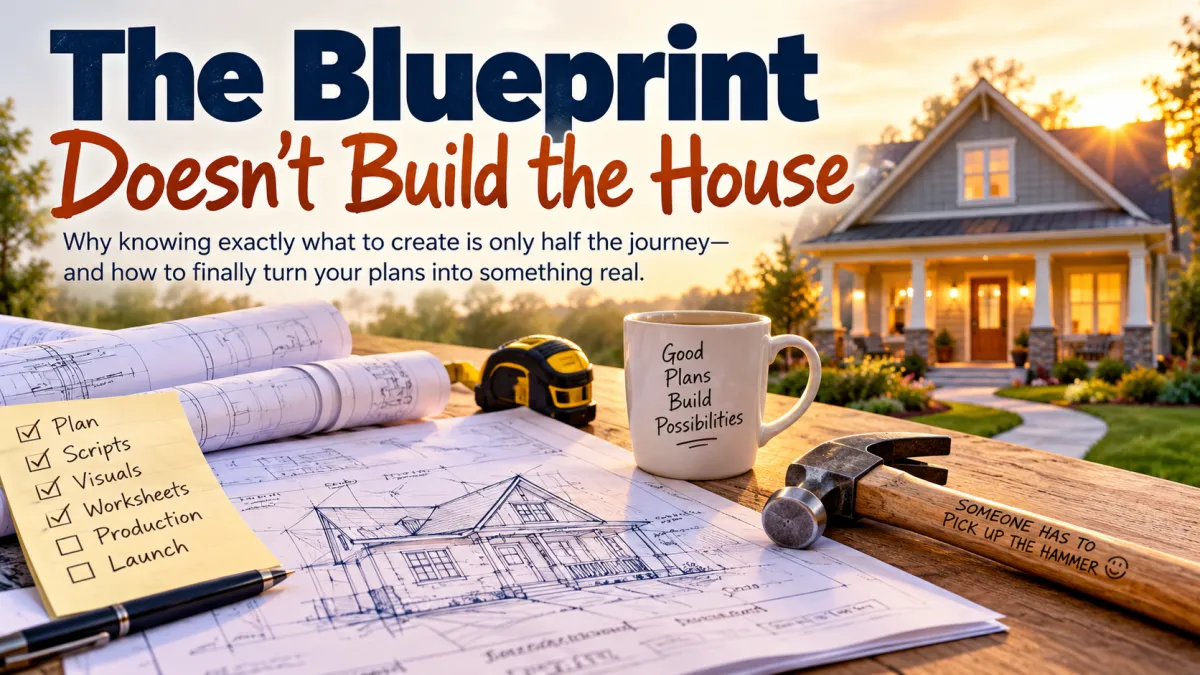
The Blueprint Doesn't Build the House
The Blueprint Doesn't Build the House
Why knowing exactly what to create is only half the journey.
There's a peculiar kind of satisfaction that comes from finishing a really good plan.
You've done the research. You've wrestled with the difficult questions. You've made decisions, discarded bad ideas, rearranged the pieces, and finally arrived at something that makes sense.
Maybe it's a new business strategy. Maybe it's a course you've wanted to create for years. Maybe it's a lead magnet, a marketing campaign, or an entirely new service.
You can practically see the finished thing.
And then comes that slightly uncomfortable realization.
You still have to make the damn thing.
──────── ⚡ ────────
The Wonderful World of Almost Finished
I've worked with enough entrepreneurs to recognize a particular moment in the creative process.
Someone comes to me with an idea they're excited about. We talk through what they want to accomplish, who it's supposed to help, and what needs to happen to bring it to life.
Sometimes the idea is still a little foggy. Other times they've already spent months thinking about it.
We get to work.
Before long, there's a strategy. A structure. Maybe a complete set of scripts for a three-module training course.
The material is there. The teaching progression makes sense. The words are ready to be spoken.
All that's left is to record the videos.
Simple enough, right?
Well...
I once worked through a situation where that last step became an unexpected sticking point. The scripts were prepared, the recording instructions had been discussed, and the project was waiting for the videos that would allow everything else to move forward.
But from the other side of the arrangement, the project still felt unfinished.
And, of course, it was unfinished.
That was the curious part.
We were looking at the same unfinished project from opposite sides of the same doorway.
One person was waiting for the next piece of material. The other was waiting for the finished result.
Neither perspective changed the fact that the videos still needed to be recorded.
It was a frustrating experience, but it left me thinking about something that goes well beyond one project.
There's a surprisingly large distance between knowing what needs to happen and actually making it happen.
And sometimes the distance isn't measured in effort at all.
It's measured in ownership.
The Blueprint Is a Real Accomplishment
I don't want to diminish planning. Quite the opposite.
A good blueprint is enormously valuable.
Imagine trying to build a house without one. You could buy some lumber, gather a few tools, and start hammering boards together. Eventually, you'd probably have something standing.
Whether you'd want to live in it is another question.
Business projects aren't much different.
A poorly conceived course can contain hours of beautifully recorded video and still leave its students confused. A marketing campaign can feature gorgeous graphics and clever writing while attracting entirely the wrong audience.
A lead magnet can look spectacular and deliver absolutely nothing useful.
The planning matters because it determines whether the thing we're creating is worth creating in the first place.
That's been a major focus of our Business Brain Builder journey.
Before asking AI to produce a mountain of material, we've been working to establish what the business knows, who it serves, what those Customers actually need, and what meaningful progress looks like.
We want the blueprint to reflect something real.
But there's a catch.
The more complete the blueprint becomes, the easier it is to mistake that feeling of accomplishment for completion of the entire project.
You can have a beautifully organized folder filled with course outlines, lesson scripts, worksheet designs, and production notes.
You can even have an AI assistant enthusiastically congratulate you on your progress.
And you should feel good about it.
You've accomplished something worthwhile.
You just haven't built the house yet.
When AI Hands You Another Blueprint
Artificial intelligence has made this distinction considerably more interesting.
It can help us think through ideas, organize information, write scripts, create visual concepts, develop exercises, and prepare materials that once required a great deal more time and effort.
That's remarkable.
But AI also has a funny habit.
Ask it to create something substantial, and sometimes it'll respond with an impressively detailed explanation of how it proposes to create that thing.
You ask for a worksheet.
It gives you a worksheet outline.
You ask for a complete video script.
It gives you an excellent summary of what the video should cover.
You ask for the finished materials, and it tells you what an exciting opportunity it will be to develop them together.
Wonderful.
Could we perhaps develop them now?
It's a little like hiring someone to build your kitchen cabinets and receiving a beautifully illustrated presentation about the importance of kitchen cabinets.
You might learn quite a bit.
You still have nowhere to put the dishes.
This is why we've reached an important stage in Business Brain Builder.
After identifying the Small Paid Transformation we want to offer and designing the curriculum that will deliver it, we've arrived at the production stage.
Not another round of deciding what the course should be.
It's time to produce the actual scripts, presenter outlines, worksheets, visual materials, exercises, and supporting resources.
The difference sounds obvious until you've spent three hours discussing a document that nobody has actually written.
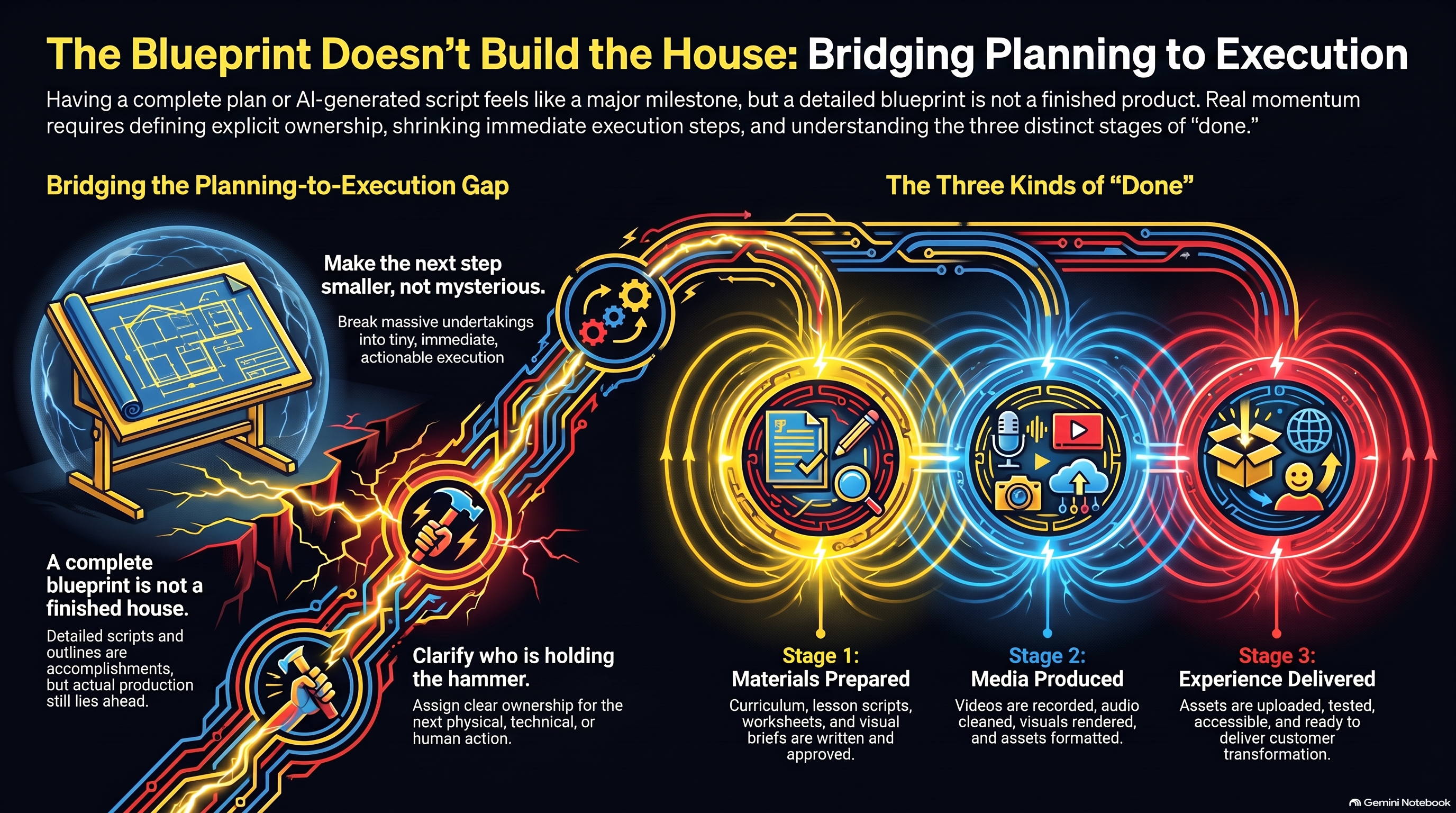
Three Different Kinds of Done
One of the lessons I've taken from working on projects like these is that we need to become much clearer about what we mean when we say something is finished.
Consider a simple three-module video course.
First, the materials can be prepared.
The curriculum is designed. The scripts are written. The worksheets are complete. The visual direction has been approved.
We have everything needed to begin making the course.
That's a meaningful accomplishment, especially when those materials are well thought out.
Second, the media can be produced.
Someone records the lessons. The audio is cleaned up. The visuals are created. The worksheets are formatted. The videos are edited and captioned.
Now we have the actual pieces of the experience.
But even that isn't necessarily a finished course.
Third, the experience can be delivered.
The videos are uploaded. The lessons appear in the correct order. Resources are available where they're needed. The Customer can access everything, follow the instructions, and complete the intended transformation.
Someone has tested the whole experience to make sure it works.
Now we're getting somewhere.
These stages overlap, and different projects may require different work. But the distinctions matter.
A completed script isn't a completed video.
A completed video isn't necessarily a functioning course.
And a functioning course isn't automatically an effective one. That's something we begin to discover when real Customers use it.
The point isn't to complicate production with endless categories.
It's to stop confusing one kind of progress with another.
──────── ⚡ ────────
Who's Holding the Hammer?
There's another side to this that AI can't solve for us entirely.
Participation.
A business owner might hire someone to create a marketing system, but still need to supply information about their products, approve creative decisions, or participate in recording videos.
A consultant might develop an excellent strategy, but the business still needs someone to put it into practice.
An AI assistant might produce an outstanding script, but somebody has to decide whether to record it, use an avatar, or take another approved approach.
This is where expectations can become surprisingly tangled.
Sometimes we believe we've explained exactly what someone needs to do, while the other person believes they've hired us to take care of everything.
Sometimes the distinction was explained, but it didn't really register.
And sometimes circumstances change. A task that sounded perfectly manageable during planning becomes intimidating when it's finally sitting on the calendar.
I can understand that.
Recording yourself on video is a wonderful example. For some people, it's no more intimidating than making a phone call. For others, it's approximately as appealing as giving a speech to a room full of dentists while discovering you've forgotten to put on pants.
Knowing the words are already written doesn't necessarily make pressing Record any easier.
But the responsibility for the next step still needs to be clear.
That's one lesson I've become more conscious of in my own work.
It isn't always enough to explain what's next. Sometimes we need to make the handoff unmistakable.
What has been completed?
What is waiting?
Who owns the next action?
And what, specifically, becomes possible when that action is finished?
Those questions can save an extraordinary amount of frustration.
You know the old saying about leading a horse to water.
I've come to think there's another useful question to ask before walking away from the trough.
Does the horse know this is the part where it's supposed to drink?
Make the Next Step Smaller, Not Mysterious
One reason projects stall is that the next action feels larger than it really is.
"Produce your course" sounds like an enormous undertaking.
"Record the first lesson using the script we've already approved" is much more approachable.
Even better:
Open the script. Set up the camera. Record the first two minutes. Watch them back. Make one adjustment.
Now we're moving.
The same principle applies to AI-assisted production.
Rather than asking for an entire course in one enormous request and hoping everything comes back complete, we can work through manageable pieces.
Produce the Introduction.
Review it.
Refine what needs attention.
Save the approved materials.
Move to the first lesson.
There's something reassuring about knowing that finished work will stay finished unless we have a genuine reason to revisit it.
And that's why our production process includes a simple inventory of what exists, what has been approved, what still needs work, and where the actual files can be found.
Not because entrepreneurs need another spreadsheet to maintain.
Heaven knows we have enough of those.
It's because progress becomes much easier to trust when we can see exactly what has been accomplished.
We shouldn't have to reconstruct an entire project from a three-week-old conversation just to figure out whether Lesson Two was ever finished.
Nor should we confuse an AI-generated description of an image with an actual image sitting in a folder somewhere.
If it's done, we should be able to find it.
If it isn't done, we should know what comes next.
A Workshop Between the Blueprint and the House
This is where I think AI has an especially exciting role to play.
For a long time, many entrepreneurs have found themselves stuck between a good idea and the resources needed to execute it.
They could envision the course, but not afford to hire someone to write every lesson.
They knew they needed a workbook, but couldn't find the time to create one.
They had a compelling marketing concept, but struggled to turn it into finished copy and graphics.
AI doesn't eliminate the need for judgment, skill, or participation.
But it can make the workshop between planning and execution dramatically more productive.
Instead of staring at a blank document, we can begin with a complete working draft.
Instead of spending an afternoon arranging worksheet questions, we can review an actual usable worksheet.
Instead of trying to invent every visual direction from scratch, we can work from established brand intelligence.
And because the Business Brain carries the context we've developed along the way, those materials don't have to begin as generic guesses about our business.
They can begin much closer to what we actually need.
That's the opportunity.
Not replacing the entrepreneur.
Not pretending AI can magically complete every physical, technical, and human task.
But removing a remarkable amount of unnecessary friction between deciding what to build and having the materials ready to build it.
There's still craftsmanship involved. Sometimes a lot of it.
The difference is that we get to spend more of our energy improving something tangible rather than repeatedly describing what we hope to create.
The House Still Needs Someone to Live in It
Of course, even a beautifully completed course isn't the end of the story.
Eventually, real Customers arrive.
They bring questions we didn't anticipate, misunderstand instructions we thought were perfectly clear, and occasionally find brilliant uses for materials we considered fairly ordinary.
That's when we discover how well our blueprint survived contact with reality.
It's also why I'm reluctant to call any business system permanently finished.
We build. We deliver. We observe. We improve.
And sometimes we discover that the most important change isn't another lesson, another worksheet, or another automation.
It's making the next action easier to recognize and take.
That's true for the Customer moving through a course.
It's true for the entrepreneur building the course.
And it's certainly true for those of us helping entrepreneurs bring their ideas into the world.
The blueprint matters.
The workshop matters.
The person holding the hammer matters.
And if we're clear about which stage we're in, what we've accomplished, and whose turn it is to act, we have a much better chance of eventually opening the front door.
Because the blueprint doesn't build the house.
But it sure makes a difference when everybody knows what they're building—and who's picking up the hammer next.
──────── ⚡ ────────
We're exploring this very process in the Business Brain Builder, part of Magnetix Marketing's Powerful Progress Program. The goal is to help entrepreneurs develop the intelligence behind their business, use AI to turn that intelligence into practical materials, and learn how to put those materials to work. One manageable step at a time.