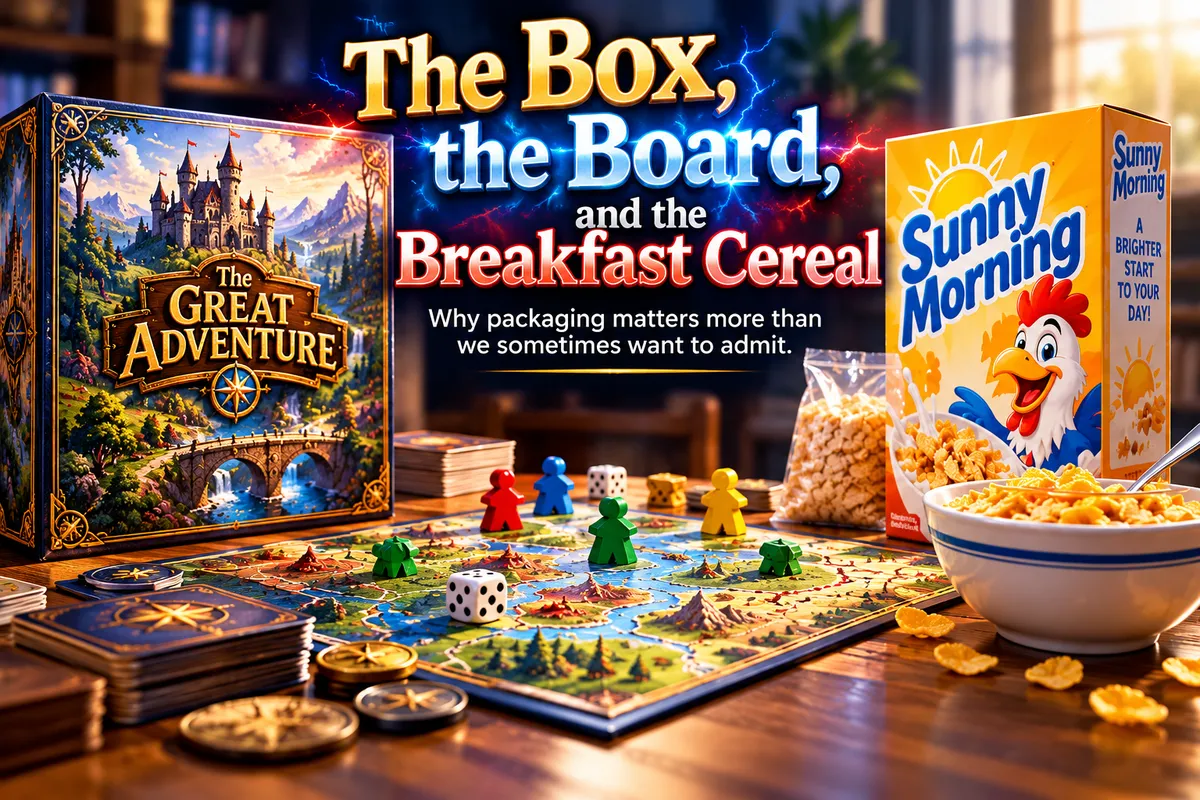
The Box, the Board, and the Breakfast Cereal
The Box, the Board, and the Breakfast Cereal
Why packaging matters more than we sometimes want to admit.
The other day, I came across an interesting observation about fashion. The suggestion was that some clothing looks fashionable largely because of the attractive people modeling it. Put the same outfit on someone else and suddenly it might not seem nearly as impressive.
That sparked a conversation about something much bigger than fashion.
Sometimes an exceptional product makes its packaging look good. Other times, the packaging makes an otherwise ordinary product seem extraordinary. And sometimes the relationship works both ways, with the product and its presentation making each other more desirable.
Which got me thinking about board games.
Imagine you've invented a fantastic board game. The rules are clever, the gameplay is entertaining, and everyone who's tried it has had a wonderful time. You could print the board on a folded sheet of paper, put the cards and pieces in a plastic bag, and technically have everything necessary to play.
Now imagine trying to convince Walmart to put that bag on a shelf.
Compare it with the same game presented in a sturdy, beautifully illustrated box, complete with a heavyweight board, satisfying game pieces, and artwork that promises an adventure before anyone has even read the rules.
The gameplay hasn't changed. But almost everything about how the Customer perceives its value has.
And here's the really interesting part: the expensive-looking version might not actually be the better game.
What Are We Really Paying For?
Breakfast cereal offers another wonderful example.
Walk down the cereal aisle and you'll find colorful boxes competing for attention with mascots, photographs, nutritional claims, and promises of delicious mornings. Somewhere nearby, you might find a much plainer bag containing a remarkably similar product at a substantially lower price.
The ingredients could be nearly identical. The nutritional value might be comparable. Yet people willingly pay more for the familiar box.
Why?
Brand recognition certainly plays a part. So do trust, habit, convenience, and the memories we associate with products we've known for years. Packaging also performs practical jobs, from protecting the contents to making a product easier to display, identify, store, and use.
But something else is happening. Presentation gives us clues about value before we've had the opportunity to experience that value for ourselves.
A heavy game board suggests quality. A beautifully designed box suggests care. A familiar cereal package suggests consistency. None of those things guarantees a better product, but each influences what we're prepared to believe about it.
And what we're prepared to believe can have an enormous influence on what we're prepared to pay.
That creates an interesting opportunity for business owners. Sometimes increasing profitability doesn't require fundamentally changing the product. It requires helping people recognize its value more readily, or adding elements to the experience that make it more satisfying to own and use.
Of course, there's a less admirable version of that opportunity, too. You can make something appear more valuable than it really is.
A magnificent box might persuade someone to buy a mediocre board game once. Convincing them to buy the expansion pack could prove considerably more difficult.
We've Already Built the Game
This is where our Business Brain Builder journey gets interesting.
Over the previous three packets, we've been working on what we call a Small Paid Transformation: a focused, affordable offer designed to help a Customer make one meaningful improvement.
We chose the treatment, designed the experience, and created the materials needed to deliver it.
In other words, we've been building the game.
Now, in Packet 034, we're designing the box.
And no, that doesn't mean we're going to spend the next month deciding whether our course thumbnail should have a slightly more dramatic lightning bolt. Although I can think of at least one person who might enjoy that discussion.
The real work is making sure the value we've created is understandable, desirable, and presented in a way that supports the Customer's experience.
Suppose you've created five short lessons that help small-business owners build a practical follow-up sequence for new leads.
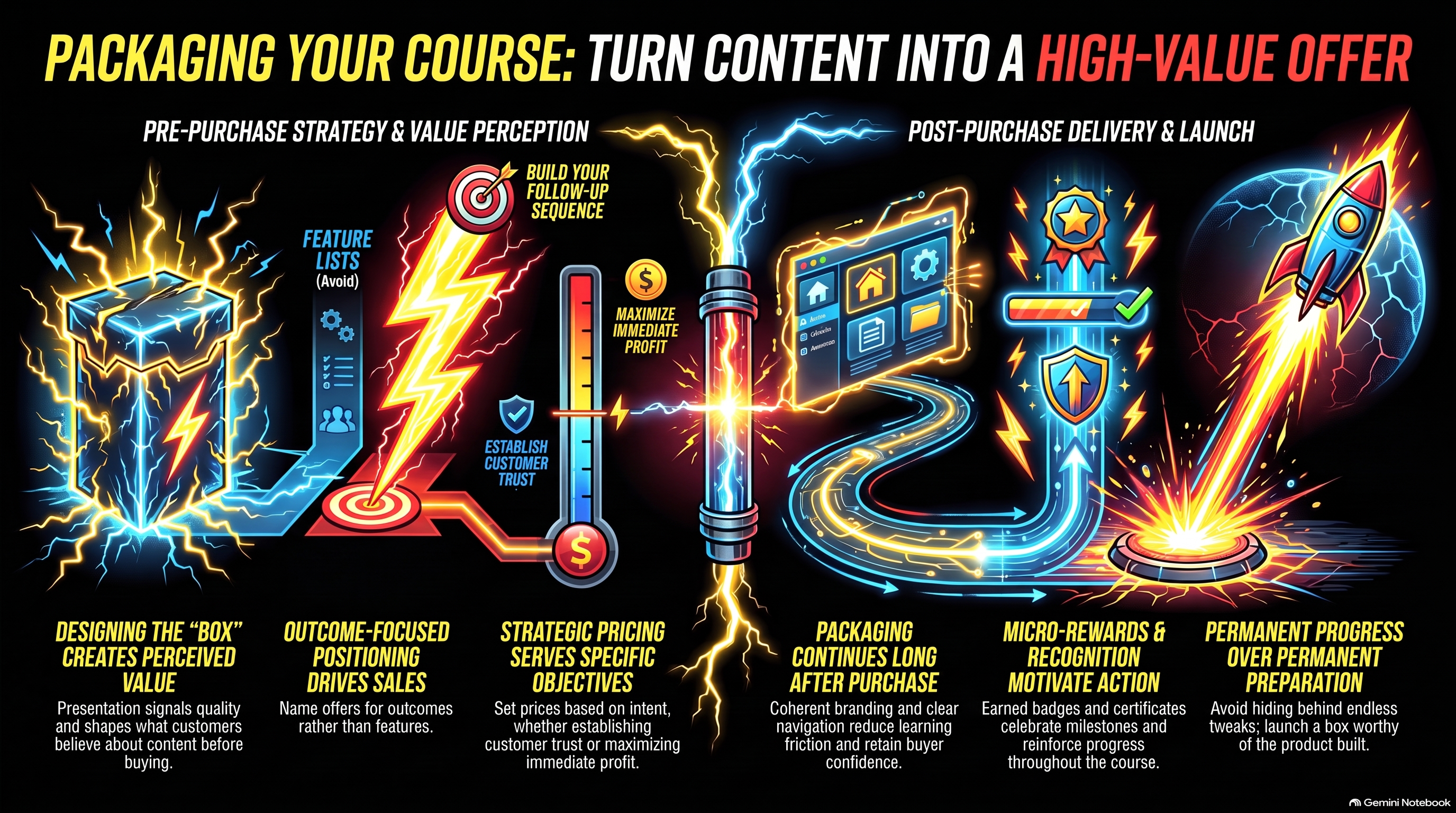
You could package the offer as Five Video Lessons About Lead Follow-Up. It's an accurate description of the contents, but it doesn't tell the Customer much about why those lessons matter.
Or you could call it Build Your First Five-Message Follow-Up Sequence.
Now the Customer can picture an outcome. They can imagine having something useful in place that wasn't there before.
Same underlying lessons, but a clearer expression of what those lessons are intended to accomplish.
That's an important distinction. We're not inventing a grander promise to make the offer sound impressive. We're communicating the genuine transformation in language that makes sense to the person who needs it.
A great product deserves packaging that communicates its value. Great packaging deserves a product that lives up to its promise.
Sometimes the First Sale Has Another Job
There's another dimension to packaging that doesn't have much to do with colors, graphics, or course names.
Price.
Suppose your new mini-course could reasonably sell for $47. You might decide that's the right price, especially if the course delivers substantial value and you need the purchase itself to be profitable.
But perhaps you're building a business where the first purchase serves another purpose.
Maybe a $27 introductory offer encourages more people to become first-time paying Customers. Maybe the course introduces them to a larger service you provide. Or perhaps you're testing whether a smaller purchase can help establish enough trust for someone to consider working with you more extensively.
The point isn't that cheaper is better. A lower price can attract more buyers without necessarily producing more profit, and a poorly chosen discount can undermine the very perception of value we're trying to establish.
The point is that pricing should reflect the job the offer is meant to perform.
For some businesses, the Small Paid Transformation needs to stand on its own as a profitable product. For others, it may also serve as the beginning of a longer Customer relationship. Those goals can coexist, but understanding which matters most helps us make better decisions about pricing, positioning, promotions, and what happens after the purchase.
Our box needs to communicate the right value to the right people, at a price that makes sense for both the Customer and the business.
The Box Doesn't Disappear After the Purchase
Here's something our board game analogy doesn't quite capture.
With a physical board game, you eventually open the box, take out the pieces, and start playing. The packaging has largely finished its job, although a well-designed box can continue making storage and setup easier.
With a digital learning experience, the presentation continues long after the purchase.
Think about what happens when someone buys your course.
They receive their access instructions, visit your learning environment, sign in, and begin looking around. The colors, graphics, organization, navigation, and course materials all contribute to their impression of what they've purchased.
If the sales page promised a polished, thoughtful learning experience but the Customer arrives in a confusing collection of generic screens, that disconnect can undermine their confidence before they've completed the first lesson.
On the other hand, a welcoming environment with recognizable branding and clear organization can make the experience feel more coherent and easier to use.
And that's where packaging starts becoming part of the product itself.
A useful distinction, isn't it? Presentation can influence the perception of value, but thoughtful presentation can also create real value by reducing confusion, improving usability, and helping Customers stay engaged.
Better yet, we don't need to reinvent the entire learning environment for every new course.
We can establish a reusable visual foundation for the business, then give individual courses their own covers, thumbnails, and supporting graphics. Over time, that creates a recognizable home for everything we teach.
There's a practical consideration here, too. Software platforms change, and design features don't always behave exactly as expected. Preserving our original graphics, recording where approved assets live, and keeping track of what we've created gives us flexibility when implementation doesn't go according to plan.
The goal isn't to build the most elaborate digital university anyone has ever seen. It's to create an environment that serves the Customer today and remains useful as the business grows.
And Then There Are the Little Things People Remember
Have you ever finished something difficult and felt unexpectedly pleased when someone acknowledged the accomplishment?
A certificate, a badge, a small symbol of progress—these things don't necessarily add much to the mechanics of a course, but they can add meaning to the experience.
Some recognition is earned through achievement. Other forms might represent identity, participation, or membership. A Customer who completes a meaningful milestone might receive a badge celebrating that accomplishment, while someone taking an archetype assessment might receive a symbol representing their particular result.
Those are different kinds of recognition, and they deserve to be treated differently.
There's also plenty of creative freedom. One badge family might use gemstones, another might feature animal symbols, and another might represent achievements through increasingly elaborate emblems. A subtle shared design element could connect them all without forcing everything into the same visual mold.
It's easy to imagine how much fun that could become.
It's equally easy to imagine spending several weeks designing a magnificent recognition system for a course that hasn't welcomed its first Customer.
So we're giving ourselves permission to make three decisions: produce what we need now, preserve promising ideas for later, and skip anything that doesn't serve the experience.
There's no shame in leaving a good idea on the shelf until the business is ready for it.
The Right Box for the Right Game
One of the more dangerous things about packaging is how easily it can become an excuse to avoid finishing.
Perhaps the offer needs another bonus. Maybe the course needs a more exciting name. Maybe we should redesign the learning environment one more time, or spend another week studying what competitors charge.
Some of those decisions might genuinely improve the result. Others are simply opportunities to remain comfortably busy without giving anyone the chance to purchase what we've made.
That's why Packet 034 isn't about starting the treatment over again.
We're bringing together the decisions we've already made, checking them against the materials we've actually created, and turning the result into a coherent offer. We'll clarify the promise, contents, price, access, support expectations, and next steps. We'll design the learning environment, prepare the necessary visual assets, and preserve the decisions and materials that future courses can inherit.
Then we'll verify that the package accurately represents what we're prepared to deliver.
The sales page comes next. The technical implementation follows. We don't have to complete those jobs prematurely to make meaningful progress today.
And that brings me back to the board game.
If you've invented something wonderful, you owe it to yourself to give people a reason to pick it up and discover what's inside. The presentation doesn't have to be extravagant, but it should help the right Customer recognize what you've created.
If the game is disappointing, the prettiest box in the world won't make it better. But if the game is genuinely good, a terrible box might prevent people from ever discovering that.
The best packaging doesn't have to pretend the product is valuable. It helps people see the value that's already there—and sometimes makes the experience even better.
That's what we're building in Business Brain Builder Packet 034 — Package the Treatment.
A box worthy of the game we've made.
And, with a little luck, one that people will actually want to open.
Permanent Progress. Not Permanent Preparation.