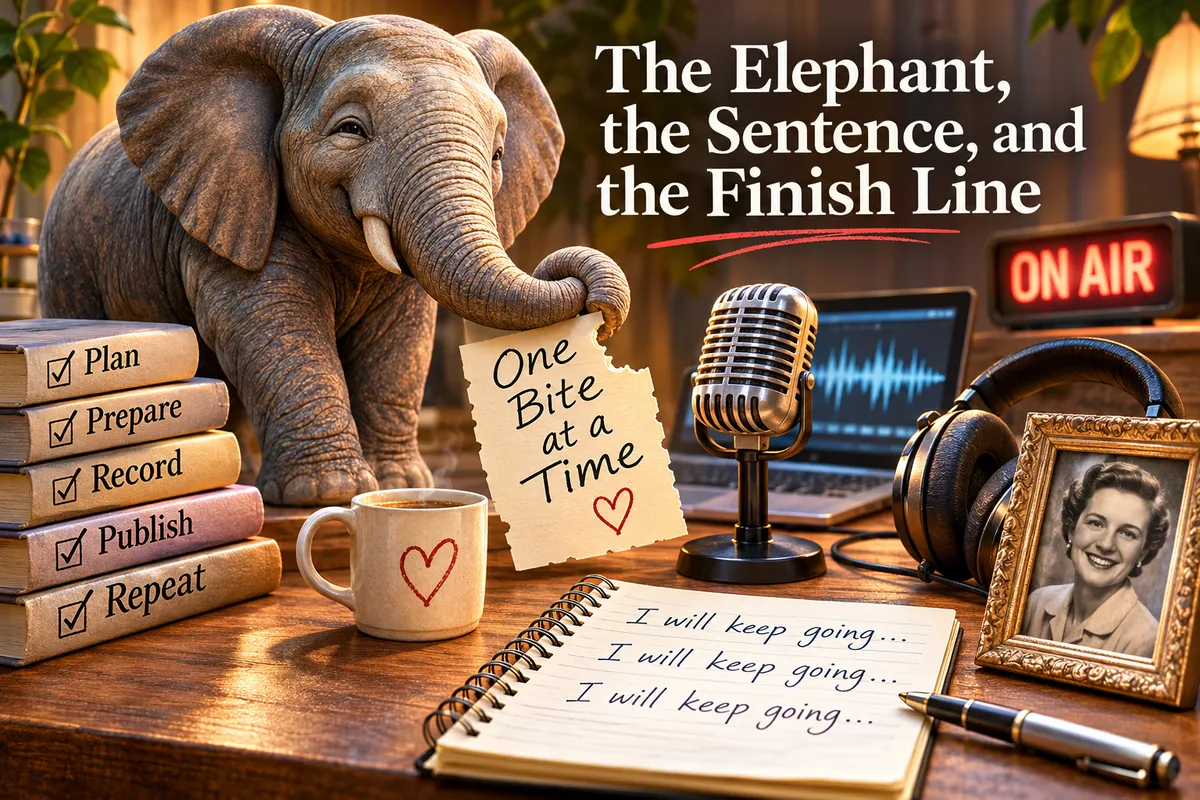
The Elephant, the Sentence, and the Finish Line
The Elephant, the Sentence, and the Finish Line
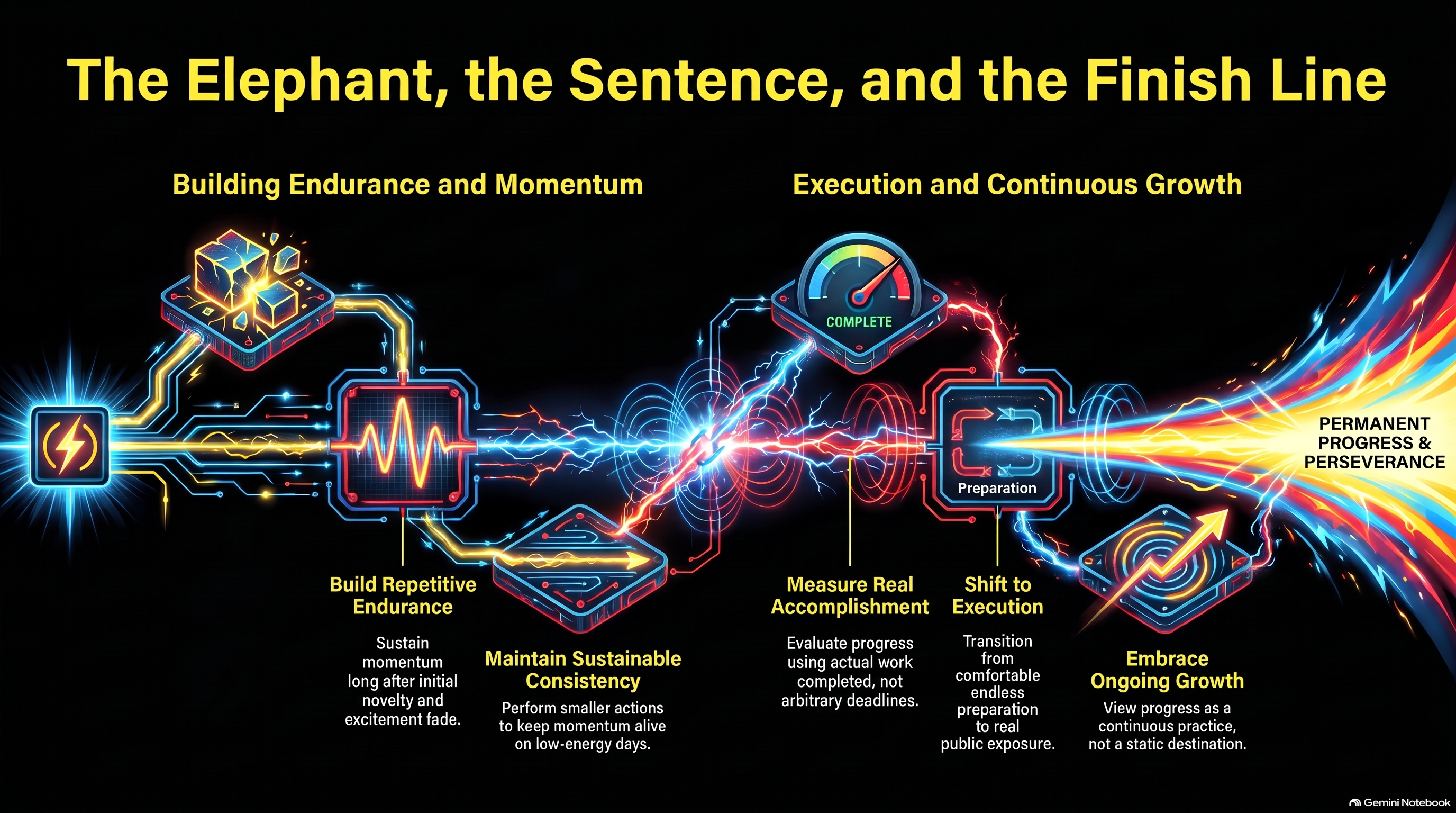
What launching a podcast teaches us about patience, perseverance, and the surprising power of small victories.
Dedicated to Mom, who taught me that even an elephant can be eaten one bite at a time—and that writing sentences can sometimes be the best way to learn how to finish one.
There's a peculiar moment in nearly every ambitious undertaking when you realize that the thing you thought would take a few afternoons has somehow become a three-month project.
You haven't been sitting around doing nothing. Quite the opposite. You've been making decisions, solving problems, learning things you didn't know you needed to learn, and discovering entirely new categories of work that weren't visible when you began.
And yet, somewhere in the back of your mind, a little voice keeps insisting that you should have finished by now.
I have some news for that little voice.
It's terrible at estimating projects.
I tell every client I work with that practically every meaningful goal takes considerably longer than you think it will—or think it should. Not because you're incompetent, undisciplined, or particularly unlucky. It's because meaningful undertakings contain complexities that are almost impossible to appreciate before you begin.
You can plan for the work you know about. It's the work you don't know about that tends to rearrange your calendar.
And that's not necessarily a problem.
The problem begins when you mistake an unrealistic expectation for a reasonable standard of success.
How Do You Eat an Elephant?
My mother had a saying that I heard approximately seventeen thousand times growing up.
"How do you eat an elephant?"
"One bite at a time."
I suspect she wasn't conducting a serious investigation into the dietary habits of elephant enthusiasts. She was trying to teach me something about approaching tasks that seemed too large, too tedious, or too overwhelming to contemplate.
And she was right.
You don't write a novel in one sitting. You don't build a successful business in a weekend. You don't create a worthwhile educational program between breakfast and lunch.
And you certainly don't launch a podcast simply by purchasing a microphone.
Consider what actually goes into producing a podcast.
First, you need to decide who it's for and why anyone should listen. Then you develop the show's identity, choose a format, identify topics, outline episodes, prepare scripts or interview questions, establish a recording process, create artwork, write descriptions, select a publishing approach, and figure out how anyone will discover that the thing exists.
Somewhere in there, you might even get around to speaking into the microphone.
What initially sounded like "I think I'll start a podcast" has become a collection of interconnected projects.
That doesn't mean the idea was bad.
It means you've finally begun to understand what the idea requires.
And every completed piece matters.
The first approved episode outline is a victory. So is the artwork that finally captures the show's personality. So is the recording plan that fits your actual schedule instead of the imaginary schedule of a person who has no other responsibilities.
Those aren't insignificant accomplishments because the podcast hasn't launched yet.
They're the bites that make the elephant manageable.
Sentenced to Write Sentences
My mother had another educational technique that I appreciated considerably less at the time.
When I misbehaved, one of her favorite punishments was making me write the same sentence over and over.
And over.
And over.
In retrospect, there's something delightfully ironic about serving a sentence by writing sentences.
At the time, however, I was less interested in the wordplay and more interested in escaping what seemed like an unreasonable amount of repetitive labor.
But something interesting happened.
I learned that I could finish things I didn't particularly want to do.
Not because I suddenly developed a passion for handwriting the same declaration of improved behavior several hundred times. I didn't. I learned to keep going even when the novelty had disappeared, the excitement was nonexistent, and the finish line seemed offensively far away.
One sentence.
Another sentence.
Another.
Eventually, the page filled up.
Then another page.
And eventually, the assignment was finished.
I doubt Mom was consciously developing my future capacity for long-term entrepreneurship. She probably just wanted me to stop doing whatever had earned me the assignment in the first place.
But the lesson stuck.
Years later, I can recognize how much of what I've accomplished depended on that same capacity: the willingness to continue working on something long after the initial excitement had worn off.
Because here's something we don't discuss enough when celebrating ambitious people.
Most meaningful projects contain stretches that aren't particularly exciting.
There are tedious details, unexpected setbacks, revisions that need revising, and afternoons when you'd rather reorganize your sock drawer than open the project again.
That doesn't mean you've lost your passion.
It means you're doing the work.
The Trouble With Imaginary Finish Lines
One of the easiest ways to turn a rewarding journey into a miserable experience is to become emotionally attached to a deadline you invented before you understood the work.
Suppose you decide to launch a podcast in thirty days.
It's an exciting goal. You've got a name, a few ideas, and an enthusiasm level normally associated with people who have just discovered espresso.
Thirty days later, you've developed an excellent show concept, created a distinctive visual identity, prepared several promising episodes, and discovered that your recording process needs some additional attention.
The podcast isn't live.
Have you failed?
That depends on whether you measure progress against the work you've actually accomplished or against a prediction you made when you knew considerably less.
Of course, deadlines can be useful. Real commitments matter. And some projects genuinely suffer when we allow preparation to continue indefinitely.
But there's an important difference between a deadline that helps organize your efforts and one that becomes a weapon you use against yourself.
The first creates direction.
The second creates discouragement.
Sometimes the right response to a missed deadline is to examine your process, eliminate unnecessary work, and make a firmer commitment.
Other times, it's to recognize that your original estimate was fantasy and adjust accordingly.
The skill lies in knowing the difference.
When the Spark Goes Missing
There's another part of this philosophy that I think deserves more attention.
You won't always feel like working on your goal.
I know. Shocking revelation.
There will be days when you're excited enough to work for hours without noticing the time. Ideas arrive effortlessly. Problems seem fascinating. You finish something substantial and immediately want to begin the next thing.
Wonderful.
Enjoy those days.
But there will also be days when the very same project feels like a chore.
Maybe you're tired. Maybe another responsibility has consumed your attention. Maybe you've been wrestling with the same problem for three days and would prefer not to see its smug little face again.
On those days, I recommend something remarkably simple.
Do a little.
Not necessarily a lot. Not an elaborate productivity ritual. Not a heroic effort to prove that you're sufficiently committed to your dream.
Just something meaningful.
If you're producing a podcast, perhaps you refine the opening of one episode. Maybe you write three interview questions, identify a useful example, or review a paragraph of your show description.
Then, if that's genuinely all you've got today, call it good.
You moved forward.
You kept the project alive.
And you left yourself a slightly better starting point for tomorrow.
There's a difference between abandoning a goal and temporarily reducing the size of your contribution.
Consistency doesn't mean contributing the same amount every day. It means finding a sustainable way to keep returning.
Sometimes you'll take enormous bites.
Sometimes you'll take tiny ones.
The elephant doesn't care.
But Eventually, Turn On the Microphone
Now, there's a complication.
Not every activity that feels like progress actually moves you toward the result you want.
You can spend six months comparing microphones, redesigning podcast cover art, researching hosting services, and refining your introduction until it sounds like the opening ceremony of the Olympic Games.
And never record an episode.
That's not patience.
That's preparation becoming a comfortable substitute for participation.
The distinction matters because my mother's elephant lesson wasn't about endlessly polishing the fork.
It was about eating the elephant.
In podcasting, that means there comes a point when the next meaningful step is no longer another outline, another design variation, or another round of planning.
It's recording.
Then reviewing what you've recorded.
Then making the necessary improvements and getting the episode in front of actual listeners.
The audience is part of the learning process. You cannot completely predict what people will respond to while you're sitting alone in your rehearsal room.
A real listener may love a segment you almost removed. An interview may reveal a topic you never anticipated. A supposedly minor observation may inspire an entire future episode.
Those discoveries become possible only when the work encounters reality.
So yes, celebrate the small steps.
But make sure they're steps toward something.
A little progress is valuable.
A little progress in circles is considerably less so.
A Finish Line That Keeps Moving
Here's where podcasting offers another particularly useful lesson about ambitious undertakings.
The first episode isn't the end of the project. Neither is the tenth.
A successful podcast is generally a continuing relationship with an audience, built through a series of individual promises kept. You prepare an episode, produce it, publish it, and then begin again.
That could sound exhausting if you imagine the goal as one enormous mountain you must somehow conquer before you're allowed to feel successful.
But what if you think of each episode as its own finish line?
Each one represents an idea developed, a challenge overcome, a piece of work completed, and another opportunity to connect with someone who finds your perspective valuable. The larger journey continues, but the individual accomplishments remain real.
And this principle applies well beyond podcasting.
A business doesn't become successful once and then stop requiring attention. A writer doesn't finish a book and permanently retire from the act of writing. A teacher doesn't deliver one excellent lesson and conclude that education has been completed.
Many of our most meaningful goals aren't destinations we arrive at and abandon. They're practices we become better at through continued participation.
The finish line isn't always moving because you're falling behind.
Sometimes it's moving because you're growing.
And that's worth remembering when the work takes longer than expected. There's a remarkable amount of satisfaction available along the way if we stop reserving all our celebrations for the final result.
The moment an idea becomes clear. The first time a difficult piece finally comes together. The problem you can now solve in ten minutes that would have consumed an entire afternoon six months ago. The podcast episode that sounds a little more natural than the previous one. The listener who tells you that something you said made a difference.
These aren't distractions from the destination. They're part of why the destination matters.
Not every delay is beneficial, of course. Sometimes a delay is just a delay, and the sensible response is to fix what's causing it. But treating every additional day as evidence of failure makes the journey unnecessarily difficult, especially when the journey is where so much of the value is created.
I sometimes wonder what my mother would think about how often her little lessons have followed me into adulthood.
The elephant still shows up whenever a project begins to feel impossibly large. And those endless handwritten sentences still remind me that progress doesn't always require excitement, inspiration, or even particularly good handwriting.
Sometimes it just requires doing the next thing.
Then the next.
And allowing the accumulation of those efforts to become something larger than any one of them could have been.
If you're building a business, developing a course, launching a podcast, writing a book, or pursuing something that matters deeply to you, I hope you'll give yourself permission to appreciate the work along the way.
Set ambitious goals. Make sensible plans. Celebrate meaningful milestones. And when the spark temporarily disappears, don't assume the dream has disappeared with it.
Take a smaller bite. Write one more sentence. Prepare one more episode.
Because the wonderful thing about small, meaningful victories is that they accumulate whether or not you feel particularly victorious at the time.
Mom understood that long before I did.
And after all these years, I suspect she'd still have the same advice.
"How do you eat an elephant?"
One bite at a time.
Permanent Progress. Not Permanent Preparation.