
The Idea That Kept on Giving
The Idea That Kept on Giving
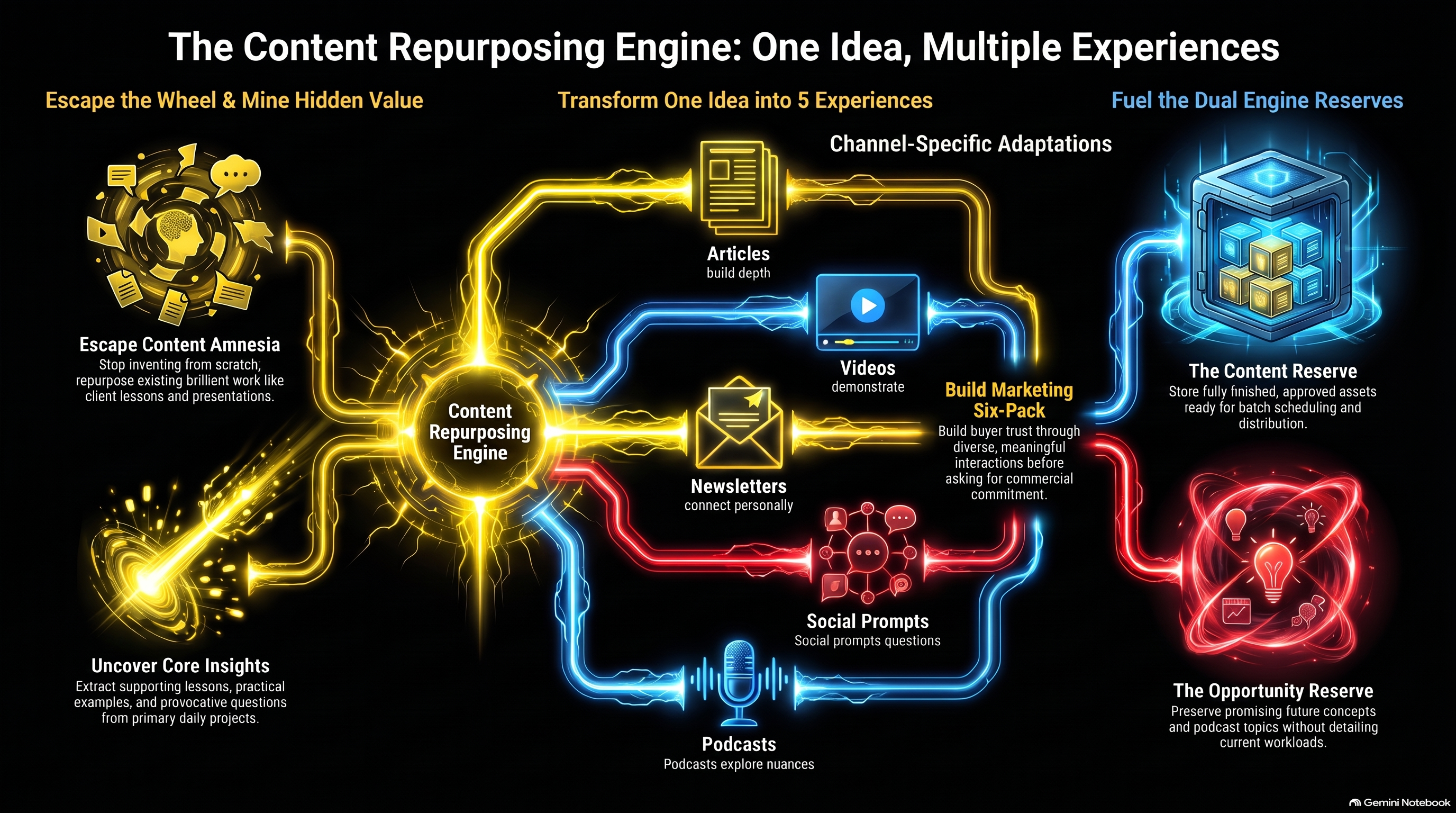
Why your next great piece of content might already be hiding inside the work you've done.
There's a peculiar form of amnesia that seems to afflict business owners whenever it's time to create marketing content.
On Monday, you spend three hours preparing a brilliant presentation. You research the subject, organize your thoughts, wrestle with a few difficult concepts, and finally arrive at an explanation that makes everything click.
On Tuesday, you deliver it. Your audience loves it. Someone even tells you that you've changed the way they think about their business.
By Wednesday, the presentation has disappeared into a folder somewhere, and you're staring at a blank screen wondering what on earth to write about in Friday's newsletter.
Apparently, all that brilliance had a shelf life of approximately twenty-four hours.
And now the social media calendar wants feeding.
Again.
The Content Hamster Wheel
Marketing advice has developed a rather impressive talent for creating work.
You need a blog. You need a newsletter. You need short-form videos, long-form videos, social posts, graphics, podcasts, webinars, downloadable resources, and enough compelling material to make the internet believe you've been awake and interesting every minute of your adult life.
Each channel arrives with its own collection of experts explaining why you're falling behind.
And they're not necessarily wrong about the opportunities. Different people do prefer different ways of encountering information. Some enjoy reading a thoughtful article. Others would rather watch a demonstration, listen to a conversation, or encounter an interesting idea while scrolling through their phones.
The problem begins when we treat each of those experiences as an entirely separate creative obligation.
Need a blog? Invent something.
Need an email? Invent something else.
Need a video? Better find another idea.
It's like running a restaurant where the chef invents an entirely new menu every time a customer walks through the door.
At some point, you have to wonder whether the kitchen might benefit from a little organization.
There's More in That Idea Than You Think
Suppose you're a business coach developing a lesson about pricing.
Your original purpose is straightforward: help your students understand how to set prices that make sense for their customers and their businesses.
But as you develop the lesson, you discover several interesting things.
You notice that business owners often confuse affordability with perceived value. You find a useful example of how different pricing structures change customer expectations. You remember a story about a client who dramatically underestimated the value of their own work.
Then you stumble into a fascinating question: Why do people sometimes trust a more expensive option, even when they don't fully understand what makes it better?
You've just uncovered several worthwhile subjects.
The pricing lesson still needs to be completed. That's the reason you began the work in the first place.
But why should all those additional discoveries disappear when the lesson is finished?
One might become a thoughtful newsletter. Another could make an excellent short video. The client story might inspire a social post. The broader question about perceived value could become a fascinating podcast conversation.
You don't have to produce all of them today.
You don't even have to decide when you'll publish them.
But you've already done much of the thinking.
And that's where the opportunity begins.
One Idea, Several Different Experiences
There's an important distinction between repurposing content and merely copying it.
If you write a two-thousand-word article, divide it into eight pieces, and publish each piece as a social post, you've certainly created more content.
Whether you've created more value is another question.
Good repurposing isn't about making the same message appear everywhere wearing a different hat.
It's about recognizing how an idea can become useful in different circumstances.
An article can develop an argument carefully, allowing the reader to consider its implications.
A video can demonstrate something that would require several paragraphs to explain.
A newsletter can connect the same idea to a personal experience, helping the reader recognize something in their own life.
A social post can introduce a question that invites someone to reconsider an assumption.
A podcast can explore the uncertainties, disagreements, and unexpected directions that make a subject interesting.
The underlying idea remains recognizable, but the experience changes.
Think of a good musician performing the same composition as a piano solo, a jazz arrangement, and an orchestral piece.
The melody survives.
The experience doesn't have to remain identical.
And before someone accuses us of trying to turn every business owner into a one-person media empire, there's another distinction worth making.
You don't need to use every instrument in the orchestra.
The Secret Is to Stop Throwing Away Your Thinking
Most businesses have considerably more intellectual material than they realize.
It's scattered through old presentations, client conversations, training documents, frequently asked questions, workshops, emails, research notes, and lessons learned the expensive way.
Much of it has already been paid for in time, effort, experience, and occasionally a few spectacular mistakes.
Yet when it's time to create new content, we behave as though none of it exists.
We start over.
A more useful approach is to develop two collections.
The first is a reserve of content you've already produced. Articles, scripts, graphics, emails, demonstrations, and other materials that are ready to use or can be prepared for publication when needed.
The second is a reserve of opportunities. Interesting ideas, unanswered questions, potential podcast subjects, workshop concepts, or future educational products that deserve attention someday.
The difference matters.
A finished social post is something you can schedule.
An idea for a podcast is something you might develop later.
Both have value, but they shouldn't be confused with one another.
And neither requires you to abandon whatever you're supposed to be accomplishing today.
Your Marketing Six-Pack
There's a familiar problem in the business world: someone develops an offer, builds a landing page, launches an advertisement, and expects strangers to become enthusiastic customers.
The offer might be excellent.
But what happens when someone becomes curious enough to investigate?
They visit the website. Perhaps there's a brief description of the service, a few promotional promises, and a photograph of the founder looking reassuringly confident with their arms folded.
Then the trail goes cold.
No substantial explanations. No demonstrations. No interesting perspective. Very little that helps a potential customer understand how this business thinks or whether it can genuinely help.
It's rather like showing up for a first date and immediately asking whether the other person is ready to get married.
Maybe we should get to know each other first.
Marketing coaches sometimes circulate formulas suggesting that buyers need a particular number of hours, interactions, or channels before making a purchase. The specific numbers can sound wonderfully scientific, but human beings are not vending machines that dispense trust after the eleventh interaction.
A person buying a sandwich doesn't necessarily need the same reassurance as someone hiring a business advisor.
Still, the underlying principle is worth considering.
People often develop confidence through repeated, meaningful encounters. They discover something useful. They explore a little further. They begin recognizing a perspective, a personality, a level of competence.
Different experiences reveal different dimensions of the business.
That's why developing a substantial body of worthwhile material can be so valuable.
You're building your marketing six-pack before asking the world to admire your physique.
Of course, there's a catch.
You don't have to spend three years in the gym before you're allowed to go on a date.
And you certainly shouldn't spend three years preparing your marketing before allowing a real customer to tell you whether any of it matters.
Build a credible foundation. Begin engaging the market. Learn from the response. Keep improving.
The exercise is supposed to make you stronger, not provide an excuse to hide in the locker room.
The Day You Need Three Months of Content
Now imagine a different situation.
You've spent several months developing educational material, working with customers, writing articles, and documenting what you've learned.
Along the way, you've developed related social posts, email drafts, video scripts, and graphics. You've organized them by subject, audience, and intended purpose.
Some have already been published. Others are waiting patiently for their turn.
One morning, you decide it's time to schedule three months of social content.
Under the old approach, that announcement might trigger a mild panic, followed by a prolonged relationship with a blank calendar and several cups of coffee.
Under the new approach, you begin with an inventory.
You identify the material that's still relevant, choose appropriate topics, review anything that needs updating, and arrange the content into a sensible publication schedule.
There's still work involved. Platform requirements change. Offers evolve. Old claims need checking, and repetition needs managing.
But you're no longer trying to manufacture three months of interesting thoughts from nothing.
You've been collecting them all along.
The same principle applies when you decide to start a podcast.
Instead of sitting down to invent fifty episode subjects, you can explore the ideas that have already emerged from your work.
Perhaps those fifty episodes have been waiting inside the lessons you spent the past year developing.
You just hadn't asked them to introduce themselves yet.
The Work Gets Easier Because the Work Accumulates
There's an interesting economic advantage to this approach.
The first time you investigate a subject, much of the effort goes into understanding it. You gather information, test assumptions, organize ideas, and figure out what you actually want to say.
Once that work has been done, creating additional experiences from the same subject can require considerably less effort.
Not zero effort. A good video still needs to be designed. A good email still needs to be written for its audience. A useful graphic still needs thoughtful visual communication.
But the underlying intellectual investment can support more than one result.
Over time, that changes the economics of content production.
You're no longer paying the full creative cost every time you need another piece of marketing.
You're developing a growing body of work that can be adapted, extended, and revisited.
And with AI helping organize the material, identify promising connections, prepare adaptations, and maintain source references, the process can become substantially more manageable.
AI doesn't eliminate the need for judgment. It makes that judgment easier to apply across a larger collection of possibilities.
You still decide what deserves production, what meets your standards, and what your audience should actually receive.
Because the objective was never to fill the internet with more stuff.
The objective was to make your worthwhile ideas more accessible to the people who might benefit from them.
Give Your Ideas a Longer Life
Some of the best material you'll ever create won't begin as marketing.
It will begin as an answer to a customer's question.
A lesson you're preparing.
A problem you finally figured out how to solve.
A story that helped someone understand something important.
A thought that occurred to you halfway through an entirely different project.
The trick is learning to recognize those moments before they disappear into the next item on your to-do list.
Complete the work you set out to do. Then look for the additional value inside it.
Create the adaptations that make sense. Preserve the possibilities you aren't ready to pursue. Organize what you've produced so you can find it when you need it.
And when the next blank page appears, don't assume you need a brand-new idea.
You may already have a perfectly good one waiting for another opportunity to shine.
One worthwhile idea. Multiple meaningful experiences.
That's not just a better way to produce content.
It's a better way to make your thinking count.