The Magnet Doesn't Create the Pull - Maybe We've Been Thinking About Lead Magnets Backwards
The Magnet Doesn't Create the Pull
Maybe We've Been Thinking About Lead Magnets Backwards
I've been thinking about Lead Magnets lately.
Not because they're new. Quite the opposite. They've been around online marketing long enough that we've mostly stopped thinking about the name.
Make a free thing. Put it behind a form. Someone gives you their email address. Congratulations, you've generated a lead.
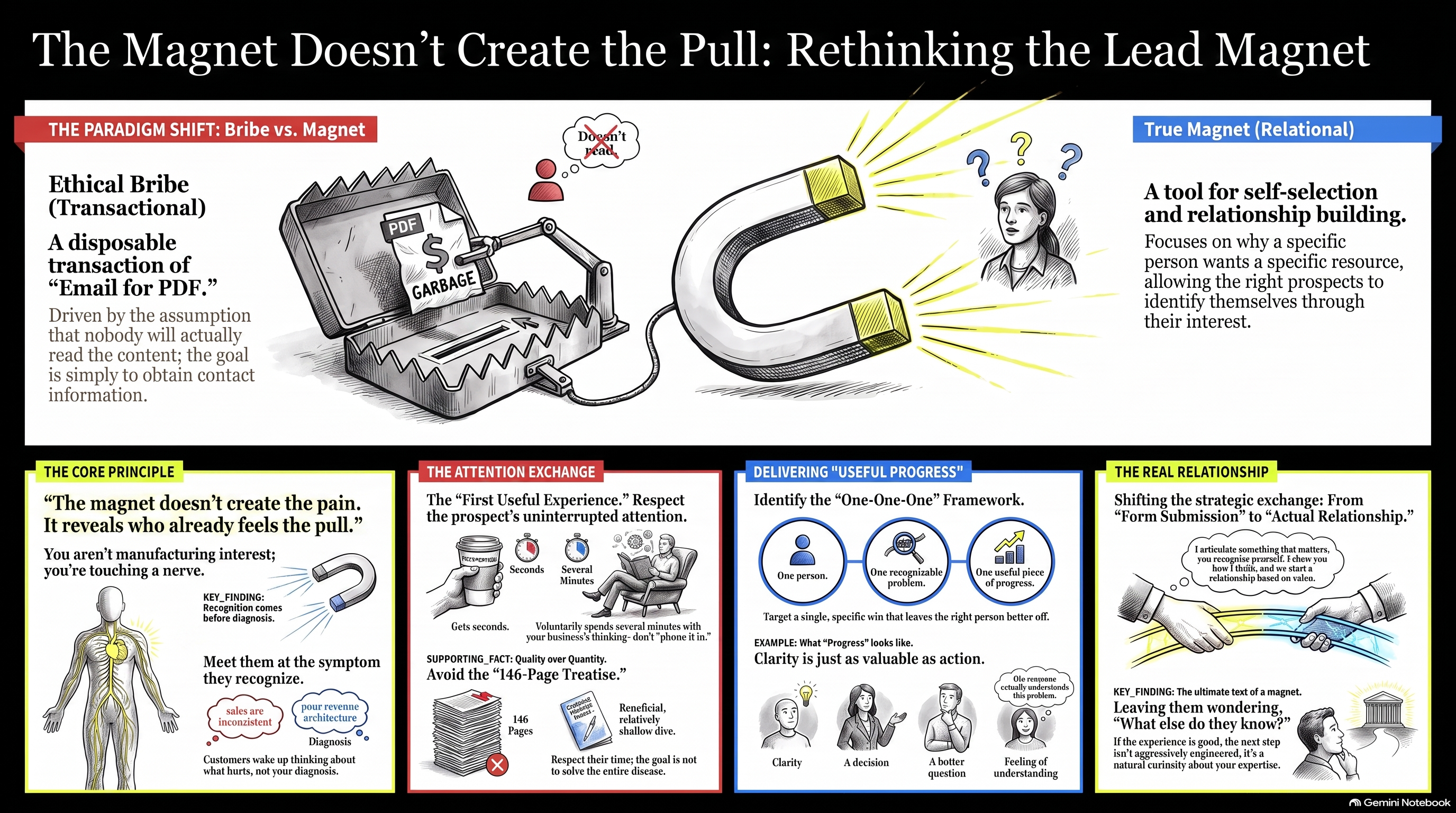
At various points I've even heard the transaction described as an “Ethical Bribe.”
I understand what people mean. You have something they want. They have contact information you want. Everybody agrees to the exchange and nobody has to meet behind a warehouse with an unmarked envelope.
Fair enough.
But the longer I've been working on this stuff, the less interesting the exchange itself seems to me.
The interesting part is why that particular person wanted that particular thing in the first place.
──────── ⚡ ────────
The Magnet Isn't Making Anything Magnetic
Imagine I put something in front of you called:
3 Signs Your Follow-Up Is Costing You Customers
You stop.
Someone else scrolls straight past it.
Why?
Presumably I didn't create your concern about follow-up in the three seconds it took you to read the headline.
Maybe you've been wondering why so many promising conversations disappear, or you already know you're inconsistent about following up but haven't quite decided how much it's costing you. You might even think your real problem is that you need more leads, while something about that headline pokes at a suspicion that the leads you already have aren't getting the attention they should.
You don't necessarily know the diagnosis.
You just recognize the nerve I touched.
And suddenly the word magnet becomes more interesting.
The magnet doesn't create the pain. It reveals who already feels the pull.
That's a very different way to think about a Lead Magnet.
──────── ⚡ ────────
The Person Who Stops Just Told You Something
There's a whole school of marketing advice devoted to figuring out exactly who the customer is—sometimes with enough imaginary detail that somewhere a fictional woman named Susan is probably wondering why we need to know what kind of SUV she drives.
To be fair, demographics, interests, behaviors, search data and all the rest can absolutely be useful.
But there's another kind of customer identification happening when someone says:
Wait. That's a problem I have.
They've just told us something about themselves through their interest.
Not necessarily that they're ready to buy, qualified, or particularly interested in hearing about our calendar link.
Just that something matters.
That's useful information.
And it makes me wonder whether one of the most important jobs of a Lead Magnet isn't actually lead generation.
Maybe it's self-selection.
──────── ⚡ ────────
That's Also Why the Free Thing Can't Be Garbage
This is where the old “Ethical Bribe” framing starts causing trouble for me.
If the purpose is primarily to obtain contact information, then the thing being exchanged only needs to be attractive enough to get the information.
Mission accomplished.
And that's how we ended up with an internet full of PDFs that appear to have been created under the assumption that nobody would ever make the terrible mistake of actually reading them.
I've even heard coaches advise people not to put too much effort into Lead Magnets because nobody is going to read or remember them anyway.
Those coaches may simply be lucky some people don't.
Because think about what just happened. Someone recognized themselves in something you said, became curious enough to ask for more, and now—possibly for the first time—they've voluntarily agreed to spend several uninterrupted minutes with the way your business thinks.
That's not the moment I'd choose to phone it in.
But the answer isn't to panic in the other direction and write the collected works of your professional expertise either.
If someone has an irritating problem, they probably don't need your 146-page definitive treatise on the industry before breakfast.
They need useful progress.
Maybe they come away understanding something they didn't before, identify a mistake they've been making, rule out a solution that wasn't going to help anyway, or finally acquire language for something that's been bothering them for months.
Sometimes the win is simpler than all of that:
Oh. Someone actually understands this problem.
That's not nothing.
In fact, that feeling may be one of the most important things a business can create during a first encounter.
──────── ⚡ ────────
Maybe That's the Real Exchange
The more I think about it, the less I like this version:
You give me your email address. I give you my PDF.
Technically accurate.
Strategically boring.
Because there's a lot more happening around that little transaction.
I articulate something that matters to you. You recognize yourself in it and decide to come a little closer. I get an indication that this particular problem matters to you, and in return for your attention I get an opportunity to show you how I think about it.
If I do my part properly, you leave with something useful.
And now we've had the beginning of an actual relationship rather than merely completing a form submission.
Maybe it goes nowhere.
That's okay too.
You still learned something. I still learned that this particular problem was important enough for you to raise your hand.
And if the experience was good, the next thought doesn't have to be engineered quite so aggressively.
It might simply be:
What else do they know?
──────── ⚡ ────────
That's a Much Better Magnet
None of this means the humble PDF is dead.
It doesn't mean every Lead Magnet needs to become an elaborate production.
And it definitely doesn't mean we need to invent another piece of marketing jargon to replace a perfectly serviceable one.
Actually, I think I like the old name better now.
I just think the metaphor deserves a little more credit.
A magnet doesn't run around convincing random objects to become magnetic. It exerts a pull where the conditions for attraction already exist.
Maybe our job isn't to manufacture interest either.
Maybe it's to understand the people we hope to help well enough to recognize the problem that's already nagging at them, put something genuinely useful in front of it, and see who leans closer.
Which, come to think of it, sounds a lot more like a magnet.
And a lot less like a bribe.