
The Mountain, the Helicopter, and the Summit You Didn't Know You Wanted
The Mountain, the Helicopter, and the Summit You Didn't Know You Wanted
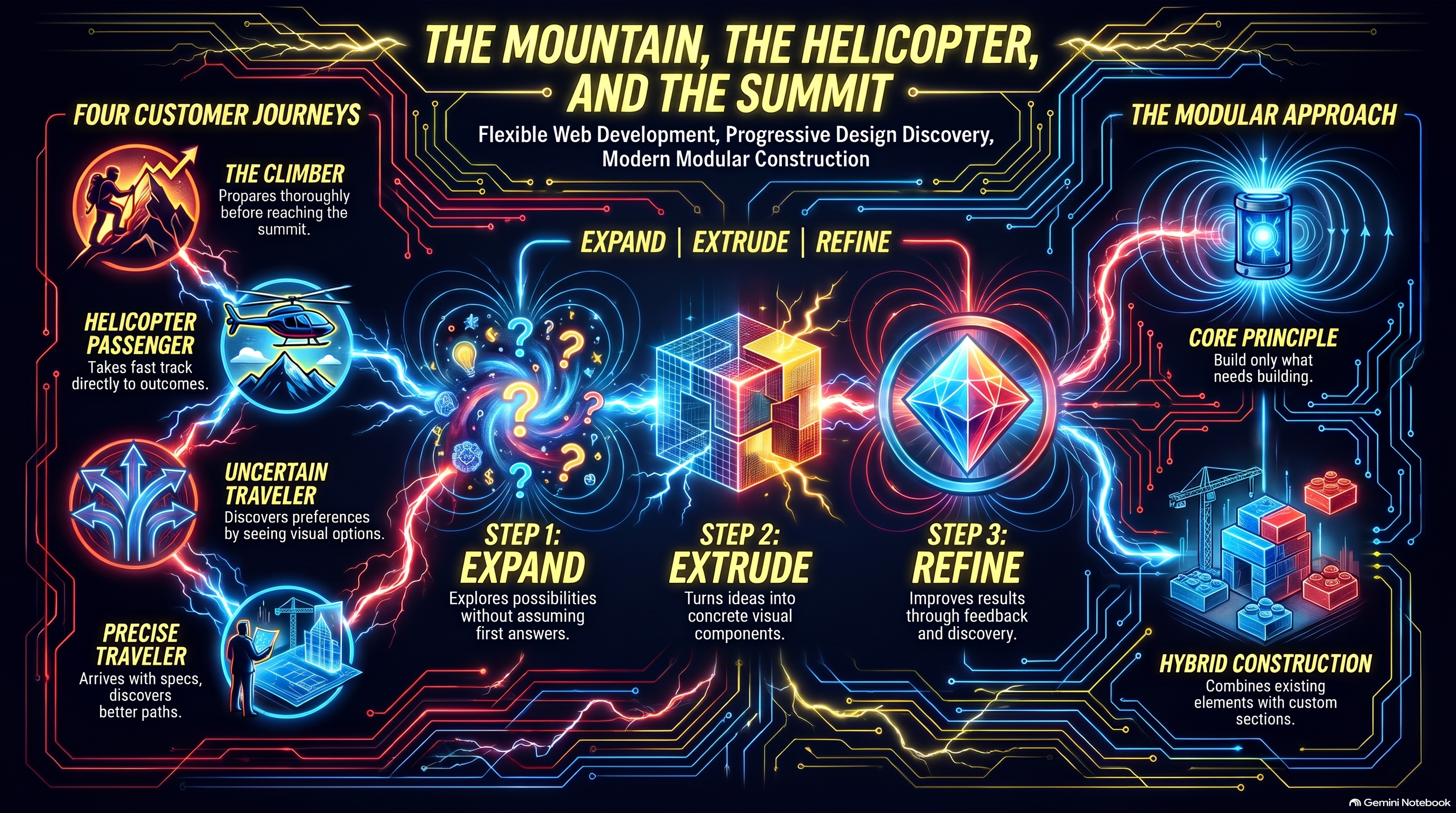
Why building a better website shouldn't require you to know exactly what you want—or follow somebody else's idea of how to get there.
Imagine you've decided to climb a mountain.
You've studied the maps, researched the terrain, bought the equipment, and spent months preparing for the expedition. You've learned about the weather, the wildlife, the geology, and every conceivable obstacle between you and the summit.
By the time you reach the top, you're practically an authority on the mountain.
You're exhausted, exhilarated, and enormously proud of what you've accomplished.
And then, just as you're settling down to enjoy the magnificent view, a helicopter lands beside you.
Out steps a fellow wearing flip-flops, carrying a coffee, and looking mildly disappointed that there's no gift shop.
"Beautiful up here, isn't it?" he says.
You stare at him.
He takes a sip of coffee.
"Want a ride down?"
There are probably a few things you'd like to say to this man. Most of them shouldn't be printed in a respectable business publication.
But here's the uncomfortable truth.
You both reached the summit.
And depending on what each of you wanted from the experience, you might both have made exactly the right decision.
The Trouble With Other People's Mountains
Building a website can feel remarkably similar to climbing a mountain. Especially when somebody else insists there's only one proper way to do it.
Perhaps you've worked with a designer who handed you a twenty-page questionnaire before they'd even discuss what your website might look like.
"What is your brand's emotional positioning within your primary demographic's aspirational identity?"
You were hoping for something with a nice blue background and a button that works.
Or perhaps you've experienced the opposite.
You hired someone, explained what you wanted, and three weeks later received a website that looked absolutely spectacular.
Unfortunately, it looked spectacular for somebody else's business.
Maybe you've encountered a provider who insisted that their proven system required you to follow their exact sequence of steps, regardless of how much you'd already accomplished.
Or perhaps you were the customer with extremely specific instructions.
You wanted the headline moved slightly to the left.
They redesigned the entire page.
You wanted the background a little darker.
They replaced the color palette, changed the typography, and introduced a photograph of a smiling businesswoman pointing at something just outside the frame.
You didn't ask for the businesswoman.
Nobody knows what she's pointing at.
She's been appearing on websites since 2007.
And now she's on yours.
These experiences share a common frustration: the process you're being asked to follow doesn't match the way you think, communicate, or make decisions.
Sometimes the provider is the problem. Sometimes expectations were never properly established. Sometimes nobody involved had a clear picture of what success was supposed to look like.
But there's another possibility worth exploring.
What if the process itself is too rigid to accommodate the people using it?
Some People Want the Climb. Others Want the Helicopter.
There are business owners who genuinely enjoy the journey of building something.
They want to understand their customers, refine their offers, explore their messaging, and think carefully about how every part of their business fits together.
They appreciate the preparation because the preparation changes how they see the destination.
For them, climbing the mountain is part of the reward.
Other business owners have a different perspective.
They already have a business. They have customers to serve, employees to manage, bills to pay, and seventeen things demanding their attention before lunch.
They don't particularly want to become experts in website architecture, marketing psychology, or the finer points of conversion optimization.
They want a better website.
Preferably before lunch.
And there's nothing inherently wrong with that.
The problem arises when we assume that one person's preferred journey should become everybody else's mandatory itinerary.
A comprehensive business development process can be enormously valuable. But making every participant complete every stage before they're allowed to produce anything useful can turn preparation into a rather elaborate obstacle course.
On the other hand, rushing straight to production without understanding the business can produce something beautiful, functional, and completely inappropriate.
So which approach is right?
The mountain or the helicopter?
Perhaps we've been asking the wrong question.
What if the better approach is to let people begin where they are, while giving them the freedom to explore as much of the mountain as they need?
There's Another Passenger We Haven't Met Yet
Our helicopter pilot has picked up another customer.
This passenger isn't particularly interested in climbing mountains. In fact, they're not entirely sure which mountain they want to visit.
They've seen some photographs. They've heard good things about the scenery. They have a vague impression that somewhere up there is a view they'll enjoy.
"Where would you like to go?" asks the pilot.
"Somewhere amazing."
"Any particular mountain?"
"Not really."
"What kind of scenery do you prefer?"
"I'll know it when I see it."
Anyone who's ever worked in a creative profession is probably experiencing a small involuntary twitch right now.
But this passenger represents an enormous number of perfectly reasonable customers.
They aren't necessarily indecisive. They simply lack the experience, vocabulary, or visual references to describe something they haven't encountered yet.
They may know exactly how they want to feel about the finished result without having the slightest idea what that result should look like.
And here's where things become interesting.
Instead of demanding a precise destination, our pilot offers a short tour.
They fly past rugged peaks, green valleys, snowy ridges, and a spectacular lake surrounded by forests.
The passenger points excitedly.
"THAT! That's what I want!"
The pilot smiles.
"Funny. You said you wanted a mountain."
"Well, yes, but I didn't know THAT was an option!"
And suddenly, the customer who couldn't explain what they wanted has become the customer who knows exactly what they want.
Nothing magical happened.
They simply encountered a possibility they hadn't previously been able to imagine.
Knowing What You Want Isn't Always the Same as Knowing What's Possible
There's a fourth passenger, too.
This one arrives with coordinates.
They know the destination, the altitude, the direction of approach, and precisely where they'd like the helicopter to land.
Wonderful. There's no reason to subject this person to a lengthy questionnaire about their favorite mountains.
But halfway through the flight, they notice something unexpected.
A beautiful plateau sits just beyond the ridge. There's a waterfall, a sheltered valley, and a view of three mountain ranges.
"What's that place?"
"Another landing option."
"Could we go there instead?"
"Of course."
And just like that, someone who knew exactly what they wanted discovers something they want even more.
This isn't a failure of planning. It's the natural consequence of learning.
Our preferences aren't always fixed objects waiting patiently inside our heads to be extracted through sufficiently clever questioning.
Sometimes preferences emerge through experience.
We see something. We compare it with what we imagined. We recognize what appeals to us, what doesn't, and what we hadn't considered.
We become better at choosing because we've encountered something worth choosing between.
This has enormous implications for building websites, developing marketing strategies, and working with artificial intelligence.
A good creative process shouldn't merely collect decisions. It should help people become better equipped to make them.
What If Your Website Could Be Discovered Instead of Merely Specified?
Think about how websites are often commissioned.
The customer describes what they want. The provider interprets the description. A design is produced. The customer reacts. Revisions follow.
Sometimes this works beautifully.
Other times, the customer spends weeks trying to translate an impression into instructions, while the provider tries to translate those instructions into a design.
Both parties may be competent, well-intentioned, and increasingly frustrated.
Now imagine a different approach.
Instead of requiring the owner to describe every detail before anything can be produced, the process begins with what they already know.
Perhaps they have a clear vision. Great. Start there.
Perhaps they have an existing website with three excellent sections and four dreadful ones. Keep the excellent sections and work on the dreadful ones.
Perhaps they have a brand, an offer, and a marketing plan already developed. Use them.
Perhaps they have nothing more than a business name, a general idea, and a strong desire to stop looking at their current homepage.
That's a legitimate starting point, too.
The process can then expand the possibilities, produce tangible options, and refine the results based on what the owner discovers.
We call this Expand → Extrude → Refine.
Expand explores the relevant possibilities without assuming the first answer is the only answer.
Extrude turns those possibilities into something concrete enough to evaluate: a page structure, a visual direction, a headline, a website section, or an entire customer journey.
Refine improves the result through feedback, new discoveries, and increasingly informed decisions.
The process doesn't require the owner to possess a designer's vocabulary or a marketer's expertise before beginning.
Nor does it force an experienced owner to pretend they don't already know what they want.
And critically, it doesn't assume that today's decisions must remain tomorrow's decisions.
The goal isn't to keep people endlessly exploring.
It's to help them make meaningful progress while preserving their ability to change direction.
You Don't Have to Demolish the House to Paint the Kitchen
There's another problem with conventional website production, especially when AI enters the picture.
Sometimes you ask for one small change and get an entirely new creation.
You love the header. You love the testimonial section. You love the appointment calendar.
You'd just like a more interesting presentation of your services.
But the proposed solution is to regenerate the entire page.
That's rather like hiring someone to repaint your kitchen and returning home to discover they've replaced the house.
Admittedly, the new house has a lovely kitchen.
Unfortunately, your furniture doesn't fit, the front door is now on the second floor, and nobody knows where the dog went.
A more useful approach is modular.
Preserve what works. Improve what doesn't. Build new elements where they're needed.
For websites built in GoHighLevel, this can mean combining existing visual-builder sections with selectively developed custom elements, rather than treating every page as an all-or-nothing construction project.
AI can help design and produce those elements, while the owner retains control over the broader result.
There are technical considerations, of course. Custom elements need to work with the surrounding page, behave properly on different devices, and preserve the functionality visitors depend on.
But those are implementation challenges, not reasons to abandon the principle.
Don't regenerate what already works. Build only what needs building.
That approach respects both the owner's existing investment and the discoveries that emerge during development.
The Website Is Only the View From One Summit
Here's where our mountain story becomes much larger than website design.
A website doesn't exist in isolation.
It represents a business. It communicates with an audience. It presents offers, creates expectations, invites action, and often serves as the gateway to an entire customer relationship.
Someone who begins by wanting a prettier homepage may discover that the real problem isn't the homepage at all.
Perhaps their offer is confusing.
Perhaps visitors don't understand who the business serves.
Perhaps there's no meaningful next step after someone expresses interest.
Perhaps the website attracts attention but doesn't connect that attention to a useful marketing process.
A better website might help. But a better understanding of the business could help much more.
And this is where the distinction between the mountain and the helicopter becomes particularly valuable.
The person who takes the long journey can arrive with a carefully developed understanding of their audience, offers, brand, messaging, and marketing strategy.
Their website becomes an expression of that accumulated knowledge.
The person who takes the helicopter can begin with the website and discover those same questions as they become relevant.
They might realize they need to clarify an offer, create a lead magnet, develop an email sequence, or rethink the journey from first contact to customer.
They can explore those areas without having to abandon the progress they've already made.
Neither approach eliminates the need for good decisions.
The shortcut skips prerequisites. It doesn't eliminate discovery.
And the longer journey doesn't guarantee perfection, either. Even the best-prepared climber may discover something unexpected at the summit.
The important thing is that the system can support both.
A Business Brain That Learns With You
This is the philosophy behind the Business Brain Builder.
Rather than treating every business owner as someone who must complete the same sequence of instructions, the system is designed to develop and use an increasingly useful understanding of the business.
Its broader journey explores the foundations of the business, its customers, its offers, its brand, its marketing, and the many ways those elements work together.
But its website-building process also allows an owner to begin directly with the outcome they need, using the information already available and discovering missing pieces along the way.
The owner can be deeply involved, selectively involved, or ask AI to propose directions and do much of the initial creative work.
They can be particular about every detail or ask to see possibilities before deciding.
They can approve individual sections, entire pages, or broader design directions as appropriate.
And when it's time to turn those decisions into working technology, the Powerful Progress Program provides the companion implementation guidance for GoHighLevel.
The objective isn't to replace the owner's judgment with AI.
It's to give that judgment better material to work with.
An owner who knows precisely what they want should be heard.
An owner who doesn't yet know should be helped to discover it.
And an owner who changes their mind after seeing a better possibility should be allowed to grow.
The resulting website isn't simply something a system produced.
It's something the business owner can recognize as an increasingly accurate expression of what they're trying to accomplish.
The Summit Was Never the Whole Point
Let's return to our original mountain.
The climber has earned a remarkable understanding of the journey.
The helicopter passenger has saved considerable time.
The uncertain traveler has discovered a destination they couldn't have described beforehand.
And the passenger with the precise coordinates has discovered that an even better destination was waiting just beyond the ridge.
Four people. Four different experiences.
None needed to be forced into somebody else's preferred way of traveling.
And perhaps that's the lesson worth carrying into our businesses.
We spend an extraordinary amount of time trying to make people fit our processes.
We ask them to communicate in our language, make decisions in our preferred sequence, and commit to outcomes before they've had enough experience to understand the alternatives.
Then we're surprised when they become frustrated.
What if we reversed that relationship?
What if the process adapted to the person, rather than insisting the person adapt to the process?
What if we stopped assuming that everyone needs the same preparation, the same amount of guidance, or the same degree of creative control?
And what if we recognized that the ability to change your mind isn't necessarily a weakness in the customer?
Sometimes it's evidence that the process is working.
A good system doesn't need to know every answer before it begins.
It needs a reliable way to discover better answers, turn them into useful results, and keep improving those results as understanding grows.
That's true of websites.
It's true of marketing.
And it's true of building a business worth building.
So whether you're the climber with the detailed map, the passenger with the coffee, or the person pointing excitedly out the helicopter window at a mountain nobody mentioned in the brochure, there's a path forward.
You don't have to know exactly where you're going to begin making meaningful progress.
And you shouldn't have to surrender the freedom to discover somewhere better along the way.
After all, the purpose of reaching the summit isn't to prove that you followed the correct route.
It's to discover what becomes possible when you finally get there.
Permanent Progress. Not Permanent Preparation.
About the Business Brain Builder
The Business Brain Builder from Magnetix Marketing is an AI-guided system designed to help business owners discover, develop, and express the foundations of their businesses—from audience and offer development to branding, websites, funnels, content, and marketing strategy. Its progressive discovery approach accommodates both comprehensive business development and more direct, outcome-focused starting points, with practical GoHighLevel implementation supported through the Powerful Progress Program.