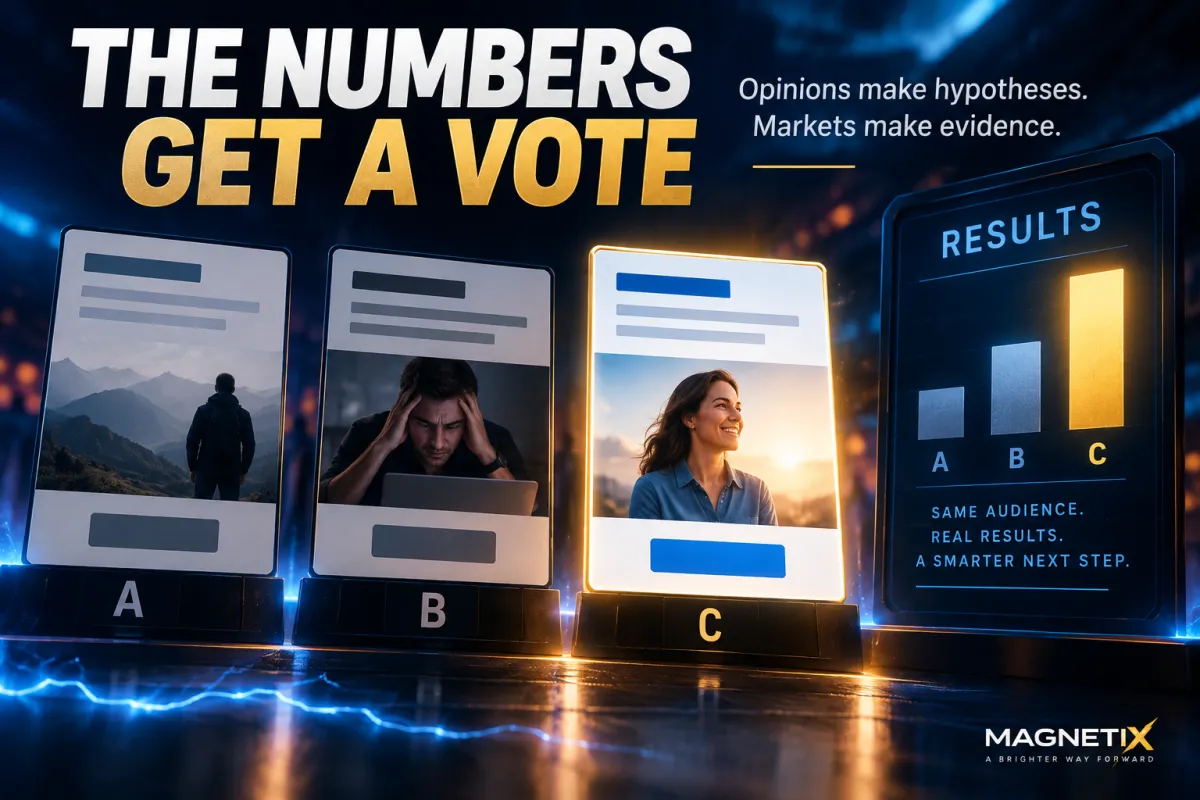
The Numbers Get a Vote | Smarter Advertising Through Testing
The Numbers Get a Vote
Years ago, a former employer asked me something I've never really forgotten.
“What did we spend most of our time in the business doing?”
He wasn't really asking. He was lamenting.
The answer was figuring out the ads.
We'd spent plenty of time on sales training. We worked on the funnel. We worked on the offer. There were all the normal moving pieces you'd expect.
But the ads?
Those things consumed an astonishing amount of attention.
Which image worked? Which opening line worked? Was the problem the copy or the creative? Why did something we were certain would work fall flat while another idea suddenly took off?
Eventually, you figure things out.
Then the market changes. The creative gets tired. You introduce another offer or try to reach a different kind of customer.
And there you are again.
Figuring out the ads.
──────── ⚡ ────────
I've been thinking about that experience again because AI has changed one side of this equation dramatically.
What once made experimentation expensive in time can now be produced at a scale that would have been ridiculous for us back then.
I can generate fifteen Hooks in the time it once took to labor over a handful.
I can give AI the advertising formula I've used successfully for years and have it write surprisingly good copy from it. Then I can give another AI conversation the same information, deliberately withhold the formula and say, “Okay. You think you know better? Show me.”
That's a range of credible hypotheses I couldn't have produced nearly as quickly or cheaply before.
The funny part is that AI can also explain, in exquisite detail, why its favorite version is obviously the best one.
It can score the alternatives. Critique them. Tell me which psychological principles each one employs.
It can probably produce a twelve-column comparison table if I make the mistake of asking.
But then I spend the money.
And sometimes the beautiful theory gets its ass kicked.
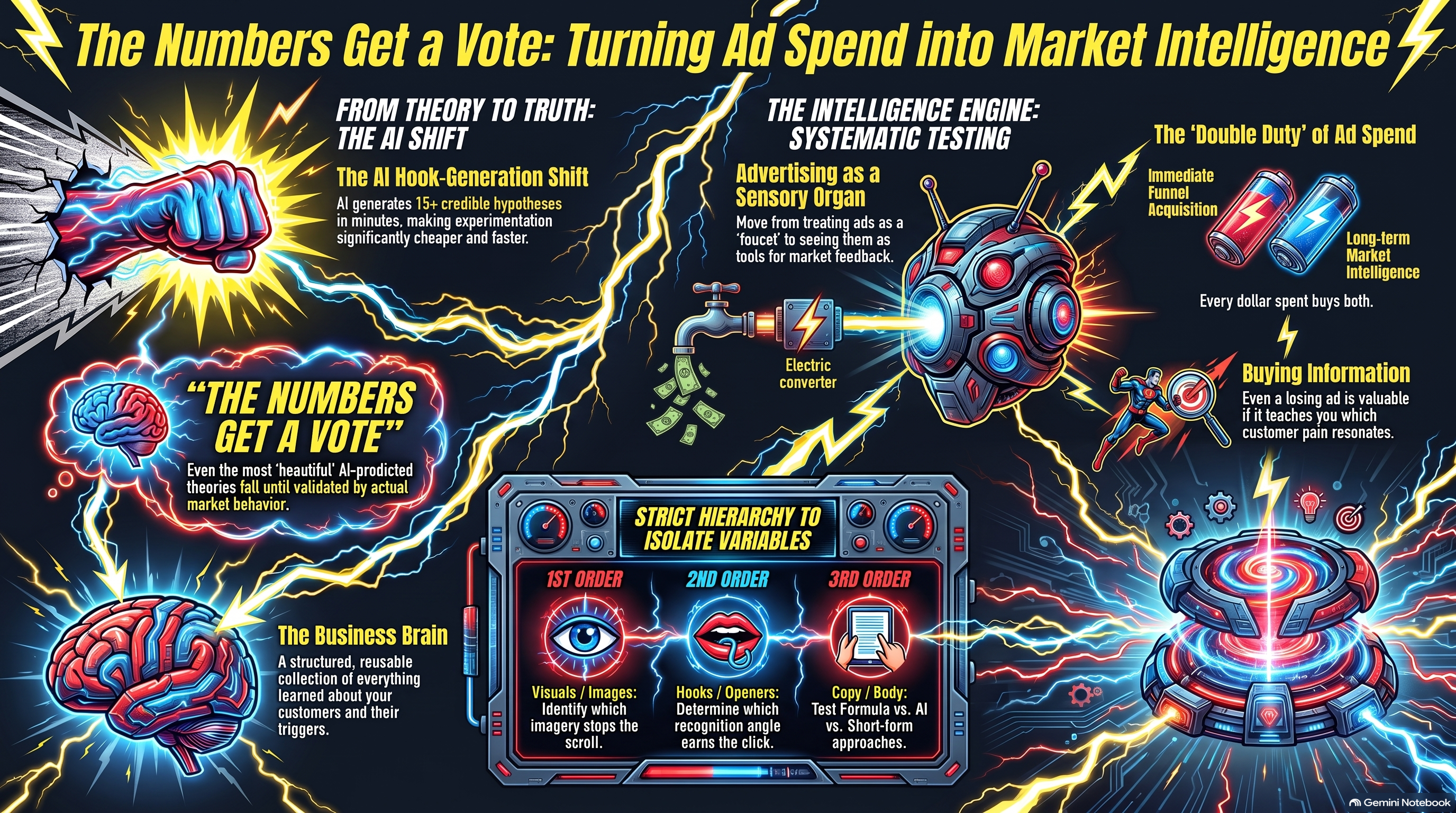
Because eventually, the numbers get a vote.
──────── ⚡ ────────
There's a difference between creating a lot of ads and running an experiment.
Suppose I create two advertisements.
The first has one image, one Hook and one body of copy.
The second has a different image, different Hook and different body copy.
The second one wins.
Great.
Why?
I have absolutely no idea.
Maybe the picture did it. Maybe the Hook did it. Maybe the copy did it. Maybe one of those was terrible and another was strong enough to drag it across the finish line anyway.
I found a winner, perhaps, but I didn't necessarily learn very much.
That's why the approach I've used over the years became more systematic.
Test the images. Learn something.
Hold the winner steady and test the Hooks. Learn something else.
Then test the larger copy approaches.
You still don't know what's going to win before you run the experiment. That's rather the point.
What you can do is make sure every contestant deserves to be in the race and structure the race so its outcome teaches you something.
──────── ⚡ ────────
That's where building what I've come to call the Business Brain—a structured, reusable collection of what we've learned about the business, its customers and how it communicates—has made me reconsider my old employer's question.
Maybe the tragedy wasn't that we spent so much time figuring out the ads.
Maybe it was that we weren't systematically preserving everything the ads had taught us.
Because an advertising campaign isn't only sending prospects into a funnel.
It's sending information back.
The image somebody stops for tells us something.
The Hook they click tells us something else.
Whether they opt in adds another piece.
Whether that lead goes anywhere afterward puts all the earlier numbers into better context.
Suddenly the advertising system starts looking less like a faucet we're desperately trying to turn on and more like one of the business's sensory organs.
We're putting something into the world. The market reacts. We observe the reaction.
Then we get to know something we didn't know before.
──────── ⚡ ────────
That's where I think AI gets much more interesting than simply “AI can write ads now.”
Sure it can.
What I'm more interested in is whether we can use AI and the Business Brain to systematically train ourselves on the market.
Suppose repeated tests show that customers respond much more strongly when we talk about losing control than when we talk about saving time.
That's useful beyond the winning advertisement.
Maybe we've learned something about the customer.
Suppose an image showing somebody frustrated by the problem consistently beats the beautiful aspirational image of somebody who has already solved it.
That's not merely an image-selection decision anymore.
It's another clue.
And if we've preserved those clues, the next time the campaign needs refreshing—or we want to approach a different customer—we aren't starting over.
We have ammunition for the next hypothesis.
Eventually, even a losing advertisement may have bought us something.
It bought information.
──────── ⚡ ────────
That changes my perspective on all those years spent “figuring out the ads.”
I don't expect we'll ever finish figuring them out.
I'm not sure we'd want to.
Markets move. Businesses change. Customers surprise us. Competitors change the environment. Something that worked wonderfully eventually stops working.
But perhaps we can stop paying quite so often to learn the same lesson twice.
Advertising spend is normally treated as the price we pay to acquire attention, leads and customers. Once the campaign ends, the money is gone.
But if the experiment was constructed so that we actually learned from it, something can remain.
We bought acquisition. We also bought market intelligence.
The first return feeds the funnel.
The second can make the next campaign smarter.
That's the double duty I'm becoming much more interested in.
AI can make the hypotheses dramatically cheaper to create. A Business Brain can give us somewhere to preserve what we learn. And a properly constructed experiment can make the money we're already spending on advertising do both jobs.
Have an opinion. Build a hypothesis. Make your best prediction.
Then let the numbers get a vote.