The Ones That Weren’t Ready
The Ones That Weren’t Ready

When I was in college, I became fascinated by a worldview very different from the one I had grown up around.
A girl I cared very deeply about had been raised with a strong connection to her family’s Native American cultural and spiritual traditions. Her mother had passed much of that understanding on to her, and eventually I asked if her mother would be willing to teach me something of it too.
She agreed, though not casually. I understood even then that there were things here that deserved respect, and I was told to bring tobacco as part of asking her to teach me.
So I did.
What I wasn't expecting was for my spiritual education to begin with yard work.
Behind their home was a fenced-off section of ground about the size of a trailer lot. They were preparing it as a corral for a horse they planned to get. The property was fairly wooded, and inside the fence were saplings, young pines, brush and all the miscellaneous things that grow when nobody has yet informed the forest that this particular patch has other plans.
My assignment was to clear it by hand. No shovel.
I was young, in decent shape and preparing to go into the Army, so part of me figured the work couldn't hurt. Another part of me was beginning to wonder whether I had just discovered an extraordinarily elaborate method of obtaining free landscaping.
But there were instructions, and those instructions changed the nature of the work.
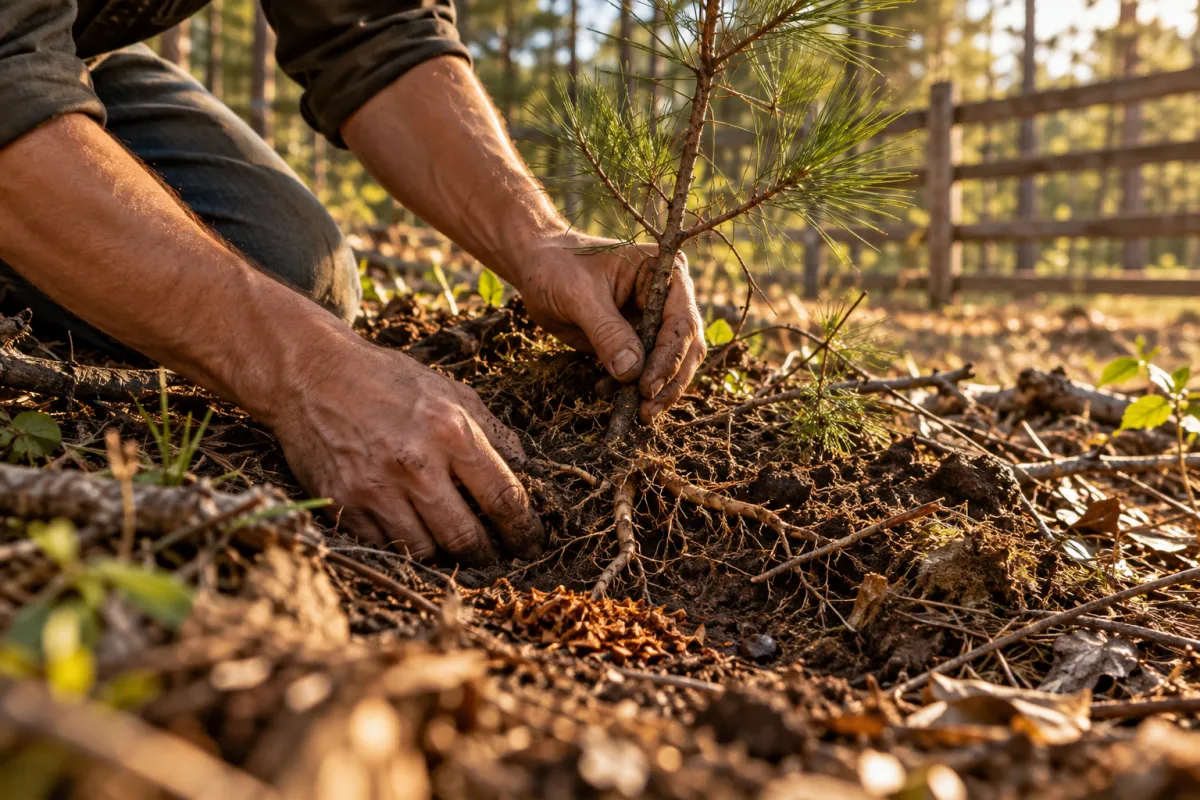
When I pulled a plant from the ground, I was to acknowledge what I was taking. I would thank it and leave some tobacco in its place. The practice slowed everything down and made it very difficult to treat clearing the ground as simply destroying whatever happened to be in my way.
Then I encountered the plants that wouldn't come out.
I could pull, work around the roots and expose more of them, but while some gave way fairly easily, others seemed absolutely determined that this was where they lived and I could kindly make other arrangements for the horse. The instruction wasn't to overpower those. If one wasn't ready to come free, I worked around its roots as much as I reasonably could, left some tobacco there, acknowledged its resistance and moved on.
I'd come back later.
Eventually I made my way around the entire corral and started another pass. That's when something happened that I still remember remarkably well.
Some of the plants I'd fought with earlier came free.
I don't know exactly why. Maybe exposing more of their roots had weakened their hold. Maybe I was getting better at what I was doing. Maybe after hours of pulling plants I had learned something about leverage without realizing it. The experience was being given to me within a spiritual understanding as well, and I don't feel any particular need either to explain that away or to claim an explanation for something I can't prove.
I only know what I experienced.
Some weren't ready the first time. I left them alone and came back. Some were ready then, while others still weren't, so I worked a little further, showed the same respect and made another pass later.
Before the week was over, that entire patch of ground had been cleared by hand.
It took me years to realize I was still walking around that corral.
──────── ⚡ ────────
Later, I spent quite a bit of time working in telemarketing and call centers, which turned out to be a different sort of landscaping.
One thing I noticed was how quickly a good lead could become a “bad lead” in someone's mind when the Customer didn't buy. We called. They were interested. We explained the offer. They didn't buy. On to the next one.
I had a hard time seeing it that way.
If somebody genuinely wasn't a fit, that was one thing. If they clearly didn't want further contact, that deserved to be respected too. But sometimes there was still legitimate interest and the person simply wasn't ready to act on it yet.
So I'd come back.
Maybe we'd schedule another conversation a month later. Circumstances might change. Something that hadn't made sense before might finally click, or the concern that seemed enormous during the first conversation wouldn't seem nearly as important during the next one. If the interest was still there but the timing still wasn't, there was often nothing wrong with leaving the relationship in good condition and coming around again when appropriate.
In call centers where I stayed long enough to watch that process unfold over many months, I saw people who had seemed like lost opportunities eventually become Customers. Not everybody did, of course, and this wasn't some clever strategy for wearing people down until they surrendered.
It was simply an understanding that “not now” and “never” are not the same answer.
Somewhere along the way, without consciously deciding to do it, I had started selling the way I'd cleared that corral.
There's an enormous amount of sales training devoted to overcoming resistance. Find the objection, isolate it, answer it and close again. There can certainly be value in helping someone examine a concern. If you genuinely believe the solution is right for them, giving up at the first sign of hesitation isn't necessarily serving them particularly well either.
But there is a lot of room between immediately surrendering and relentlessly pushing.
Resistance can tell you something.
Maybe the Customer doesn't understand something yet. Maybe they don't trust something yet. Maybe the timing really is terrible, another decision maker needs to be involved, or the financial risk feels too large right now. Maybe they want the result but are afraid of what implementation will demand from them.
Or perhaps the resistance is telling you something you don't particularly want to hear: this really isn't right for them.
The point isn't that every resistance can eventually be overcome. The point is that resistance itself contains information, and understanding what it means gives you a much better idea of what should happen next.
Sometimes that means continuing the conversation. Sometimes it means another conversation later.
And sometimes it means letting the plant stay in the ground.
──────── ⚡ ────────
I've been thinking about that experience again while working on the Business Brain Builder because we've spent so much time considering what a business should know before it communicates with a Customer.
Who are we trying to help? What are they trying to change? What's getting in their way? What do we actually offer, and why might it matter to them? What evidence do we legitimately have that gives them reason to believe us?
That's all useful intelligence to bring into a conversation.
Lately, though, I've become just as interested in what comes back out.
The Customer knows things we don't. They know why the explanation we thought was perfectly clear wasn't clear to them. They know which concern mattered more than the one we expected, the words they naturally use for a problem we've been describing in marketing language, and what finally made the value recognizable to them.
They know why they bought.
And when they don't buy, there's potentially something to learn there too.
That doesn't mean Bob doesn't buy on Tuesday afternoon and by Wednesday morning we've rewritten our entire understanding of the Customer. Maybe Bob is unusual. Maybe we misunderstood him. Maybe Bob hadn't eaten lunch.
A business can make itself every bit as foolish by reacting to every individual Customer comment as it can by ignoring Customers altogether.
But then somebody else says something similar. Three weeks later, you hear a variation of it again. Another Customer uses almost exactly the same phrase. Something you initially dismissed as peculiar begins to look less peculiar.
Eventually you realize you've walked past this particular plant several times.
Now there's something worth examining.
Maybe your understanding of the Customer is wrong. Maybe it isn't wrong at all but is incomplete. Maybe you've discovered a variation you hadn't accounted for. Perhaps an objection you thought was about price is actually about implementation, or Customers consistently value something you considered secondary. Maybe the explanation you're proudest of simply isn't connecting.
You don't have to rewrite what you know every time somebody says something unexpected, but you probably shouldn't throw the unexpected thing away either.
Capture broadly enough to learn. Promote selectively enough to trust.
That's the balance I've been trying to find.
──────── ⚡ ────────
When I first walked into that corral, I thought I had asked someone to teach me something profound and had somehow ended up doing manual labor instead. Gradually, I realized the manual labor was part of the lesson.
I didn't leave there thinking I'd just learned something about sales. I certainly didn't imagine that decades later I'd be sitting at a computer thinking about Customer follow-up, sales conversations and how businesses accumulate intelligence.
That's one of the funny things about useful knowledge. Life doesn't always label it according to where you're eventually going to use it.
What stayed with me was something much simpler.
Resistance doesn't always require force, and it doesn't always require abandonment.
Sometimes you learn a little more about what's holding on. Sometimes you leave things in good condition and give them time. Sometimes you come around again. And sometimes, after enough trips around the corral, you begin noticing patterns that teach you something you hadn't known before.
So after the next sales conversation, the obvious question still matters:
Did we get the sale?
But I'm beginning to think there's another one worth asking before we move on.
What did we learn that we shouldn't forget?