
The Question That Almost Lost the Sale
The Question That Almost Lost the Sale
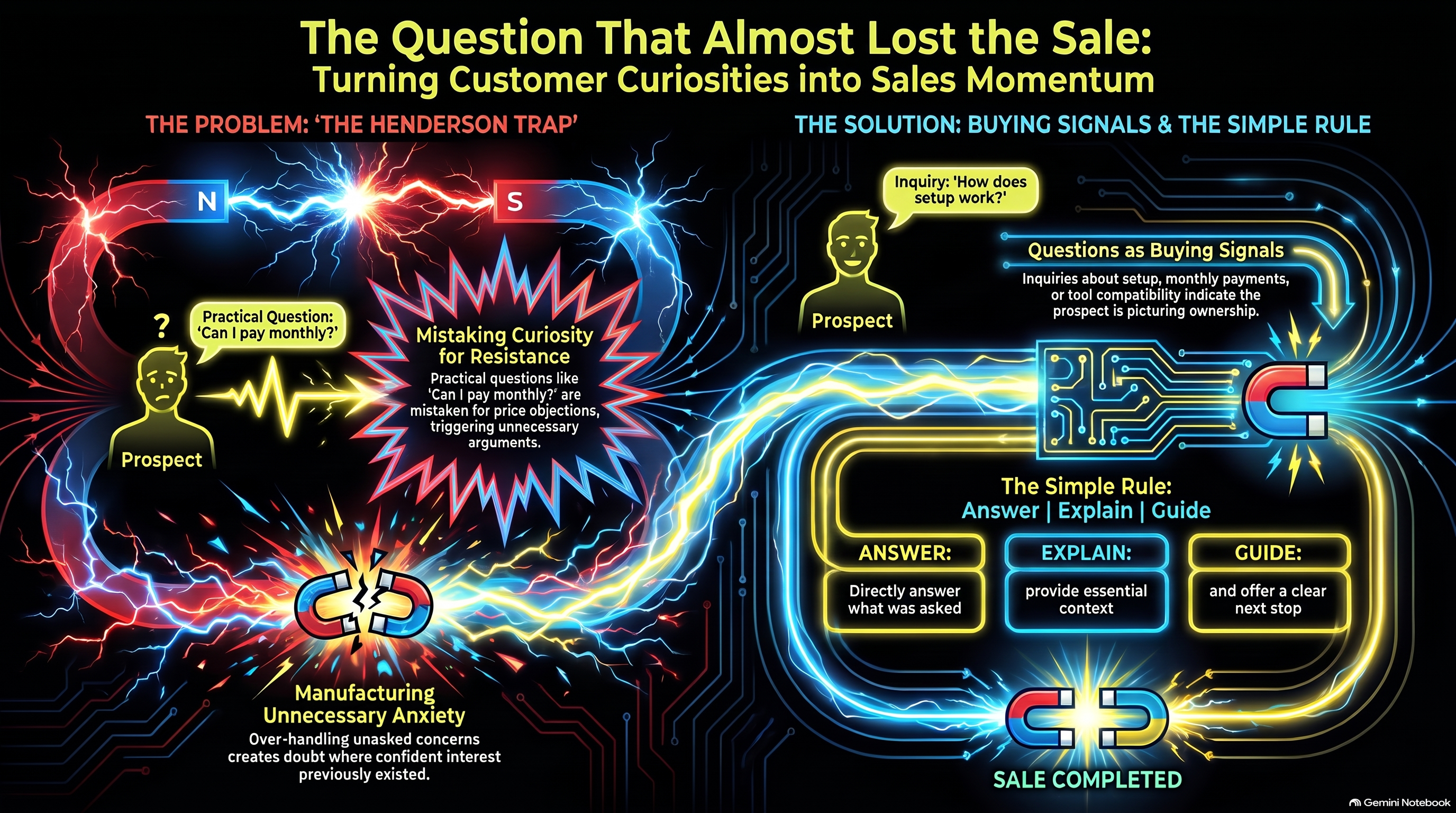
Sometimes the customer isn't objecting. They're already imagining what happens next.
Henderson was ready.
He had rehearsed the presentation twice, memorized the prospect's company history, and prepared forty-seven slides covering every conceivable reason someone might hesitate to purchase his services.
There were charts. There were testimonials. There was a color-coded objection matrix.
There was even a slide titled THE PSYCHOLOGY OF RESISTANCE, featuring a photograph of a mountain climber hanging precariously from a cliff.
Henderson was particularly proud of that one.
His prospective customer, a small business owner named Melissa, had spent the last twenty minutes listening politely as he explained how his marketing system could help her organize customer inquiries, automate follow-ups, and stop losing potential sales somewhere between the first conversation and the third unanswered email.
She liked what she was hearing.
In fact, she'd already begun thinking about which employees would need access, how quickly they could move their customer information into the new system, and whether she could finally retire the spreadsheet that had been running her business through sheer force of habit.
Henderson reached slide thirty-two.
Melissa raised her hand.
"Can I pay monthly?"
The room changed.
At least, it did for Henderson.
He stopped speaking. His smile tightened. Somewhere in the elaborate machinery of his sales training, an alarm began ringing.
Price objection.
He had prepared for this.
"Melissa," he began, lowering his voice into the reassuring tone he'd practiced in front of the bathroom mirror, "I completely understand your concern. But let me ask you something. What's the cost of doing nothing?"
Melissa blinked.
"Well, I was just wondering if—"
"Because every day you delay," Henderson continued, advancing to slide thirty-three, "your business could be losing opportunities."
A graph appeared. It was red. Very red.
Melissa glanced at her watch.
"Right. But do you offer monthly payments?"
Henderson moved to slide thirty-four.
THE HIDDEN COST OF INACTION.
By slide thirty-seven, Melissa was beginning to wonder whether asking about payment arrangements had been a mistake.
By slide forty-one, she was wondering whether Henderson had heard the question at all.
And by slide forty-seven, she was wondering whether she should have stayed home and wrestled with the spreadsheet.
The remarkable thing was that Melissa hadn't objected to the price.
She'd already decided the system looked useful. She was trying to figure out how to buy it.
Henderson had mistaken the sound of a door opening for the sound of one slamming shut.
When a Question Isn't an Objection
If you've spent much time around sales training, you've probably encountered the idea of handling objections.
There's nothing inherently wrong with learning how to respond when a customer has a genuine concern. People deserve clear explanations, and sometimes an honest conversation can resolve a misunderstanding.
But somewhere along the way, it's easy to develop a peculiar habit: treating every question as though it's an obstacle standing between us and a sale.
A customer asks whether a product works with their existing equipment. We hear resistance.
They ask how long delivery takes. We prepare to defend our shipping process.
They ask whether monthly payments are available. We launch into a passionate explanation of value.
Meanwhile, the customer may simply be trying to imagine what purchasing the thing would look like.
Think about the questions you ask when you're considering buying something yourself.
If you're shopping for a new computer, you might ask whether your existing monitors will work with it. If you're considering a training program, you might want to know how much time you'll need each week. If you're looking at a service provider, you may ask how quickly they could begin.
Those questions don't necessarily mean you're searching for reasons to walk away.
Often, they mean you're beginning to picture the purchase as a real possibility.
You're moving beyond What is this? and into How would this work for me?
That shift is worth recognizing.
The Questions That Signal Movement
Salespeople sometimes call these buying signals: behaviors or questions that suggest a potential customer may be considering a purchase more seriously.
Some are obvious.
"When can we get started?"
"Does this come in another color?"
"Can my team use it too?"
Others are subtler.
"How difficult is it to move everything over?"
"What happens after I sign up?"
"Can I upgrade later?"
Notice what these questions have in common. They're often about the practical experience of becoming a customer.
The person may be imagining ownership, implementation, participation, or the changes that would follow a decision.
That doesn't guarantee they're ready to buy. Someone can ask detailed questions and still decide the product isn't right for them. They may be comparing alternatives, checking a requirement, or simply satisfying their curiosity.
And a question can contain both interest and genuine hesitation. "Can I cancel if it doesn't fit?" might be an ordinary request for policy information, a concern about commitment, or both.
We don't need to read minds to respond appropriately.
We need to listen.
When someone asks how soon they can start, tell them how soon they can start. If there are conditions or delays, explain them.
When someone asks about monthly payments, tell them what payment arrangements are actually available.
When someone asks about compatibility, explain what works, what doesn't, and what might require further checking.
It's amazing how often the most useful sales technique is simply answering the question.
Henderson, unfortunately, had purchased an advanced course on overcoming resistance and was determined to get his money's worth.
The FAQ Page That Invented Problems
Now imagine that Henderson is given responsibility for building the Frequently Asked Questions section of his company's website.
This is where things could become particularly entertaining.
He begins by identifying every objection a customer might conceivably have. Then he writes a question designed to introduce each one.
"What if your marketing system fails completely?"
"Why should I trust your company with my business?"
"Could this investment turn out to be a terrible mistake?"
"Am I risking everything by making the wrong decision?"
He follows each question with three paragraphs of persuasive reassurance, a testimonial, and a prominent button labeled OVERCOME YOUR FEAR TODAY.
Henderson is delighted.
He's anticipated objections before anyone has a chance to raise them.
Unfortunately, he's also introduced several concerns that visitors may never have considered.
Someone who arrived wondering whether the system integrates with their calendar now finds themselves contemplating catastrophic business failure.
That's not necessarily a helpful customer experience.
A FAQ section can be an excellent resource, but it can also become a surprisingly effective way to make people nervous if we confuse answering questions with manufacturing objections.
There's an important ethical distinction here.
We should absolutely communicate material limitations, relevant risks, costs, cancellation conditions, and other information people need to make informed decisions. Avoiding an uncomfortable subject because it might interfere with a sale isn't good marketing. It's a failure of transparency.
But we don't need to dream up frightening hypotheticals simply to demonstrate our ability to neutralize them.
The better question is whether a particular answer helps a real visitor understand something relevant.
Sometimes that's an assurance.
Sometimes it's a limitation.
Sometimes it's a practical detail so ordinary that nobody in the marketing department thought it deserved attention.
And sometimes that ordinary detail is exactly what the customer came looking for.
The Questions People Actually Want Answered
Consider a business selling fresh pet food.
A visitor might want to know how much to feed their dog, how the food should be stored, whether delivery is available, or how to transition from their pet's current diet.
Those aren't glamorous questions. They don't necessarily lend themselves to dramatic sales copy.
But they're useful.
A customer who's considering ordering food may be imagining where to store it, how to serve it, and whether it will fit into the household routine.
A thoughtful FAQ section helps them work through those practical details.
Now consider a business offering online courses.
Visitors may wonder whether lessons are self-paced, how long they retain access, whether they need prior experience, or what happens if they fall behind.
Again, these are ordinary questions with potentially important answers.
Someone asking about time commitments may be picturing the course alongside work, family, and everything else competing for their attention.
They're not necessarily rejecting the offer.
They're trying to understand how it would fit into their life.
The answers may reveal that the offering is a good fit. They may also help someone recognize that it isn't.
Both outcomes are valuable when the goal is to help people make informed choices.
A useful FAQ page doesn't exist solely to push people across the finish line. It helps them understand where the finish line is—and whether they actually want to cross it.
One Good Answer Can Work in Several Places
Here's where FAQ development becomes especially interesting from a marketing systems perspective.
Most businesses think of FAQs as a page.
A collection of questions, perhaps organized into categories, sitting somewhere in the website navigation.
That's useful, but it's only part of the opportunity.
Suppose a potential customer is reading about a particular service and wondering how long setup takes.
Why make them leave that page, find the FAQ section, search through several categories, and eventually locate the answer?
If the question is relevant to that service, answer it there.
The same approved answer can also appear in the central FAQ library, where visitors exploring the business more broadly can find it.
A question about a specific customer situation might belong on a Who We Serve page. A question about scheduling might be useful near a booking form. Questions about an individual product may be best answered alongside that product.
And if a detail is essential to understanding the offer—such as a major limitation or important purchase condition—it may deserve prominent explanation on the page itself rather than being tucked inside an expandable FAQ.
The goal isn't to make people hunt for answers.
It's to make the right information available at the moment it becomes useful.
That means a well-organized FAQ library is more than a webpage. It's a collection of reusable explanations that can improve communication throughout the customer journey.
Of course, there's a catch. If you copy the same answer onto six pages and later change your policy, you now have six opportunities to forget an update.
That's why it helps to maintain one authoritative version of each approved answer and track where it's being used.
For frequently changing details, such as pricing tiers or seasonal availability, it is often wiser to explain the general framework and direct visitors to a single, authoritative page rather than repeating numbers across multiple locations.
A good system makes information easier to maintain as well as easier to find.
The Questions You Haven't Heard Yet
Even the best FAQ library begins with an incomplete understanding of what customers want to know.
That's unavoidable.
You can draw on past conversations, support requests, sales calls, and the practical realities of your products and services. You can use AI to suggest questions that seem relevant based on what you know about your customers.
But an AI-generated question isn't proof that real customers frequently ask it—it's a candidate worth evaluating.
And sometimes the most valuable questions are the ones nobody inside the business thought to include.
That's why I like the idea of offering visitors a simple invitation:
Didn't find your question? Ask us.
It doesn't have to be complicated.
A short form can give someone a way to raise a question that wasn't covered. The business can decide whether it needs an individual response, whether the answer belongs in the public FAQ library, or whether the question reveals something unclear elsewhere on the website.
Over time, those submissions can become a surprisingly useful source of insight.
If several people ask how long setup takes, perhaps the answer deserves a more prominent position.
If people repeatedly ask whether a particular product works for their circumstances, perhaps the product description needs improvement.
And if customers consistently ask something the business hadn't anticipated, perhaps it's time to reconsider what the business assumes everyone already understands.
Not every submitted question belongs in a public FAQ. Some are personal, some are too specific, and some are already answered elsewhere.
But every genuine question is an opportunity to listen.
That alone can make the invitation worthwhile.
Making the Hard Part Easier
There's another reason I like building FAQ libraries with the help of AI.
It's one of those tasks that's relatively simple in principle but surprisingly exhausting in practice.
Sit someone down in front of a blank document and ask them to produce twenty-five useful customer questions, write accurate answers, organize them into categories, and decide where each one belongs on their website.
Watch their enthusiasm evaporate.
Now change the experience.
Ask AI to propose five relevant categories based on what the business already knows about its customers and offerings.
Choose the strongest categories.
Then take one category and explore five possible questions. Keep three, revise one, reject another.
Draft the answers together. Check the facts. Approve the finished results.
Suddenly, instead of facing an enormous writing assignment, the business owner is making a series of manageable decisions.
And after a few rounds, there's a real FAQ library taking shape.
That's the approach we're using in Business Brain Builder Packet 047: The Questions Between Interest and Action.
The objective isn't to produce the longest FAQ page on the internet. It's to help business owners build a useful initial collection—often fifteen to twenty-five approved questions—without inventing filler or becoming overwhelmed by the process.
From there, the questions can be organized into a central FAQ experience, reused on relevant website pages, and expanded as customers reveal new things they want to know.
What once looked like a tedious administrative task becomes an opportunity to understand the business and its customers a little better.
And unlike Henderson's objection matrix, the finished product might actually help someone buy something.
The Difference Between Being Prepared and Being Present
There's a broader lesson hiding in Henderson's unfortunate presentation.
Preparation is valuable.
We should understand our products, anticipate genuine information needs, know our policies, and be ready to explain what customers can reasonably expect.
But preparation can become a trap when we're so committed to the conversation we've rehearsed that we stop noticing the conversation we're actually having.
Henderson heard a question about monthly payments and responded to an objection Melissa hadn't made.
He wasn't listening to her. He was listening for the cue that would allow him to deliver the next part of his presentation.
And perhaps that's the deeper purpose of a good FAQ system.
Not to predict every possible thought in a customer's head. Not to eliminate every uncertainty before it exists. Certainly not to turn every question into a sales opportunity.
It's to practice the habit of answering people as though their questions matter.
Because they do.
Sometimes a question reveals confusion. Sometimes it reveals a genuine concern. Sometimes it exposes a weakness in how we've explained something.
And sometimes, wonderfully, it means the person is already imagining a future in which they're our customer.
The challenge is recognizing the difference without assuming we know more than they've told us.
Melissa, for example, didn't need a lecture about the cost of inaction.
She needed to know whether she could pay monthly.
A single sentence might have moved the conversation forward.
Forty-seven slides nearly ended it.
P.S. Henderson has since revised his sales process. His new presentation contains fifty-three slides, including a section titled How to Recognize When the Customer Is Asking a Question Rather Than Raising an Objection.
Melissa has requested that the answer be available in writing.