
The Story Behind the Business
The Story Behind the Business
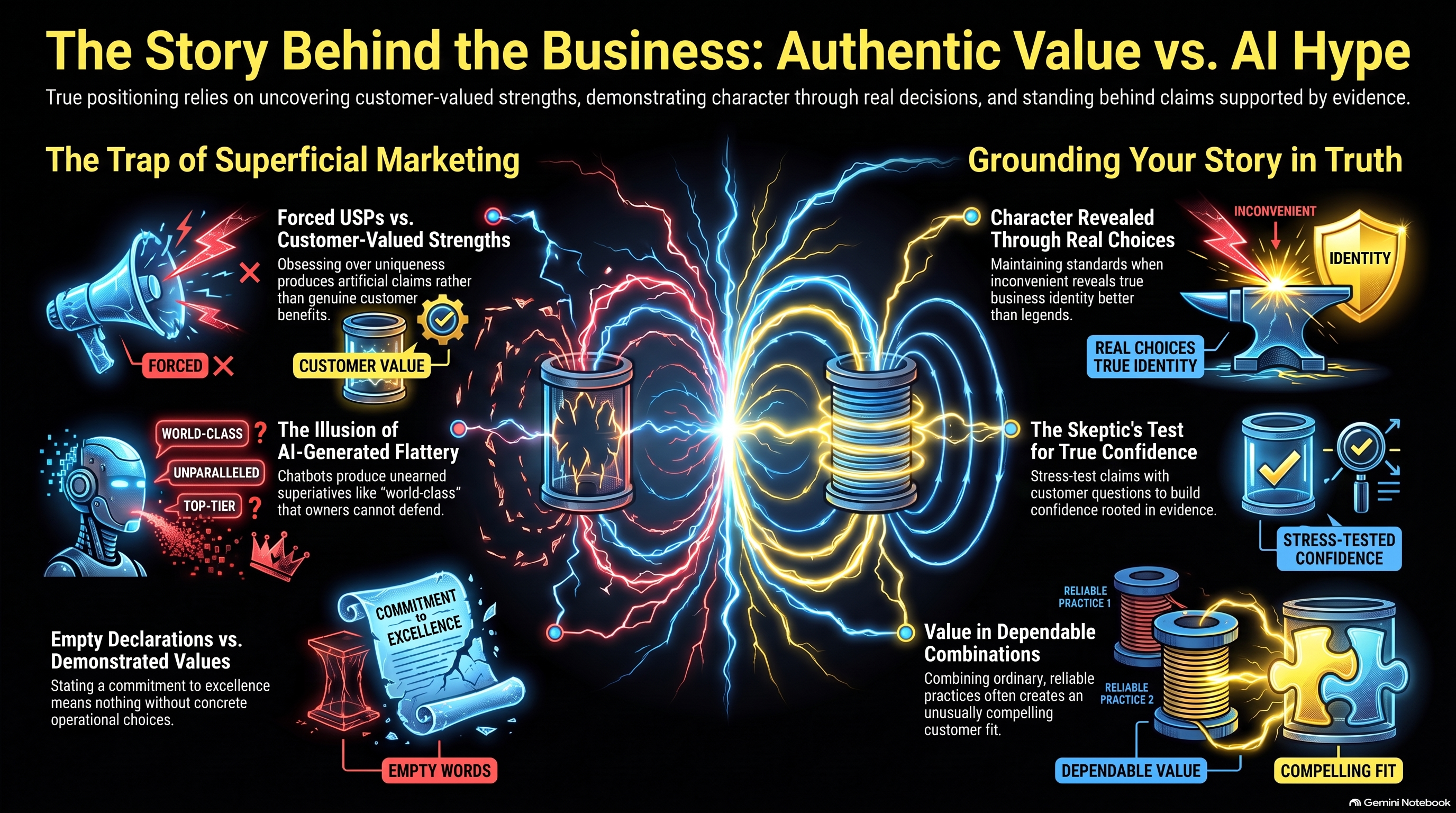
You Don't Have to Be Extraordinary to Have a Story Worth Telling.
There's a particular moment that can bring an otherwise productive afternoon of website writing to a grinding halt.
You've made some progress. The homepage is taking shape, the services are reasonably well explained, and you've finally stopped fiddling with the logo long enough to tackle the About Us page.
Then you encounter a deceptively simple question.
What makes your business different?
The cursor blinks. Your coffee gets cold. And somewhere in the back of your mind, a collection of perfectly respectable marketing phrases begins lining up for inspection.
"We provide excellent Customer service."
"We're passionate about what we do."
"We believe in quality."
None of those statements is necessarily dishonest. Most business owners genuinely care about their Customers and take pride in their work. But there's a rather inconvenient problem: practically everyone else says the same things.
So what are you supposed to do? Claim you're better than all your competitors? Invent a revolutionary methodology? Dig through your company's history in search of a dramatic struggle against impossible odds?
Or perhaps there's another possibility.
Maybe the things that make your business valuable have become so familiar that you've stopped noticing them.
──────── ⚡ ────────
The Trouble With Standing Too Close
Think about something you've been doing for years.
Maybe you're an accountant who can spot a bookkeeping problem almost immediately, a contractor who recognizes a bad installation before anyone else notices, or a consultant who knows which questions to ask because you've seen the same underlying problem wearing a hundred different disguises.
To you, that's simply part of the job. Experience has taught you what to look for, which mistakes to anticipate, and where things are likely to go wrong. You may not even remember when those observations stopped requiring conscious effort.
And because they feel ordinary, you probably don't think to mention them when explaining your business.
Meanwhile, a prospective Customer might be desperately searching for exactly that kind of expertise. They don't know what's obvious to you. They haven't seen the mistakes you've learned to prevent, experienced the frustrations your process avoids, or discovered why certain seemingly minor decisions can make such a difference.
You see a routine. They might see the answer to a problem that's been keeping them awake at night.
There's a peculiar blindness that comes from familiarity. We become so accustomed to our own strengths that we assume everyone else possesses them. Sometimes they do, sometimes they don't, and sometimes the real value lies in a particular combination of experience, judgment, and practices rather than any single unusual ability.
Which raises a more useful question than simply asking what makes us different.
What have we learned to do well, and why might that matter to someone else?
Not Everything Valuable Has to Be Unique
Somewhere along the way, marketing became rather obsessed with uniqueness.
We're encouraged to discover our unique selling proposition, identify our secret formula, and explain what makes us unlike anyone else on the planet. Those can be worthwhile exercises, but they can also send perfectly capable business owners searching for distinctions that simply aren't there.
Consider a hypothetical family-owned plumbing company that's served its community for twenty years.
A homeowner calls about a leaking pipe beneath the kitchen sink, worried that a relatively small problem might turn into an expensive repair. When the technician arrives, they take a look, explain what has failed, and walk the homeowner through the available options. If a straightforward repair will do the job, they say so rather than recommending a more expensive replacement.
Before leaving, they check their work, clean up the area, and explain what signs the homeowner should watch for in the future.
Nothing revolutionary has happened. The technician has simply followed the company's established way of doing business.
Has this company invented a new approach to plumbing? Probably not. Does it have a spectacular founding story involving betrayal, bankruptcy, and a triumphant return from the brink? Perhaps, but let's hope not. Twenty years of plumbing is probably enough adventure for anybody.
What it does have, assuming those practices genuinely reflect its operations, is a recognizable way of treating people. And to a homeowner worried about an unexpected expense, that approach might matter enormously.
Other plumbers may work exactly the same way. We shouldn't pretend otherwise. But the existence of equally capable competitors doesn't make those practices meaningless.
This is where three ideas frequently get tangled together: being different, providing Customer value, and possessing a competitive advantage.
A difference doesn't automatically benefit a Customer. Something genuinely valuable isn't necessarily unique. And claiming an advantage over competitors requires more evidence than an enthusiastic paragraph on a website.
A business doesn't always need to declare, "Nobody else does what we do." Sometimes a more useful message is, "Here's how we work, why we've chosen to work that way, and what that means for you."
That's something a prospective Customer can actually evaluate.
Your Business Has a Character of Its Own
We've all heard some version of the marketing advice that says the Customer should be the hero and the business should be the guide.
There's wisdom in that. Customers have their own goals, challenges, and decisions to make, and our marketing ought to respect their perspective.
But I've never been entirely comfortable with the suggestion that a business should therefore disappear from its own story.
Your company has a history. It has made decisions, developed habits, learned lessons, and chosen priorities. Perhaps it's changed dramatically over the years, or perhaps some of its defining principles have remained remarkably consistent.
Either way, those choices reveal something about its character.
Imagine a small manufacturer facing an unexpected increase in material costs. It could quietly substitute a cheaper component, but instead it decides to explain the situation to its Customers, adjust its pricing where necessary, and preserve the quality standard it originally promised.
That decision doesn't automatically make the manufacturer better than every competitor. Nor does it guarantee that every Customer will appreciate the higher price. But it tells us something about what the company prioritizes when circumstances become inconvenient.
And that may be more revealing than a mission statement announcing an unwavering commitment to excellence.
An About Us page is one of the few places on a website where visitors arrive specifically because they want to know more about the business itself. They're not necessarily looking for another sales pitch. They may want to understand why you started, what you believe in, what kind of people they'll be dealing with, or whether your approach is compatible with their expectations.
Sometimes they simply want reassurance that there's a real human being behind the polished website.
The Customer remains the protagonist of their own journey. But your company can certainly be the protagonist of its own history.
The trick is to tell that history in a way that reveals character rather than merely cataloging accomplishments.
──────── ⚡ ────────
The Stories That Don't Make Movies
We tend to recognize stories when something dramatic happens.
A founder loses everything and starts again. An unexpected discovery changes a company's direction. A major obstacle forces the team to rethink its entire approach.
Those can be compelling stories when they're true. But what about the company that hasn't experienced a spectacular transformation?
What about the business that quietly kept its promises for fifteen years, or the owner who realized Customers needed more education and began explaining the work more carefully? What about a company that continued honoring a difficult commitment long after it would have been easier to abandon it?
There's character in those decisions, too.
Sometimes a company's story reveals who its people have become. Other times, it reveals who they've consistently chosen to remain.
We don't need to manufacture a catastrophe to make a business interesting, nor do we need to turn every founder into a conquering hero. Growth, perseverance, curiosity, sacrifice, discovery, and steadfastness can all shape a company's identity. Sometimes the most meaningful story is simply an explanation of why someone decided to do the work in the first place—and why they're still doing it.
The important part is that the story is true.
What Does Your Story Mean to Someone Else?
Here's where things get especially interesting.
You might have an extraordinary company history, but that doesn't automatically mean every detail belongs on your About Us page.
Imagine a business owner enthusiastically explaining how they spent three years developing a complicated internal process. They remember the experiments that failed, the long evenings spent refining it, and the satisfaction of finally getting everything to work.
It's a meaningful achievement, and perhaps an important part of the company's identity.
But somewhere in the middle of that explanation, a prospective Customer may be wondering what the process actually means for them. Will it save time, reduce confusion, prevent expensive mistakes, or give them more control over the outcome?
This is the bridge between a company's internal story and the value that story communicates.
We begin with something real about the business, consider which Customers might care, explore the benefit they could receive, and identify what evidence supports that connection. Only then do we decide how to communicate it.
That doesn't mean every paragraph needs to become a sales proposition. Quite the opposite. A good company story should still feel like a story, not a brochure that keeps interrupting itself to announce another benefit.
Understanding why a detail matters simply helps us decide which details deserve the reader's attention.
It's often the difference between a company history that people politely skim and a story that helps them feel they've gotten to know the business.
Confidence Isn't Something AI Should Hand You
There's another reason this discovery matters, particularly now that so many business owners are using artificial intelligence to help develop their marketing.
A lot of entrepreneurs struggle to explain their value with confidence. And AI, helpful as it can be, sometimes responds by telling them how extraordinary they are.
Give it a few paragraphs about your company, and it may enthusiastically declare that you've built an innovative, world-class, industry-leading organization.
Wonderful!
Except now we have a different problem. Can you actually stand behind those words?
What happens when an interested Customer asks what makes your approach industry-leading, how your service differs from the alternatives, or what evidence supports the results you're promising?
Suddenly that impressive paragraph doesn't feel quite so comfortable.
This is the same trap we encountered when discussing uniqueness. The pressure to sound distinctive can tempt us to substitute impressive language for genuine understanding. AI can make that temptation even harder to resist because it produces polished claims so effortlessly.
I'd much rather see it help a business owner investigate those questions than flatter them with conclusions.
Look at the evidence. Examine the Customer's needs. Consider what the company actually does and explore possible strengths, including ones the owner might have overlooked. Then challenge the conclusions with the kinds of reasonable questions a thoughtful prospective Customer might ask.
What does that mean in practice? Why would that help someone like me? How do you know you can deliver it?
Not as some kind of confidence-destroying interrogation, but as an opportunity to discover which claims hold up and which still need work.
When you can answer those questions naturally and truthfully, something rather wonderful happens. You no longer need to memorize a grand marketing statement because you understand what you're saying.
And confidence built on understanding is much more useful than confidence borrowed from an enthusiastic chatbot.
──────── ⚡ ────────
Your About Page Isn't a Trophy Cabinet
Once you've rediscovered your company's story, you can begin turning it into an About Us page worth reading.
That doesn't mean cramming every milestone, accomplishment, mission statement, and company value into one enormous wall of text. Nor does it mean spending six paragraphs announcing how remarkable your organization is.
People aren't necessarily looking for the greatest business in the history of civilization. They're trying to decide whether yours is a business they understand, respect, and might want to work with.
Give them a meaningful introduction and the parts of your history that explain who you are. Let your values emerge through decisions and practices, not merely declarations. Show credible evidence where it matters, and offer readers a way to explore further or begin a conversation when they're ready.
And don't be afraid to let some personality through.
A business doesn't become less professional because it sounds like real people work there. In fact, that might be one of the most reassuring things about it.
The Story You Can Stand Behind
If you're struggling to explain what makes your business worth choosing, I wouldn't begin by asking you to list everything you do better than your competitors.
I'd begin somewhere a little quieter.
Think about what you've learned from serving your Customers and the decisions that have shaped the way you work. Consider the standards you've maintained when doing so wasn't particularly convenient, or the things you do almost automatically that someone less experienced might overlook.
Then ask yourself which of those things genuinely matters to the people you hope to serve.
You may discover a meaningful competitive advantage. You may uncover a combination of strengths that makes your business especially well suited to a particular kind of Customer. Or you may simply arrive at a clearer, more honest explanation of the value you provide.
Any of those would be worthwhile.
Because the point isn't to convince everyone that your business is extraordinary. It's to help the right people understand what makes it worth considering.
And perhaps, somewhere along the way, you'll come to understand it a little better yourself.
Your company doesn't need an invented legend. It needs a story you can stand behind.
──────── ⚡ ────────
This article accompanies Packet 040, The Story Behind the Business, in Magnetix Marketing's Business Brain Builder series, part of the Powerful Progress Program. The workshop guides business owners through rediscovering their company story, examining genuine competitive strengths, and developing complete About Us page content grounded in their Business Brain.