
The Things You Forgot You Had
The Things You Forgot You Had
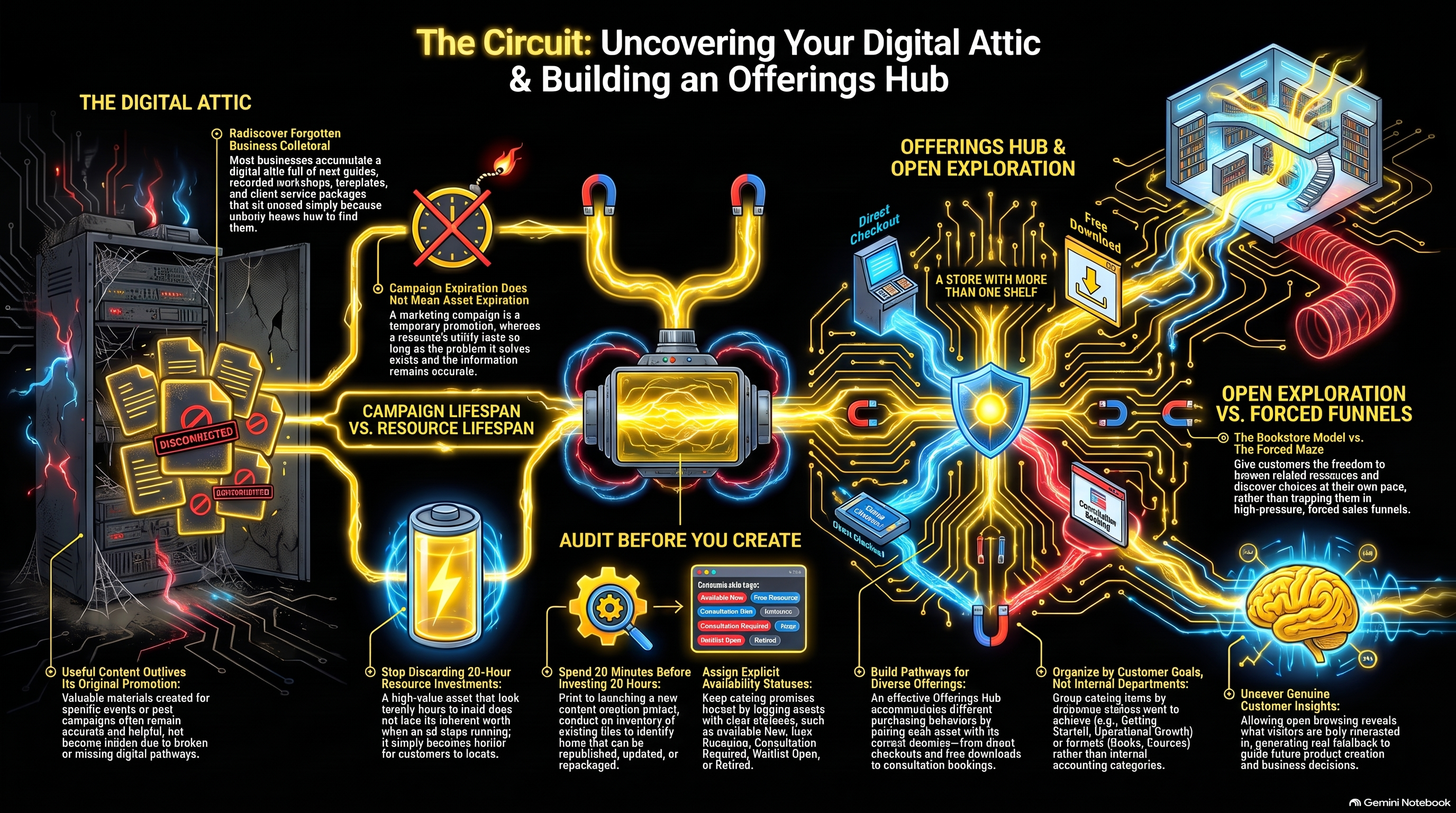
Your business might be sitting on a collection of valuable offerings that nobody knows how to find.
Somewhere in your business, there's probably something you created that deserves a second look.
Maybe it's a guide you wrote two years ago for a campaign that stopped running. Perhaps it's a recorded workshop, a collection of templates, a training program that never quite found its audience, or a service package you assembled for a client and never thought to offer again.
It might even be a product you're still selling—technically—if someone happens to know the right page, remember the correct link, or ask exactly the right question.
I suspect most businesses eventually develop a little digital attic. And like a real attic, it contains an interesting mixture of things we should probably throw away, things we meant to finish, and things that make us wonder why we ever stopped using them.
The trouble is that customers don't get to rummage through your attic. They can only discover what you've made accessible.
The Strange Economics of Forgotten Things
Think about how much work goes into creating a genuinely useful resource.
You identify a problem, research possible solutions, organize your thoughts, create the material, design the presentation, and figure out how to deliver it.
Then you build a funnel to promote it.
Perhaps you run some advertising. Perhaps you mention it in a newsletter. Maybe you give it a few weeks of attention before another project demands your time.
Eventually, the campaign ends—and somewhere along the way, we begin treating the resource as though its useful life ended with the promotion.
But if the information remains accurate, the problem still exists, and the resource still helps people solve it, what exactly expired?
Often, nothing but the promotion.
We've confused the lifespan of a marketing campaign with the lifespan of the thing being marketed.
That's an expensive misunderstanding, especially for a small business where time, attention, and money are already in short supply.
A resource that took twenty hours to develop doesn't become worthless because the Facebook ad promoting it stopped running. It becomes harder to find.
Those are two very different problems.
And recognizing the difference changes how we might think about the things we've already built.
A Store With More Than One Kind of Shelf
Of course, not every business sells products in the traditional sense.
A consultant might offer a discovery session, a fixed-price audit, an ongoing advisory relationship, and a training course. A restaurant might sell meals, bottled sauces, catering packages, gift certificates, and branded merchandise.
An educator might have books, downloadable worksheets, recorded classes, live workshops, memberships, and private coaching.
And a service business might have offerings that can't reasonably carry a fixed public price because the work depends on the customer's situation.
All of those can belong in the same broader picture of what a business makes available.
The mistake is assuming that everything must be sold the same way.
Some things belong in a shopping cart. Others deserve a detailed explanation. Some require a conversation before anyone can sensibly discuss pricing. A free resource might simply need a clear download link.
A useful Offerings Hub doesn't force every item into the same narrow display case. It gives each offering room to be understood on its own terms, helping visitors recognize what they're looking at and choose their own next step.
That's an important distinction, because customers don't arrive at your website with an intimate knowledge of your business structure.
They arrive with their own questions.
They might be ready to buy, comparing possibilities, or looking for a little help before they're comfortable making a bigger commitment. Occasionally, they're just curious.
There's nothing wrong with curiosity. Some of the most valuable customer relationships begin there.
What If That Old Guide Had Another Life?
Suppose you created a genuinely useful guide two years ago as a free lead magnet. It still solves a real problem, but the advertising campaign that introduced people to it ended long ago.
That guide might deserve a place in your public resource collection, where people can discover it without having to stumble across an old funnel.
You could keep it available as a free download. Or perhaps offer it as an inexpensive catalog product while continuing to make it available free through a separate promotional pathway.
There's nothing inherently wrong with either approach, provided the offers are honest and the customer receives what was promised.
Imagine you've accumulated several distinct resources over time.
Not twenty variations of the same five-page document with different covers. Actual resources addressing different problems, questions, or stages of a customer's journey.
Someone might spend a dollar on one useful guide, find it helpful, and return for another. Eventually, they might discover a workshop or mini-course that builds on what they've learned.
None of this guarantees sales. Payment processing fees, maintenance, and customer support still matter. And an undiscovered catalog isn't going to magically generate traffic.
But the larger idea is interesting.
Instead of treating every new campaign as an isolated beginning and ending, you're gradually building a collection of useful things that can continue working together.
Your past effort doesn't have to disappear every time your attention moves somewhere new.
The Difference Between Having Something and Offering It
Imagine walking into a bookstore where the owner keeps all the books in the back room.
You explain what you're interested in.
The owner says, "Oh, I've got something wonderful about that!" Then disappears behind a curtain.
Twenty minutes later, he returns with a book.
You might appreciate the personal service. But wouldn't it have been nice to browse the shelves?
Your website should be able to provide some of that freedom.
People should be able to explore what interests them, notice relationships between different offerings, and choose how deeply they want to engage.
Someone looking at a beginner's guide might appreciate seeing a related workshop. Someone considering a coaching package might want to read the coach's book first.
These connections aren't necessarily upsells. Sometimes they're simply helpful directions.
The difference lies in whether the recommendation serves the customer's interests or merely the business's desire to extract another purchase.
A good shopkeeper understands the distinction.
Henderson, our fictional casino marketing consultant, would undoubtedly disagree. His preferred bookstore would feature a maze of shelves, no visible exits, and a $15 bottle of water halfway to the checkout.
We won't be hiring him.
Your Customers May Surprise You
There's another benefit to making your offerings easier to explore.
You get opportunities to learn what people are actually interested in.
Perhaps the resource you considered relatively unimportant becomes one of the most frequently requested items in your collection. Maybe customers repeatedly ask about a subject you thought was too specialized.
Or perhaps a service you expected to attract beginners turns out to interest experienced customers facing a different problem.
None of these observations automatically proves why people behave as they do. Customer behavior is evidence worth investigating, not a crystal ball.
But it's more useful than assuming your original predictions were perfect.
A growing collection of offerings can become a source of feedback about the problems people want help solving. Those insights may influence what you create next, what you improve, and even what you decide to stop offering.
That's where an organized business begins developing something more valuable than a catalog: a better understanding of the people it serves.
Before You Create Something New
Entrepreneurs are particularly susceptible to the excitement of the next idea.
A new course, a new product, a new campaign, a new offer. Sometimes those are exactly what the business needs.
But before committing another twenty hours to creating something, it might be worth spending twenty minutes looking at what you've already created.
What still has value? What needs updating? What could be packaged more clearly? What deserves a place where customers can discover it?
And what should finally be retired, because keeping an outdated promise alive isn't doing anyone any favors?
You don't need a hundred products. You don't even need ten.
You need an honest, useful collection that reflects what your business can actually provide.
Give those offerings a sensible place to live. Make the next step clear. Connect related things where doing so helps people, and allow customers the freedom to explore without demanding that every visit follow a predetermined sales journey.
Because sometimes the next opportunity isn't waiting inside your next big idea.
Sometimes it's sitting quietly in a folder you haven't opened in three years, still useful and still relevant.
Just waiting for someone to find it.
This article is part of The Circuit, Magnetix Marketing's ongoing exploration of the systems, decisions, and practical skills that help entrepreneurs build businesses with greater clarity and staying power. Packet 044 of the Business Brain Builder helps you organize your products, resources, services, and programs into a customer-friendly Offerings Hub, preparing the structure for implementation through the Powerful Progress Program.