
Three Gnomes in a Trench Coat
Three Gnomes in a Trench Coat
Why Your Next Webinar Might Work Better When You Stop Hiding the Sales Pitch
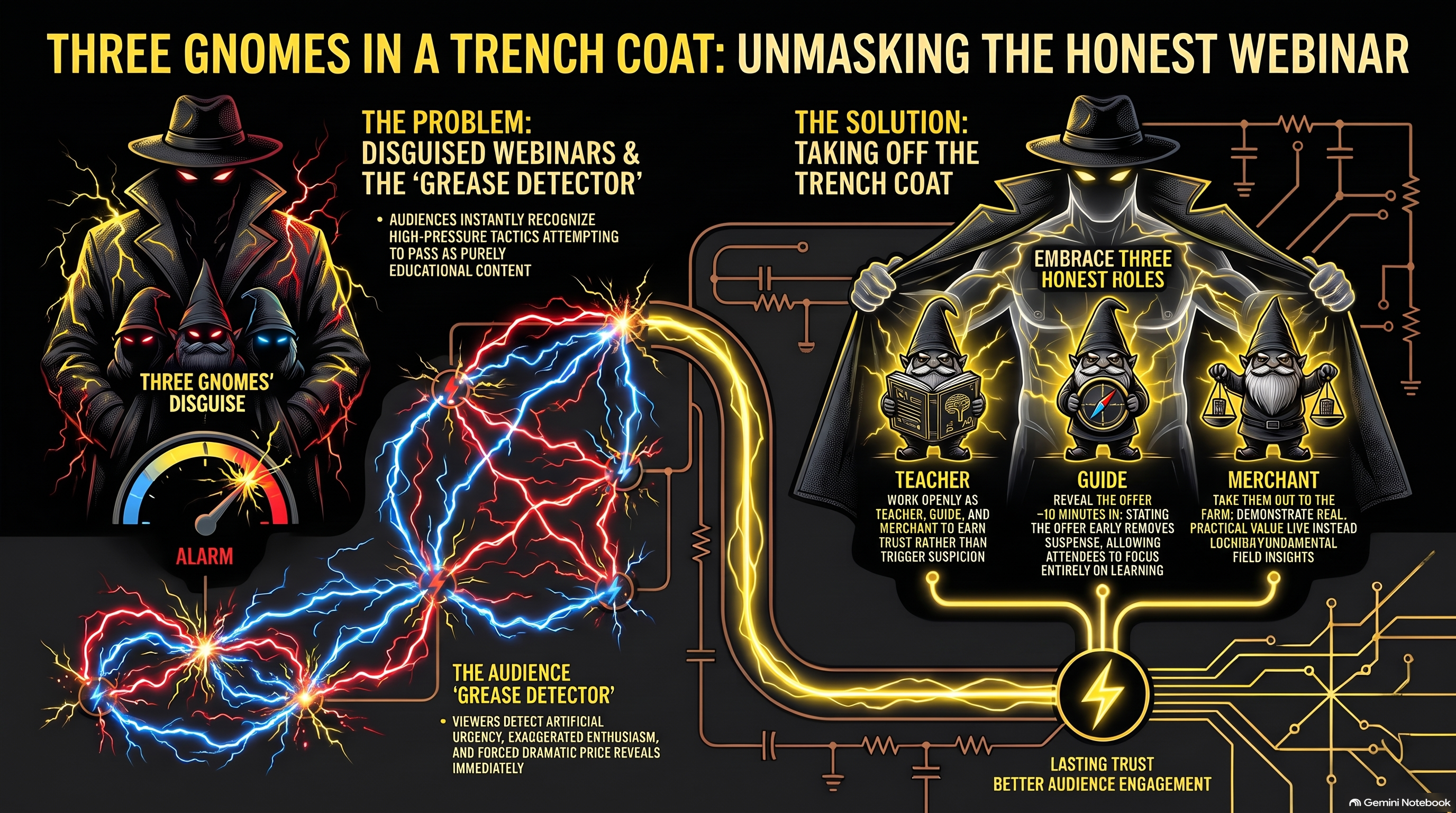
Picture three gnomes standing outside an exclusive nightclub.
The establishment has a strict policy against admitting gnomes. Why? Nobody remembers. Something about an incident involving a chandelier, a wheel of cheese, and a visiting dignitary.
But our three enterprising little fellows have a plan.
One climbs onto another's shoulders. The third takes his place at the bottom. They pull an enormous trench coat over themselves, add a fedora, and approach the doorman with all the confidence of a respectable six-foot businessman.
"Good evening, fellow adult," announces the top gnome in a voice that sounds like someone gargling gravel.
The doorman looks at the coat. He looks at the hat. He looks at the suspicious bulge around knee height.
"Three of you tonight?"
"Certainly not!" declares the top gnome. "I am one perfectly ordinary gentleman here to enjoy adult refreshments and discuss the economy."
From somewhere around the gentleman's waist comes a muffled argument about which direction to walk.
Nobody is fooled.
And yet, rather than reconsidering their approach, the gnomes conclude that what they really need is a better trench coat.
Welcome to modern webinar marketing.
The Audience Has Seen the Trench Coat Before
Somewhere along the way, the free educational webinar developed a reputation.
You know the routine.
An exciting promise. A remarkable discovery. A once-in-a-lifetime opportunity to learn something that will transform your business, your finances, your relationships, or possibly the structural integrity of your garage.
The presenter begins with an inspiring personal story. Then comes a little teaching, a little more storytelling, some impressive testimonials, and repeated assurances that something extraordinary is coming.
And coming.
And coming.
Eventually, the audience discovers that the extraordinary thing is a product available for the surprisingly affordable price of $997, provided they act before the countdown timer finishes threatening them.
The actual educational breakthrough? Apparently, that's included in Module Three.
Now, to be fair, this isn't how every webinar operates. There are excellent presenters who provide meaningful education, make an honest offer toward the end, and leave everyone better off for having attended.
There's nothing inherently wrong with that.
But the less admirable examples have created a problem for everyone else.
Audiences have learned the routine.
They've learned to recognize the transition from teaching voice to selling voice. They've developed an instinct for artificial suspense, suspiciously convenient scarcity, and the dramatic pause preceding a price reveal that requires seventeen minutes and a calculator to explain.
They've become amateur trench-coat inspectors.
And the unfortunate consequence is that even a genuinely worthwhile webinar may begin with an audience already preparing its escape.
The Great Webinar Escape Plan
Consider the attendee's perspective.
They registered because the subject interested them. They genuinely want to learn something. But they've also attended enough presentations to suspect that the information they came for will be strategically distributed around a sales pitch.
So they develop a plan.
Maybe they'll arrive fifteen minutes late to skip the biography and introductory enthusiasm.
Maybe they'll keep another browser tab open while waiting for the actual teaching to begin.
Maybe they'll leave when the presenter starts discussing the incredible value of seventeen bonuses, each apparently worth more than a moderately priced used automobile.
And perhaps they'll return for the replay, where they can skip directly to the useful parts without sitting through the theatrical production.
The presenter, meanwhile, is trying to maintain attention, establish authority, overcome objections, build desire, and keep people from leaving before the offer.
Both parties have entered the same room with entirely different defensive strategies.
The marketer wants to keep the audience from escaping.
The audience wants to avoid being trapped.
And somehow, in the middle of this elaborate dance, we're supposed to be building trust.
There's something wonderfully absurd about that.
The problem isn't necessarily the product, the price, or even the presentation structure.
It's that the audience has started treating the entire experience as something to survive.
What If We Just Introduced the Gnomes?
Here's a thought.
What if we stopped treating the commercial invitation as the grand finale?
Suppose you opened your webinar with a brief story explaining why the subject matters to you, what you've learned, and why you decided to create something that helps people with it.
Then, perhaps ten minutes in, you said something like this:
"Before we get into the really useful stuff, I want you to know that I do have a program that helps people work through this in much greater depth. Here's the link if you'd like to explore it.
"I'm mentioning it now because I don't want you spending the next hour wondering when the sales pitch is coming. You already know what I'm offering. Whether you ever buy it is entirely up to you.
"Now, let me show you something I think you'll find genuinely useful."
And then you actually did.
No mysterious reveal. No dramatic countdown. No need to pretend that the commercial side of your business doesn't exist.
The gnomes have taken off the trench coat.
They're three gnomes. One of them sells things.
Wonderful. Can we get on with the evening?
This isn't a new miracle formula guaranteed to triple conversions by next Thursday. It's simply an alternative worth considering in a market where suspicion has become part of the admission price.
Some audiences might appreciate it enormously. Others might prefer a different format. The only sensible way to know is to try it, pay attention, and learn.
But the underlying idea deserves consideration.
What happens when people no longer need to spend their attention anticipating the sales pitch?
Perhaps they can devote more of it to learning.
Take Them Out to the Farm
Imagine inviting someone to visit your farm because they're interested in growing their own food.
You could seat them in the barn for an hour and explain how complicated farming is.
You could describe the dangers of poor soil, unreliable weather, inefficient irrigation, and vegetables that apparently refuse to cooperate with your dreams.
You could tell them about your proprietary agricultural system, explain why ordinary gardeners are doomed to disappointment, and hint repeatedly that the secret to enormous tomatoes is coming shortly.
Then, just as everyone gets excited, you announce that they'll have to purchase your program to see the fields.
Or you could take them outside.
Show them the soil. Explain what makes it productive. Demonstrate irrigation. Let them plant something. Walk them through a few practical techniques they can use in their own gardens.
Along the way, you mention that you also have a program that helps people develop and operate a productive farm.
Now they understand what you're selling because they've experienced a meaningful piece of it.
They can see the work involved. They can appreciate the expertise. They can recognize where guidance, equipment, planning, or ongoing support might make a difference.
And if someone decides they can do everything themselves?
Maybe they can.
That's not a catastrophe.
In fact, if everyone can accomplish everything your paid program promises using what you've just taught them for free, perhaps the problem isn't that you've given away too much information.
Perhaps your paid offer needs a more compelling reason to exist.
People don't always pay for information. They pay for help applying it, avoiding mistakes, moving faster, gaining confidence, receiving feedback, or accomplishing something they would struggle to achieve alone.
Those are perfectly respectable things to sell.
And you don't have to conceal the field to convince someone that farming is worthwhile.
The Longer They Stay, the More They Get
There's another interesting possibility hidden inside this approach.
In many webinars, attendees expect the educational value to diminish as the presentation progresses. The early material is interesting, but sooner or later the teaching gives way to the sales presentation.
What if we reversed that expectation?
What if the most useful examples, practical applications, and revealing insights continued unfolding as the webinar progressed?
The offer is already on the table. Everyone knows where to find it. You might mention it again when something you're teaching makes the connection particularly relevant, but there's no need to interrupt the experience with an elaborate sales performance.
The audience stays because the experience keeps getting better.
You could even provide a genuinely useful bonus at the end as a thank-you for participating. Not a hostage payment for surviving the presentation, but something that complements what they've learned.
And finish with questions.
Real questions, from real people, answered as openly as you can. If nobody feels comfortable speaking up, you can have a few commonly asked questions prepared and identify them honestly as such.
No imaginary audience members. No fabricated enthusiasm. No need for a suspiciously well-timed question from "Jennifer in Ohio" that perfectly introduces your premium package.
Just a conversation.
The more the audience understands, the more intelligently they can decide whether your offer is right for them.
That seems like a rather good outcome for everyone involved.
Maybe They Should Come Back
Here's where the idea gets even more interesting.
Of course, a replay can be a wonderful thing. It lets people learn on their own schedules, revisit difficult material, and participate when geography, work, family, or accessibility needs make attending live impractical.
But here's an interesting question: What if we designed some webinars to be experiences worth returning to, rather than presentations people only needed to watch once?
What if you didn't automatically make a replay available?
Not because you're trying to manufacture urgency. Not because you want to punish someone who couldn't attend. And certainly not because the recording contains a secret that will self-destruct at midnight.
But because you're creating a recurring live experience that people might genuinely want to attend more than once.
Someone attends for twenty minutes and has to leave. They learned something worthwhile. They know what you're selling, and they also know they missed more useful material.
Perhaps they return the following week.
This time they stay longer, hear different questions, and recognize something they weren't ready to appreciate before.
Maybe they come back again.
Each visit becomes another voluntary interaction with your expertise, your personality, and the experience of learning from you.
Those repeated touchpoints could help trust develop naturally. They might also create additional opportunities for a purchase when someone becomes ready.
Of course, not providing a replay won't suit every audience. Some people have scheduling limitations, accessibility needs, or simply prefer learning at their own pace. For those audiences, a recording may be the more respectful and effective choice.
But it's worth asking whether the live experience itself could offer something that a static replay doesn't.
A workshop, a demonstration, an evolving discussion, a chance to ask questions, or simply a fresh opportunity to understand something more deeply.
If people return, let it be because there's something worth returning for.
Not because we've found a cleverer way to keep the gate locked.
The Grease Detector
There's a broader problem here, and it extends well beyond webinars.
People are becoming remarkably good at recognizing when a conversation has turned into a persuasion performance.
The exaggerated enthusiasm. The artificial urgency. The rehearsed vulnerability. The improbable stack of bonuses. The dramatic revelation that something supposedly worth $12,000 can be yours today for $197.
We've all encountered some version of it.
And while individual techniques aren't necessarily dishonest, their combined effect has developed a recognizable texture.
Greasy.
The audience can feel the machinery operating.
This creates a peculiar arms race.
Marketers notice growing resistance, so they refine their persuasion techniques. Audiences recognize those techniques and become more suspicious. Marketers respond with even more elaborate approaches designed to overcome that suspicion.
Eventually, everyone is working harder to accomplish something that might have been easier if we'd simply spoken to one another like adults.
The disguise creates the very suspicion it was intended to overcome.
And now even honest businesses are competing in a marketplace where customers have learned to keep one hand on their wallets and the other on the exit.
That's the real problem worth addressing.
Not whether the sales pitch belongs at minute ten or minute fifty.
Not whether a webinar should last thirty minutes or ninety.
Not whether the presenter should use seventeen slides or seventy.
The challenge is how to earn trust in a market that has been trained to expect manipulation.
Three Gnomes, Three Honest Jobs
Perhaps our little friends outside the nightclub have been going about things all wrong.
The first gnome is a teacher. He knows things worth learning and enjoys explaining them.
The second is a guide. He helps people understand how those ideas apply to their own circumstances.
The third is a merchant. He has something useful to sell and would be delighted if someone wanted to buy it.
Individually, they're perfectly respectable fellows.
It's only when they decide to disguise themselves as one mysterious, larger-than-life authority that things become ridiculous.
And perhaps that's the lesson.
You don't need to hide the fact that you sell something. You don't need to apologize for wanting your business to succeed. And you certainly don't need to stop being entertaining, persuasive, or enthusiastic.
You simply need to give people fewer reasons to distrust your intentions.
At Magnetix Marketing, this is the kind of question we enjoy exploring through the Business Brain Builder. Not to prescribe one supposedly perfect webinar formula, but to help business owners think through the educational experience, the audience's needs, the commercial invitation, and how the pieces can work together honestly.
Because the right structure depends on what you're teaching, whom you're helping, and what you're actually offering.
And sometimes the most useful marketing innovation isn't a new technique at all.
It's recognizing that your audience is perfectly capable of making an intelligent decision when you give them something worthwhile to decide about.
Maybe the next competitive advantage in marketing isn't learning how to be more persuasive.
Maybe it's giving people fewer reasons to be suspicious.
So take off the trench coat.
Show people around the farm. Teach them something useful. Answer their questions. Tell them what you're selling.
And if you've built something worth buying, give them the opportunity to recognize it.
The gnomes may be shorter than everyone expected.
But at least now we can look them in the eye.