What Are You Actually Trying to Sell? | Building a Primary Commercial Offer
What Are You Actually Trying to Sell?
There is a funny thing that happens when someone asks a business owner what they sell.
Usually, they have an answer.
“I sell consulting.”
“We sell memberships.”
“I sell dog food.”
“We build websites.”
“We offer martial arts classes.”
Perfectly reasonable answers. They tell us what changes hands.
But they don't necessarily tell us what the business is actually trying to build.
──────── ⚡ ────────
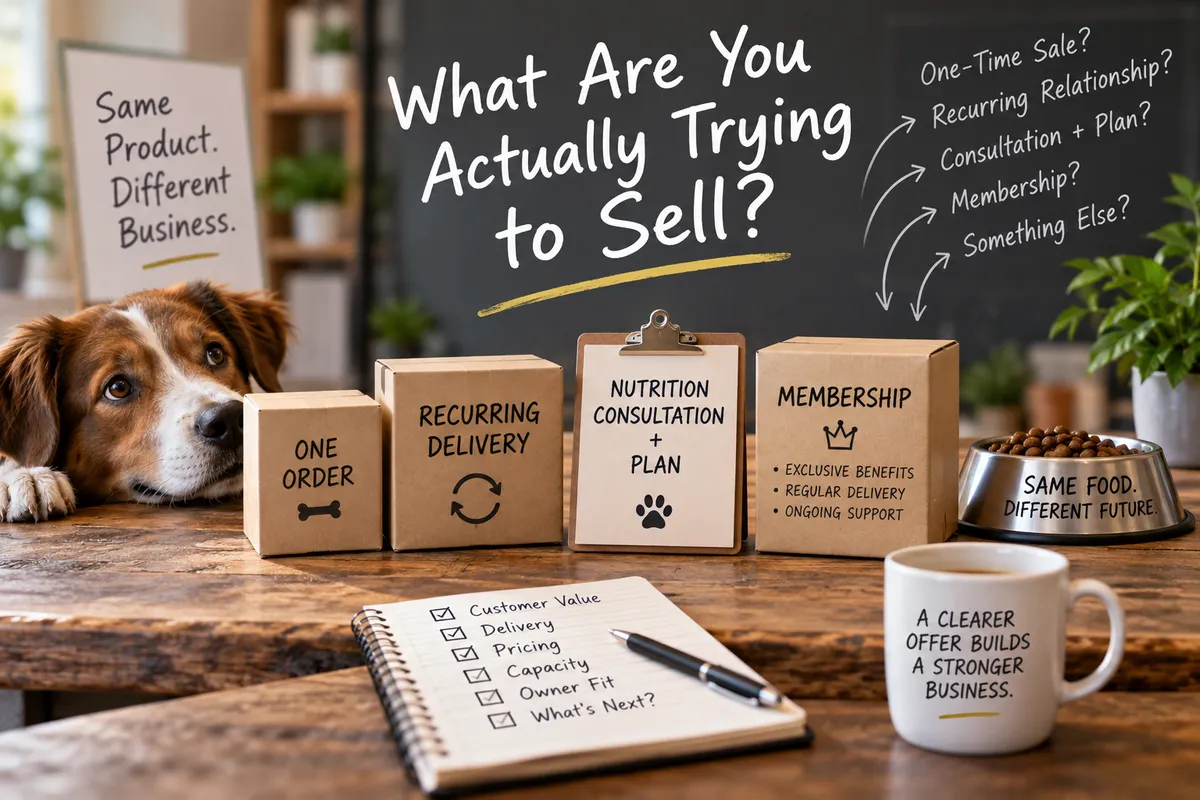
Consider a business that sells fresh dog food.
On the surface, the offer seems obvious. A customer buys a container of food. The business provides it. Money changes hands.
Done.
Except there are several very different businesses hiding inside that transaction.
One could be built around individual orders. Customers come back whenever they need more.
Another could be built around recurring delivery.
Another might begin with a nutritional consultation and move into an ongoing feeding plan.
Another might use a membership model that includes benefits alongside regular purchases.
They're all selling dog food.
They are not building the same commercial relationship.
Imagine the owner initially thinks, “We sell fresh dog food.”
After looking at the business more closely, though, they realize the relationship they actually want is to become the household's ongoing fresh-food provider. The first order still matters. So might a consultation, a sampler box, or an occasional standalone purchase. But those transactions now have context.
The business can begin asking different questions.
Does the first order make recurring purchasing more likely? Does helping an owner choose the right food improve retention? What delivery schedule works for the customer and the business? How much support does an ongoing customer require? How much can reasonably be spent acquiring someone if most people only order once versus if many remain for a year?
Nothing magical happened to the dog food.
The commercial relationship became clearer.
And that clarity changes what the business needs to learn next.
Once I started looking at offers this way, I realized how easy it is to spend a tremendous amount of time improving the thing being sold without ever deciding what kind of relationship we're hoping the sale will create.
The Biggest Receipt Isn't Necessarily the Destination
There's a habit in marketing of treating the expensive thing as the “real” offer.
The inexpensive thing gets called the tripwire. The free thing is the lead magnet. Maybe there's a middle offer somewhere in between.
Then, naturally, everything is supposed to march toward the biggest number on the price sheet.
Sometimes that's exactly right.
Sometimes it isn't.
A software company might charge a substantial implementation fee but ultimately want customers to remain subscribers for years.
A consultant might sell a relatively inexpensive workshop that leads naturally into a major engagement.
A martial arts school might collect fees for uniforms, testing, equipment and special events, but none of those necessarily represents the commercial relationship the school is fundamentally trying to establish.
Even a profitable product doesn't automatically become the destination just because people buy it.
This also means “primary” looks different across business models.
For a project-based service business, the Primary Commercial Offer might genuinely be a defined engagement that begins and ends. For SaaS, a membership business, or a recurring consumable, the individual transaction may matter less than the ongoing relationship it establishes.
Neither model is inherently better.
We're trying to identify what commercial success actually means for this business.
That got me thinking less about a primary product and more about a Primary Commercial Offer.
Not:
What's the most expensive thing we sell?
But:
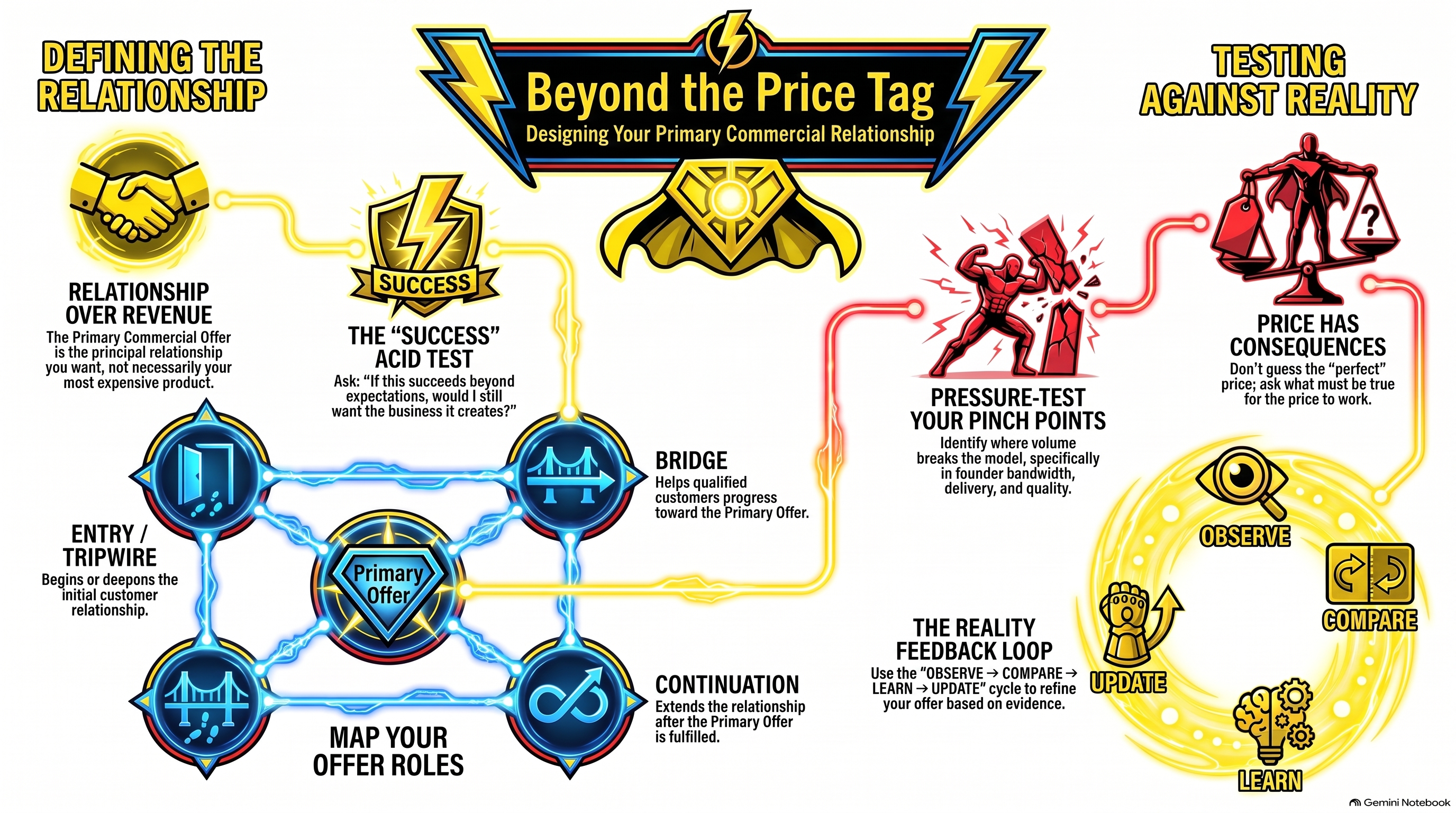
What is the principal commercial relationship we ultimately hope to establish with the right customer?
That's a much more interesting question.
Unfortunately, it also creates several more questions.
Primary Doesn't Mean Only
None of this requires a business to squeeze itself into a single-offer box.
A healthy business might have a free resource, an inexpensive starter product, a workshop, a flagship service, a subscription, add-ons and several products that happily make money without leading anywhere else.
The useful question is what role each one plays.
Some offers begin the relationship. Some help a customer become ready for a larger commitment. Some deepen an existing relationship. Some simply stand on their own.
An offer can even play more than one role.
A starter product, for example, might both begin the commercial relationship and help someone become ready for a more substantial engagement. Something else might be perfectly profitable without serving as a stepping stone to anything.
Finding a Primary Commercial Offer doesn't mean everything else has to bow before it.
It simply gives the business a clearer answer to:
When the right customer wants to go further with us, what relationship are we principally prepared to build?
That gives the other offers context without stripping them of their independence.
Every Offer Has a Business Hiding Inside It
Suppose you discover an offer customers genuinely want.
Great problem to have.
Now imagine a lot of them say yes.
Who sells it?
Who gets them started?
Who delivers it?
Who answers their questions?
Who handles the weird exceptions?
Who notices when something goes wrong?
Who keeps track of whether customers are actually getting what they were promised?
If the answer to every question is the owner's name, we've learned something important about the offer.
That doesn't automatically make it bad.
Some businesses are intentionally personal. Some customers are specifically paying for access to the founder, specialist, artist, coach or expert. A business designed around that relationship shouldn't remove the very thing customers came for just because someone told the owner that “scalable” is the magic word.
On the other hand, the founder probably doesn't need to personally schedule every appointment.
Routine onboarding may not require them.
The first response to a common support question may not require them.
The thing customers specifically came to that person for very well might.
So the useful question isn't simply:
Can this scale?
It's closer to:
If this succeeds beyond expectations, would I still want the business it creates?
That question can kill an otherwise impressive idea remarkably quickly.
It can also rescue one.
──────── ⚡ ────────
Price Has Consequences
Price is another place where it's easy to get ahead of ourselves.
Put $100 per month into a spreadsheet, assume a customer stays for two years, and suddenly that customer is “worth” $2,400.
Maybe.
They might also leave after two months.
Until customers actually behave that way, the spreadsheet is describing a hypothesis.
The same thing happens with acquisition.
An offer can look wonderful until we ask how much room its economics leave for finding customers. Or until we discover that fulfilling it consumes so much human attention that adding customers creates costs nearly as quickly as it creates revenue.
That doesn't mean we need a perfect financial model before making a decision.
It means price should be allowed to have consequences.
Instead of asking AI—or ourselves—to magically discover the perfect price, I prefer a question that is much harder to bluff:
What would have to be true for this price and this offer to work together?
Now we have something we can investigate.
Maybe customers need to remain longer. Maybe delivery needs to become more efficient. Maybe the price needs to rise. Maybe acquisition needs to stay inexpensive.
Maybe none of those assumptions survive contact with reality.
That's useful too.
And this is where having a thinking partner becomes particularly useful. Once price, delivery, customer behavior and owner involvement start affecting one another, we're no longer trying to answer one isolated question.
We're comparing systems.
Stop Asking AI to Invent the Business
This is one of the reasons I've become increasingly interested in what happens when AI is given accumulated business intelligence rather than a clever prompt and an empty conversation.
Ask AI:
Give me five great offers for my business.
It has to invent half the business before it can answer.
That doesn't mean the answers will necessarily look bad. That's part of the problem. AI is perfectly capable of producing something polished and plausible while filling gaps with assumptions you never actually made.
But imagine it already understands the customers, what they're trying to change, what the business is good at, how it currently delivers value, what the owner wants, what the owner absolutely does not want, where the business can serve people and where it is trying to go.
The useful context isn't just customer demographics and a product description.
Constraints matter too: what customers will and won't do, what the business can realistically deliver, where the founder wants to remain involved, and what kind of working life they don't want the offer to create.
Now the conversation changes.
We can ask AI to propose several materially different commercial models.
Then something even more useful happens.
We react.
“I like that.”
“That sounds exhausting.”
“Our customers would never commit to that.”
“I hadn't considered doing it that way.”
“That part is interesting, but I'd combine it with this other model.”
Those reactions aren't interruptions to the process.
They're new information.
The AI proposes. You react. Your reaction is evidence.
After a few rounds, we aren't staring at a blank page trying to invent the perfect offer anymore. We're comparing increasingly concrete possibilities against a business we understand better than when we started.
Sometimes the AI improves the offer.
Sometimes the offer improves our understanding of the business.
That's becoming one of my favorite parts of the whole process.
Eventually, Reality Gets a Vote
There is a limit to how far any of this can go inside a conversation.
We can develop a plausible offer.
We can examine the exchange from both sides.
We can consider delivery, owner involvement, pricing, capacity and acquisition.
We can identify assumptions.
We can even become reasonably confident that the pieces belong together.
None of that proves customers will buy it.
That's where I think business planning sometimes gets itself into trouble. A sufficiently detailed hypothesis starts feeling like evidence.
It isn't.
If we think customers will pay a certain amount, reality can answer that.
If we think they prefer one delivery model, reality can answer that too.
If we believe a smaller offer will naturally lead people toward a larger relationship, we can eventually measure whether they actually move that way.
And reality doesn't always require an expensive launch.
A few customer conversations can expose an assumption worth reconsidering. A small pilot can show where delivery becomes awkward. A limited offer can tell us whether people will actually pay what we hoped they would. Existing purchasing and retention behavior may already contain useful evidence.
None of those automatically proves the whole model.
They simply replace some assumptions with better information.
The point of thinking deeply beforehand isn't to eliminate uncertainty.
It's to become more precise about what we're uncertain about.
That is a surprisingly valuable improvement.
Try It Against Your Own Business
Take whatever you currently call your primary offer and ask a few uncomfortable questions.
What commercial relationship are we actually hoping this creates?
If ten times as many people said yes, what part of the business would feel it first?
What am I assuming about how long customers stay, what they'll pay, or what they'll buy next?
If this became wildly successful, would I actually want the business it creates?
You don't need perfect answers.
In fact, pay attention to the questions you can't answer.
Those aren't necessarily failures in the plan. They're clues about what reality still needs to teach you.
──────── ⚡ ────────
By the end of this exercise, I don't think a business needs to have its forever offer carved into stone.
I'd rather have something more useful:
The strongest current understanding of the commercial relationship worth developing.
Something clear enough to build around. Specific enough to test. Coherent enough that marketing has somewhere to lead.
And provisional enough that customers are still allowed to teach us something.
So take the offer you're building around today and write down what you currently believe about it.
Who is it for? What relationship are you hoping it creates? Why should the customer want it? What does the business have to do well to fulfill it? What are you assuming that customers haven't actually proven yet?
Then keep that version.
Put it in front of reality.
Watch what happens.
OBSERVE → COMPARE → LEARN → UPDATE
Compare what actually happened with what you expected to happen. Preserve what you learn. Change the model when the evidence earns the change.
Because an offer isn't finished merely because we finally found the words to describe it.
That's when it finally becomes clear enough for reality to answer back.