
What Happens If Everybody Says Yes? | Business Capacity & Scale
What Happens If Everybody Says Yes?
There is a wonderfully optimistic question hiding inside almost every business plan.
What if this works?
What if the ads start producing leads? What if people start booking calls? What if the new offer catches on? What if referrals begin arriving faster than expected?
We spend an enormous amount of time trying to make those things happen.
Far less time is spent on the question immediately after them.
Then what?
Not in the champagne-and-confetti sense.
What actually happens Monday morning when the customers show up?
Because somewhere between “This offer sounds great” and “This business is growing,” somebody has to sell it, onboard the customer, deliver what was promised, answer questions, solve exceptions, maintain quality and somehow make sure the whole thing doesn't consume every waking hour of the person who created it.
That part of an offer is surprisingly easy to overlook.
──────── ⚡ ────────
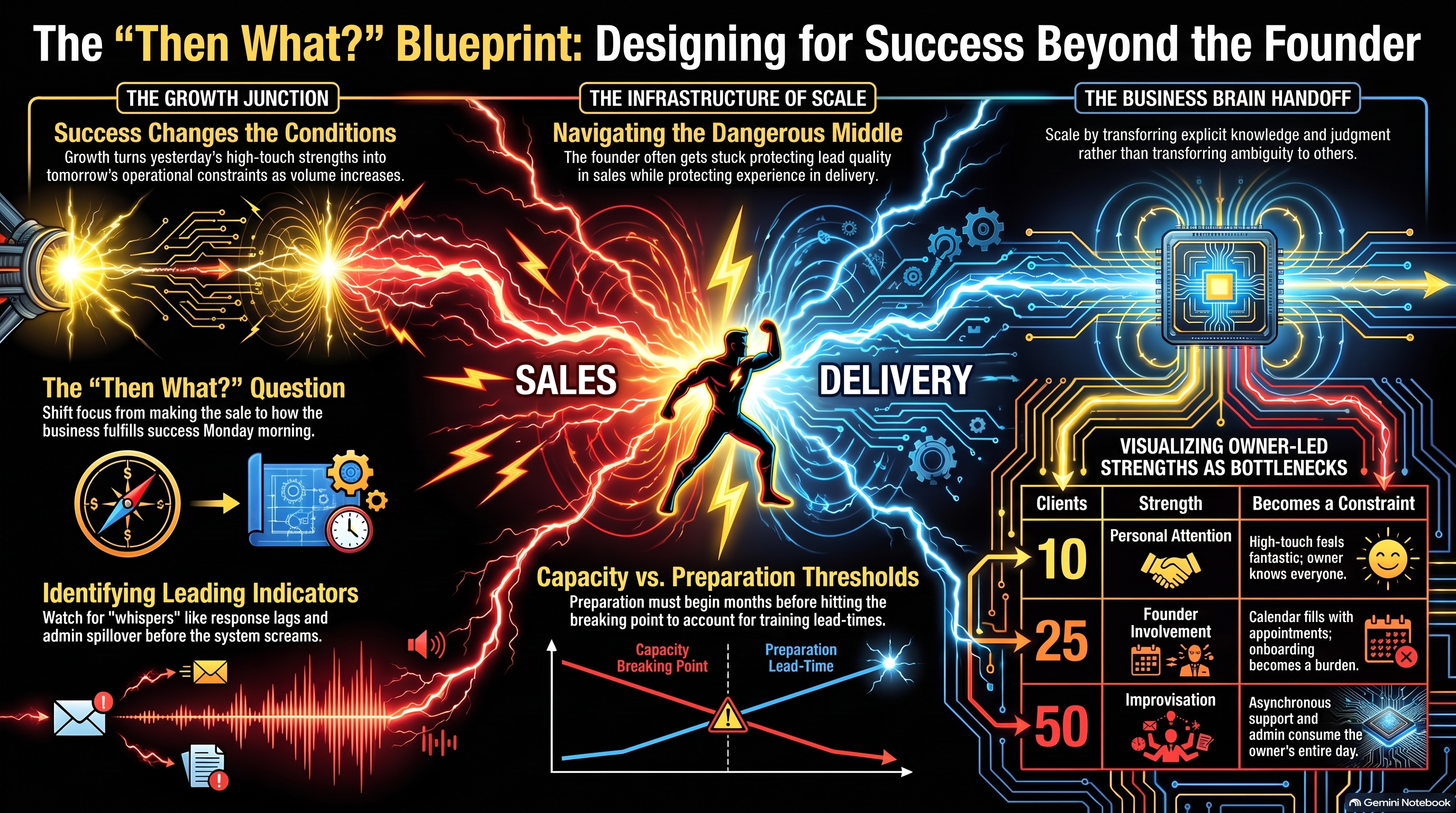
Success Changes the Conditions
Imagine a coach develops a six-month program.
It includes weekly group coaching, one private session each month, structured onboarding, asynchronous support between sessions and regular progress reviews.
At ten clients, this might feel fantastic.
The owner knows everybody. Questions are manageable. Private sessions fit comfortably into the calendar. A little administrative work gets handled between everything else.
Now imagine 25 clients.
Nothing about the offer has technically changed.
But now there are 25 private appointments every month. More onboarding. More questions. More rescheduling. More people needing attention at roughly the same time.
At 50 clients, something else might happen.
Perhaps the private sessions are still manageable, but asynchronous support has quietly become the thing consuming the owner's day.
What's interesting is that none of the things creating the problem were necessarily mistakes.
Personal attention may have helped make the program good.
Founder involvement may have helped customers get better results.
The owner's ability to improvise may have made the early business wonderfully responsive.
Keeping most of the business inside one person's head may even have made decisions incredibly fast.
Those were strengths.
Then the conditions changed.
Growth can turn yesterday's strengths into tomorrow's constraints.
That doesn't mean we should eliminate those strengths.
It means we need to understand which ones can continue operating the same way as demand changes—and which ones eventually require the business to change around them.
The interesting question isn't:
How do we make this infinitely scalable?
It's:
How many customers can we responsibly serve at the standard we're selling?
Those are very different conversations.
──────── ⚡ ────────
Not Everything the Owner Does Requires the Owner
Small businesses accumulate jobs strangely.
Someone has to do something, so the owner does it.
A customer needs an appointment changed. The owner handles it. Someone needs onboarding instructions. The owner sends them. A routine question comes in. The owner answers. A payment fails. The owner notices.
After enough repetition, all of that activity can begin to feel like part of the owner's role.
Some of it may be.
Some of it may simply be work that landed there because the business didn't yet have anywhere else to put it.
That's why one of the most useful questions isn't merely “Can this be automated?”
It's:
Why is the owner doing this in the first place?
Maybe customers really are purchasing the owner's judgment.
Maybe the founder's expertise is central to the experience.
Maybe a particular conversation requires empathy, context or specialist knowledge that shouldn't be reduced to a workflow.
Great.
Keep the human where the human matters.
But scheduling probably doesn't become more valuable because the founder personally clicks the calendar.
A routine onboarding reminder probably doesn't require twenty years of professional experience.
And a frequently asked question doesn't necessarily become better because the owner types the same answer for the 147th time.
The trick isn't removing the owner from everything.
It's figuring out where the owner is actually essential.
Scale by removing the owner where the owner isn't essential—not by accidentally removing what customers were buying.
──────── ⚡ ────────
Then You Reach the Dangerous Middle
For expertise-driven businesses, one of the nastiest capacity problems can appear between selling the work and delivering the work.
Both may depend heavily on the owner, but for completely different reasons.
Sales looks easier to transfer at first.
Someone can learn the offer. They can learn the questions to ask, the sales process and how to use the CRM.
What takes longer to transfer is the owner's understanding of what each opportunity actually represents.
A qualified lead isn't just another name sitting in a Pipeline.
Someone put real money at risk to create that opportunity.
Maybe there were months of testing behind it. Maybe several campaigns failed before one finally began producing the right people. Maybe the economics only work because enough of those opportunities receive careful follow-up.
To someone working a list, losing one lead can feel like:
Next.
To the business owner who paid to create it, that lead may represent a surprisingly expensive roll of the dice.
Burn enough good opportunities and the damage goes beyond a disappointing sales number. The business can starve the acquisition engine that was beginning to make growth possible.
Delivery creates almost the opposite problem.
A coach, consultant or specialist can learn the program, but the founder may be carrying years of accumulated judgment that doesn't transfer with the lesson plan.
There's a difference between knowing what the material says and recognizing the person in front of you.
Knowing when to push.
When to wait.
When the normal answer doesn't fit.
When something that looks like the problem probably isn't the problem.
When experience tells you to pay attention to the little thing nobody else noticed.
Customers can feel that difference.
So the owner keeps selling because nobody else sells it quite right.
And keeps delivering because nobody else delivers it quite right.
For a while, this works.
Then demand increases.
Now the same person is trying to protect the opportunities coming into the business while protecting the experience going out of it.
Eventually, even Mr. Fantastic discovers his stretch limit.
──────── ⚡ ────────
The Timing Can Be Worse Than the Problem
The obvious answer is to get help.
The timing of that help is considerably less obvious.
Bring someone in too early and there may not be enough work, income, opportunity or momentum to keep them around.
A salesperson with three conversations this month isn't necessarily going to patiently wait for the advertising machine you're still building.
A talented coach without enough clients to coach probably has other places they can use that talent.
So they move on.
Then demand arrives.
Now you need them.
Except they're gone.
Wait too long and you get the opposite problem.
The owner is already selling, delivering, supporting customers and dealing with everything else when the business finally realizes another human being is needed.
Now add recruiting them.
Training them.
Answering their questions.
Watching their work.
Correcting mistakes.
Giving them enough context to make decisions.
And slowly developing enough trust to hand over something important.
All of that consumes capacity too.
So there may actually be two different thresholds worth watching.
The capacity threshold is where the current way of operating needs to change.
The capacity preparation threshold happens earlier. It's where you need to begin preparing the next layer of capacity if you expect it to be ready when the business needs it.
If you need another coach at 50 customers, but finding and developing someone you trust takes six months, then 50 customers isn't necessarily where you start solving the problem.
That's where you needed to have finished solving it.
──────── ⚡ ────────
Before You Transfer the Work, Figure Out What You're Actually Transferring
Once a business notices repetitive work, there is an understandable temptation to reach immediately for a solution.
Automate it.
Delegate it.
Give it to AI.
Hire somebody.
Sometimes that's exactly right.
But there's a step before all of those.
Do we understand the work well enough to know what we're transferring?
Suppose customer support is becoming a burden.
Before handing it to an assistant, chatbot or new employee, it helps to know what good support actually means in this business.
What information does someone need?
What can they decide?
What requires judgment?
What counts as an acceptable answer?
What happens when the normal answer doesn't fit?
When should something be escalated?
What are we protecting—speed, accuracy, empathy, expertise, customer confidence, something else?
Otherwise we're not really transferring a process.
We're transferring an ambiguity.
That can scale too.
Just not in the direction we wanted.
──────── ⚡ ────────
The Knowledge That Built the Business Eventually Has to Be Shared
This is where something I originally thought about primarily as an AI problem became much more interesting.
AI becomes dramatically more useful when it actually understands the business it's helping.
Not just the company name and a paragraph copied from the About page.
The customers.
Their problems.
The progress they're trying to make.
The company's capabilities.
The owner's preferences and constraints.
The offer.
The delivery model.
The decisions already made and the reasoning that made those decisions sensible.
That's the idea behind building what I call a Business Brain.
But imagine we've done all that work.
We've taken knowledge that used to exist mostly as founder instinct and gradually made it explicit.
Who else might need it?
The salesperson.
The coach.
The support person.
The specialist.
The contractor.
The next person trusted to make a decision without asking the owner first.
Suddenly the same work has another purpose.
BBB doesn't just make your business easier for AI to understand. It makes your business easier for people to understand, too.
A salesperson may need a script.
But they also need to understand who the business is actually trying to serve, what makes someone a strong fit, what the offer genuinely promises, why a qualified opportunity matters and which boundaries shouldn't casually be violated merely to close a deal.
A coach may need a curriculum.
But they also need to understand what progress actually looks like for the customer, why the method works the way it does, what standards matter, what patterns tend to appear and when the standard answer probably isn't enough.
Support needs another slice of that understanding.
Management eventually needs another.
They don't all need the same instructions.
They're drawing from the same accumulated understanding of the business.
That doesn't magically transfer competence.
Another person still needs capability, training, experience, observation and judgment.
But compare these two starting points:
“Shadow me for a while and eventually you'll figure out how I think.”
versus:
“Here's what this business already knows. Now let's teach you how your role works inside it.”
That's a very different handoff.
The knowledge that helped build the business can eventually become the knowledge the business needs to learn how to share.
Build the Brain once. Use the intelligence many times.
──────── ⚡ ────────
Businesses Usually Whisper Before They Scream
Capacity problems don't always announce themselves with alarms and flashing lights.
They often begin much more quietly.
Response times get a little longer.
Administrative work gets pushed to tomorrow.
The same onboarding question keeps appearing.
Small mistakes become slightly more common.
Work starts leaking into evenings.
Exceptions pile up.
Maintaining the same quality requires noticeably more effort than it used to.
None of those necessarily means the business has reached its limit.
But they're useful signals.
Where useful evidence exists, it can help to put numbers around those signals. Hours spent on support, onboarding time, response times, calendar utilization or another measurable threshold can make an approaching constraint easier to see.
But don't invent precision the business hasn't earned yet.
A useful signal you can observe is better than an impressive-looking number you made up.
And once we understand that capacity itself may take time to build, another question belongs beside them:
How long would it take to find, train and trust the person we'll need if this keeps growing?
That's different from asking whether we need them today.
Maybe we don't.
But if the warning signs are appearing and replacement capacity has a long runway, the preparation threshold may already be getting close.
That gives us time to decide instead of react.
Maybe the work should be simplified.
Maybe a process needs to become clearer.
Maybe something can be delegated.
Maybe automation can help.
Maybe AI can handle routine work with human oversight.
Maybe another specialist needs to start learning the business.
Or maybe the business deliberately decides:
This is enough.
A capacity ceiling isn't automatically a failure.
Sometimes it's a design decision.
──────── ⚡ ────────
There Is a Business Hiding Inside Every Offer
An offer doesn't only determine what customers buy.
It quietly determines what the business has to become in order to keep selling it.
A low-priced offer requiring enormous human attention creates one kind of business.
A premium offer built around founder expertise creates another.
A subscription supported primarily through systems creates another.
A service requiring highly trained specialists creates another.
None is automatically better.
But they create different calendars, staffing needs, economics, customer experiences and very different lives for the owner.
And this is where that earlier idea comes back around.
The things that made the business successful at one level may become the constraints that define the next.
Founder-led sales may be a tremendous strength until every sale requires the founder.
Founder-led delivery may be the reason customers love the business until every additional customer requires more founder.
Personal attention may differentiate the offer until the volume required by its economics exceeds the attention available.
Improvisation may keep an early business wonderfully adaptive until another person needs to reproduce what the founder has never had to explain.
None of those strengths were mistakes.
Success changed the conditions under which they operate.
Which leads to a question worth asking considerably earlier than most of us do:
If this succeeds beyond expectations, would I still want the business it creates?
That's not pessimism.
That's design.
──────── ⚡ ────────
Let the Numbers Become Real Before They Become Impressive
Capacity has an annoying habit of turning simple assumptions into large numbers.
Suppose a support model averages three customer questions per month, and each takes about twenty minutes to handle.
At 50 customers, that's roughly 50 hours of support each month.
At 500 customers, under the same assumptions, it's roughly 500 hours.
Of course, the assumptions might change.
Better onboarding could reduce support.
Documentation might answer common questions.
Automation could handle routine issues.
AI might resolve some requests and escalate others.
Different customers might behave differently than expected.
Good.
The calculation wasn't a prediction.
It exposed an assumption worth learning about.
That's often more useful.
──────── ⚡ ────────
You Don't Have to Solve Problems You Don't Have Yet
There's another trap here.
Once you start imagining what could happen at 100 customers, it's remarkably easy to start solving the problems of 1,000.
Then 10,000.
Soon you're designing management structures for employees who don't exist, purchasing software for workloads you don't have and worrying about the international expansion of a company currently operating from the spare bedroom.
That's not preparation.
That's speculative administration.
A better question is:
What breaks first?
Or perhaps even earlier:
What would tell us we're getting close?
And then:
What has to be ready before we get there?
Find the first meaningful constraint.
Understand it.
Notice the evidence that would tell you it's becoming real.
Account for how long the next solution will take to prepare.
Then deal with the next constraint when you've earned the privilege of having it.
──────── ⚡ ────────
Try This Against Your Own Offer
Take whatever you're currently trying to sell and imagine demand increases enough that the business has to operate differently.
Ask yourself:
What work does each new customer actually create?
Which parts genuinely require me, and which parts merely happen to be done by me today?
Where am I carrying knowledge or judgment that another person would need before I could trust them with sales or delivery?
What would probably become strained first?
What would I notice before it actually became a problem?
How long would it take to prepare the person, process or system I'd need next?
If this offer became dramatically more successful, would I still want the business required to deliver it?
You don't need perfect answers.
Some of them shouldn't have perfect answers yet.
Label the assumptions. Notice the unknowns. Figure out which ones matter now and which ones can safely be learned through experience.
Then preserve what you've learned.
Because the goal isn't to predict every problem your future business might encounter.
It's to make sure the success you're working so hard to create doesn't quietly require you to build a business you never wanted—or reveal too late that the next version of the business needed to start being built months ago.
So maybe the question isn't only:
What happens if everybody says yes?
There's another one worth asking while you still have room to answer it.
What needs to be ready before they do?
──────── ⚡ ────────