
What If the Most Valuable Part of Your Business Isn't What You Think You're Selling?
What If the Most Valuable Part of Your Business Isn't What You Think You're Selling?
There’s an old piece of business advice I grew up hearing:
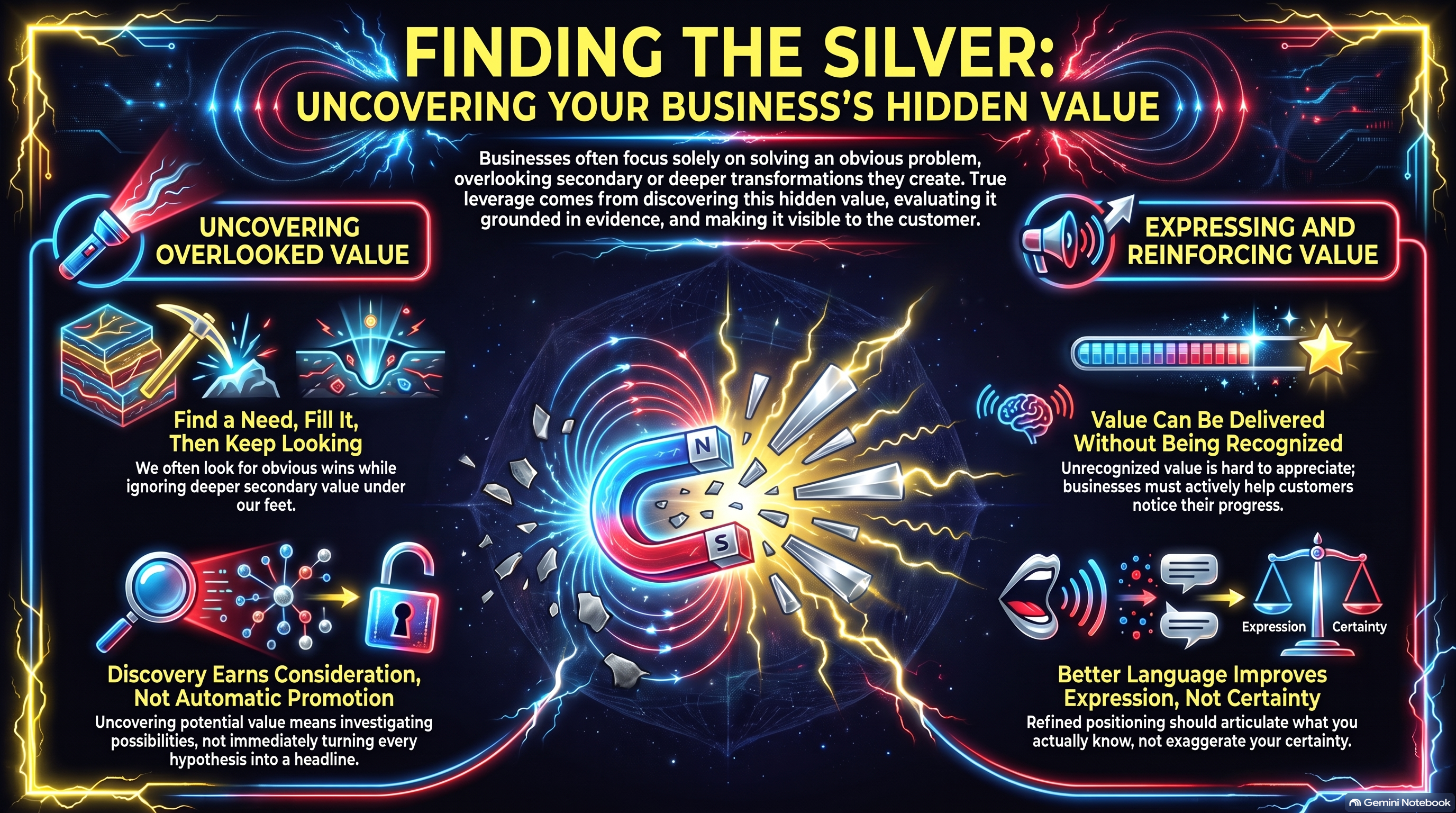
Find a need and fill it.
It's hard to argue with that.
Somebody needs something. You figure out how to provide it. If you can do that better, cheaper, faster, differently, or in a way nobody else has quite figured out, you've probably got the beginnings of a business.
But I've started wondering whether there's a second half to that advice.
Find a need and fill it. Then keep looking.
Because you may be filling more needs than you realize.
──────── ⚡ ────────
Imagine someone who teaches painting.
The obvious transaction is easy to describe.
The customer wants to learn how to paint. The instructor knows how to paint. Money changes hands. Painting instruction occurs.
Need found. Need filled.
But imagine that one of the most common things the instructor hears from prospective students is:
"I'd love to do that, but I'm just not very creative."
That's interesting.
Because the person isn't only telling us they don't know how to paint.
They're telling us something they believe about themselves.
Now suppose they take the class anyway.
They learn some techniques. They practice. They get feedback. Eventually they create a painting they're genuinely proud of.
Did they receive painting instruction?
Absolutely.
Was that the full value of the experience?
Maybe not.
Perhaps they've just acquired evidence against something they've believed about themselves for twenty years.
Maybe painting becomes something they continue doing. Maybe they start noticing color differently. Maybe they discover an activity they enjoy for the rest of their life.
Or maybe none of that happens and they simply learn to paint better.
That's important too.
The point isn't that we should immediately advertise:
UNLOCK YOUR HIDDEN CREATIVE SOUL AND TRANSFORM YOUR LIFE FOREVER!
Please don't. 😄
The point is that the business owner might be so accustomed to delivering certain kinds of value that they no longer notice them.
──────── ⚡ ────────
I've seen versions of this repeatedly while working with business owners.
Someone tells me what they sell.
Then they explain what they actually do.
Then we keep talking.
And somewhere in that conversation, something comes out almost casually.
"Oh yeah, I also help them with that."
Hold on.
You do what?
What they consider an ordinary part of doing a good job may be incredibly valuable to the customer.
The business owner wasn't hiding the value.
They simply hadn't learned to see it as value.
And that's a very different problem from not creating enough value in the first place.
You can't communicate value you haven't learned to see.
──────── ⚡ ────────
It reminds me of something else.
I've watched enough Alone to become fascinated by how people can be surrounded by resources and still struggle because they don't recognize what they're looking at.
Contestants naturally want the big score.
A fish. A rabbit. Something substantial enough to feel like a meal.
Meanwhile there may be smaller resources around them that another person, carrying different knowledge, would immediately recognize as useful.
The resource didn't suddenly appear.
Recognition changed.
Businesses can have the same problem.
We're looking for the deer while standing on the ants.
We're so focused on the obvious thing we sell that we overlook smaller ways the business creates relief, capability, convenience, confidence, enjoyment, connection, access or progress.
Some of those discoveries won't matter much.
Some will matter only to certain customers.
Some will sound wonderful until we examine them and realize we don't have enough evidence to claim them.
But occasionally you find silver.
──────── ⚡ ────────
That's the metaphor I've been using while building this part of the Business Brain Builder.
A prospector goes looking for something valuable with an idea already in mind of what valuable is supposed to look like.
That's necessary. Otherwise they're just wandering around looking at rocks.
But expectations can also create blind spots.
If you're completely focused on finding one thing, something else can sit right in front of you without registering as valuable at all.
Businesses do this too.
We know what the customer bought.
We know the obvious problem we're supposed to solve.
We know the benefit we've been putting on the website for years.
So we keep looking for ways to say those same things more persuasively.
Maybe we need a stronger headline.
Another emotional hook.
More urgency.
Another benefit stacked onto the offer.
But none of those techniques can answer the more fundamental question:
What is actually valuable here?
That's a much better place to start prospecting.
──────── ⚡ ────────
Take a dog trainer.
The obvious problem might be:
My dog keeps peeing on the rug.
Fair enough.
Nobody needs a philosophical treatise on the human-animal bond while they're standing over another wet spot with a roll of paper towels.
Solve the damn problem.
But what happens afterward?
Maybe the owner becomes better at communicating with the dog.
The dog becomes easier to take places. The household becomes less tense. Interactions that used to involve constant correction become more enjoyable.
Perhaps the owner becomes more confident handling future behavior problems.
And over the course of years, maybe that improved relationship contributes to this particular animal becoming one of the great companions of that person's life.
Now we have to be careful.
The dog trainer can't promise all of that.
Some of it may be well supported by customer experience. Some may merely be reasonable possibilities. Some may depend far more on the owner than the trainer.
That's exactly why discovering value and claiming value need to remain two different things.
A possibility deserves investigation.
It doesn't automatically deserve a headline.
Discovery earns consideration, not promotion.
──────── ⚡ ────────
This became one of the more interesting lessons while we've been building the Business Brain Builder.
AI is remarkably good at finding connections.
Give it enough understanding of a business, its customers, their pains, their desired progress, the owner's capabilities, the offer and the way it's delivered, and it can notice relationships that are surprisingly easy for the owner to overlook.
That's useful.
It can also take a perfectly reasonable observation and make it sound like you've discovered the secret to eternal happiness by Tuesday afternoon.
That's less useful.
So the human still has a very important job.
Weigh what it finds.
Is this something we know?
Something we've deliberately decided?
A working hypothesis?
An interesting possibility?
Something we simply don't know yet?
Because better wording doesn't create better evidence.
While developing this part of the system, we arrived at a principle I suspect I'll be carrying around for quite a while:
Better language should improve the expression of what we know, not increase our certainty that it's true.
That's a pretty good rule for marketing in general.
──────── ⚡ ────────
There's another side to this that I think businesses overlook.
Sometimes creating value isn't enough.
The customer needs help recognizing the value they've received.
Not through manipulation.
Through observation.
The painting instructor can point out that the student just solved a visual problem they couldn't even identify six weeks ago.
The dog trainer can help an owner notice that they're no longer constantly correcting the dog.
A coach can remind someone that a decision which once consumed three days of uncertainty has just become an ordinary Tuesday-morning decision.
Something changed.
Helping the customer notice that change isn't taking credit for something you didn't do.
It's helping them understand their own progress.
And that matters because:
Value can be delivered without being recognized.
Unrecognized value is harder to appreciate, harder to describe, harder to remember and harder to recommend to somebody else.
Sometimes delivering the value and making the value visible are two different jobs.
──────── ⚡ ────────
Which brings me back to that old advice.
Find a need and fill it.
I still love it.
But after spending this much time trying to teach an AI how to understand a business deeply enough to become useful to its owner, I'd add one more sentence:
Then keep looking. You may be filling more needs than either you or your customer realized.
Not every discovery belongs in an advertisement.
Not every possibility becomes a promise.
Not every piece of silver is worth mining.
But you can't make that decision about value you haven't learned to see.
And sometimes the thing you've been searching for isn't another product, another funnel, another clever hook or another reason someone should buy.
Sometimes you're already standing on it.
You just need to recognize what's underneath your feet.
──────── ⚡ ────────
Want more thoughts like this?
The Currents is where I share what we're discovering while building businesses, systems, and the Business Brain Builder.