
What If You Didn't Have to Invent Your Offer? | Business Brain Builder
What If You Didn't Have to Invent Your Offer?
There’s a peculiar moment that happens when you spend enough time trying to understand a business.
Eventually, you sit down to create something that should be difficult and discover that much of the work has already been done.
I ran into that recently while working through a deceptively simple question:
What, exactly, are we selling?
Not the category. Not “coaching,” “marketing services,” “martial arts classes,” or whatever convenient label fits in the navigation menu. I mean the thing someone is actually being invited to buy—the progress it offers, what they receive, what both sides commit to, how it works, where its boundaries are, and what happens after somebody says yes.
That sounds like the beginning of developing an offer.
I'm starting to think it belongs much closer to the end.
──────── ⚡ ────────
Sometimes You Find Out Too Late
Years ago, I worked with a client who spent the better part of a year getting ready to market her business.
We built pages. Funnels. Advertising. Systems. A tremendous amount of the machinery was in place, and we were getting close to the point where it could finally start doing what we'd built it to do.
Then she realized she didn't really want to work with people outside her immediate area.
That wasn't a headline problem.
It wasn't something we could fix by changing the Facebook targeting and swapping a paragraph on the landing page. Much of what we'd built assumed a business capable of reaching and serving people across a considerably broader market.
The machinery wasn't necessarily broken. We'd built machinery for a destination she no longer wanted to reach.
I've thought about that experience differently while building the Business Brain Builder because we had spent an enormous amount of effort figuring out how to get there before the destination itself had been made sufficiently clear.
You can execute brilliantly in the wrong direction.
And the later you discover that, the more expensive the discovery becomes.
That's true far beyond marketing. An early assumption rarely stays politely by itself. Other decisions begin attaching themselves to it. Those decisions produce dependencies. The dependencies eventually become pages, systems, automations, spending, processes and expectations.
By then you're no longer correcting one assumption. You're dealing with everything that inherited it.
The farther downstream a foundational uncertainty survives, the more expensive it becomes to discover.
That doesn't mean we need to know everything before we act. We'd never get anything built.
But it does mean there are some questions worth encountering while they're still cheap questions.
──────── ⚡ ────────
You Don't Need to Know Every Rock
You don't need to know every rock you'll encounter before you start climbing. But it helps enormously to know which mountain you're trying to climb.
That distinction has become increasingly important to me.
There are things we simply can't know until we put something in front of real people. We can speculate about price, response rates, objections, customer behavior and capacity all day long, but eventually reality gets a vote.
Other things can be understood much earlier.
What kind of business are we trying to build? What kind do we not want to build? Who do we actually want to help? What are those people dealing with? What progress matters to them? What are we genuinely equipped to provide?
Those questions don't produce an offer immediately. They produce understanding.
And understanding accumulates.
You learn more about the customer and discover that the problem they first describe isn't necessarily the problem underneath it. You look at the owner and realize that a theoretically scalable business isn't automatically a desirable one. You examine how customers can access the business, how delivery works, what the owner is particularly good at and where the real constraints live.
Gradually, the possible shape of the business becomes less imaginary.
That's very different from sitting down with a blank document and deciding it's Offer Creation Day.
──────── ⚡ ────────
I Thought We Were Almost There
This became particularly obvious while I was working through the Business Brain Builder.
We had reached the point where I thought we were almost ready to crystallize the primary offer. We had already accumulated a substantial amount of information about the business, its customers, what they wanted, what the owner wanted, how the business could reach and serve them, and where it was trying to go.
It felt like offer time.
Instead, another question got in the way.
What happens if this thing actually works?
Mildly inconvenient.
Also rather important.
Because an offer sitting in a document is easy to operate. It has no customers.
Once people start saying yes, somebody has to onboard them. Somebody has to deliver what was promised, answer questions, provide support, track whatever needs tracking and maintain the quality that made the offer attractive in the first place.
At ten customers, the founder's personal involvement might be one of the strongest parts of the offer. At fifty, the exact same involvement might become the thing preventing the business from serving customer number fifty-one.
Or maybe fifty is completely wrong. Maybe it's twelve. Maybe it's two hundred.
The number isn't the point.
The point is that success changes the conditions under which the offer has to work.
So instead of finishing the offer, we stopped and pressure-tested the business behind it. Where was the owner actually essential? What could another person eventually handle? What would have to be understood before that responsibility could be transferred? Where might quality begin slipping? What would probably break first if demand increased?
Not because every business should become enormous.
Quite the opposite.
The question was whether the business could responsibly fulfill the level of success its owner actually wanted.
Only after that did it make sense to return to the offer.
──────── ⚡ ────────
And That's When the Blank Page Changed
By then, something strange had happened.
We weren't really inventing the offer anymore.
We knew considerably more about the people it was for and the progress they were trying to make. We understood more about what the business could responsibly promise, what the customer would need to contribute, how delivery might work, where the owner's involvement mattered and where the boundaries probably belonged.
Some things were decisions. Some were supported by experience. Some were still working assumptions. A few remained genuine unknowns.
That's okay.
The goal wasn't to make uncertainty disappear so the document would look finished. It was to stop important uncertainty from hiding.
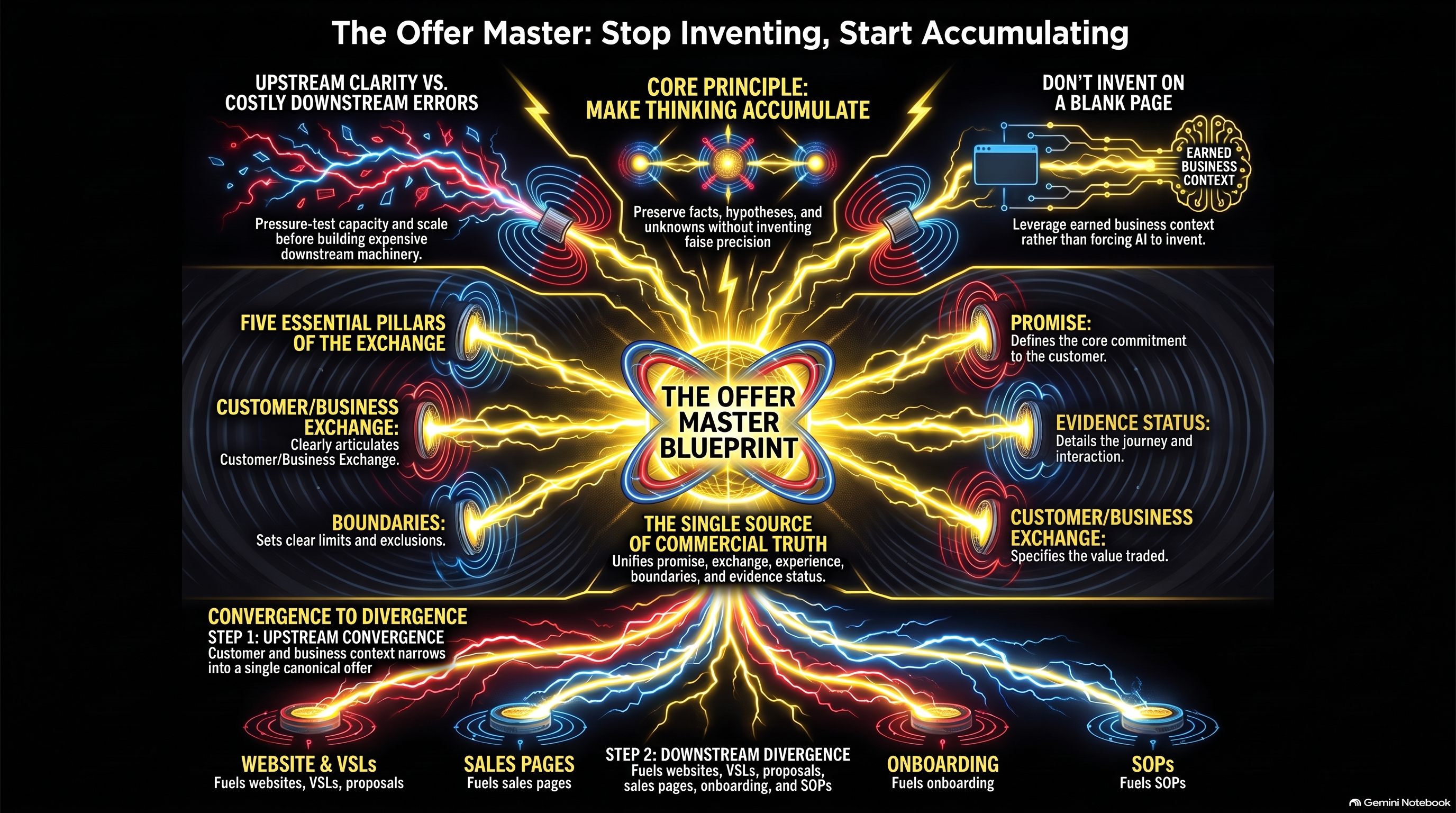
And when we finally gathered all of that into what I've been calling the Offer Master, the exercise felt surprisingly different from conventional offer creation.
The Offer Master isn't sales copy. Customers may never see it.
It's simply one reliable source for what we're actually selling: who it's for, the progress we're offering to help create, what they receive, how the relationship works, what each side commits to, what it costs, where the boundaries are, what evidence we have and what we still need reality to teach us.
Instead of asking AI to invent something compelling, we could effectively say:
Look at what we've learned. Help me assemble it.
That is a very different job.
──────── ⚡ ────────
The Answer Was Hiding in the Work
This is the part I nearly missed while we were building it.
The quality of the final answer wasn't created at the end. The earlier work made the answer possible.
Every time we clarified something important about the customer, we contributed to it. Every time we discovered something about the owner's capabilities or constraints, we contributed to it. Decisions about delivery, pricing, access, capacity and the kind of business we actually wanted all narrowed the space in which the final answer needed to be found.
There was less to invent because there was more to understand.
And that made me look back at my client's experience again.
We had done an enormous amount of downstream work before discovering an upstream answer that changed the meaning of much of it.
That doesn't make planning perfect or eliminate expensive mistakes. Nothing will. Some foundational beliefs will turn out to be wrong only after reality gives us evidence we couldn't have had earlier.
But there's an important difference between an uncertainty that requires experience and one we simply haven't stopped to examine yet.
I'm becoming increasingly interested in finding the second kind before we build too much on top of it.
──────── ⚡ ────────
The Direction Changes at the Top
There's another interesting thing about finally reaching that point.
Most of the journey toward the Offer Master converges.
We learn about the business, the customer, the problem, the desired progress, the owner, the possible relationship and the practical consequences of delivering it. Possibilities gradually become decisions. Decisions get pressure-tested. Some survive. Others change.
Eventually all of that accumulated understanding can crystallize into one coherent offer.
Then the direction reverses.
Now the offer can begin feeding other things.
A website doesn't have to rediscover what we're selling. Neither does a sales page. A VSL, proposal, webinar or sales conversation can draw from the same understanding. Advertising can inherit it. So can follow-up, onboarding and eventually the operating material needed to help other people represent or deliver parts of the business.
Each of those applications will still require thought. Some will uncover new questions. Real experience will inevitably teach us things that send us back upstream to correct or refine what we thought we knew.
That's healthy.
But we don't have to reinvent the business every time we create something for it.
That's the part that feels powerful.
──────── ⚡ ────────
Maybe We've Been Looking at the Wrong AI Advantage
A lot of the excitement around AI still centers on production.
Write the email faster. Build the page faster. Create more ads. Generate more headlines. Turn one thing into twenty things before lunch.
There's real value in that.
But speed becomes a lot less impressive when we're accelerating in the wrong direction.
The more interesting advantage may be what happens when AI has accumulated context to work from—and when the person directing it has accumulated understanding alongside it.
By the time we reached the Offer Master, the AI wasn't the only thing with better information. I understood the business problem better too.
That's easy to overlook.
Working through the questions changes the operator. You become better able to recognize when an answer fits, when something important is missing, when an assumption has quietly become a “fact,” and when the AI has confidently produced something that sounds excellent but belongs to somebody else's business.
The Business Brain improves the context available to the machine while also forcing the human to make, examine and preserve better decisions.
That's a considerably more interesting partnership than getting a better prompt.
──────── ⚡ ────────
Maybe the Blank Page Was Never the Problem
The blank page may simply be where we finally notice what we failed to understand upstream.
AI can hide that problem remarkably well because it is extraordinarily good at putting something on the page.
But perhaps the goal shouldn't be to eliminate every blank page as quickly as possible.
Maybe it's to arrive at fewer of them empty-handed.
Do enough of the right thinking early, preserve what you learn, let reality correct you when it earns the right, and the next decision gets to inherit the work that came before it.
That's the principle underneath all of this that I don't want to lose:
The goal isn't to eliminate thinking. It's to make thinking accumulate.
Because accumulated understanding compounds in one direction, while unresolved foundational assumptions can compound in the other.
We don't need perfect certainty before we start climbing. We don't need a complete map of every rock, turn and loose patch of ground waiting ahead.
But before we spend a year building a road up the mountain, it might be worth making sure we're looking at the peak we actually want to reach.
And once we've done enough of that work, something rather wonderful begins to happen.
The blank page didn't disappear because the AI got smarter.
It disappeared because the business finally had something worth telling it.