What Kind of Business Are You Actually Building?
What Kind of Business Are You Actually Building?
It sounds like an easy question.
Until you try to answer it.
Maybe you sell a service.
Except you’ve also thought about creating a course.
Maybe there’s a product involved. Maybe some customers need hands-on help while others could do most of it themselves.
Maybe part of what you do only works locally while another part could reach customers anywhere.
Suddenly:
“What kind of business do you have?”
isn’t such a simple question anymore.
And if you’re still developing the idea, it can be even harder.
You may understand the people you want to help.
You may understand the problem.
You might even have a pretty good idea of the change you’d like to help create.
But then comes the giant question:
So what exactly should you sell?
──────── ⚡ ────────
This Is Where Things Can Go Sideways
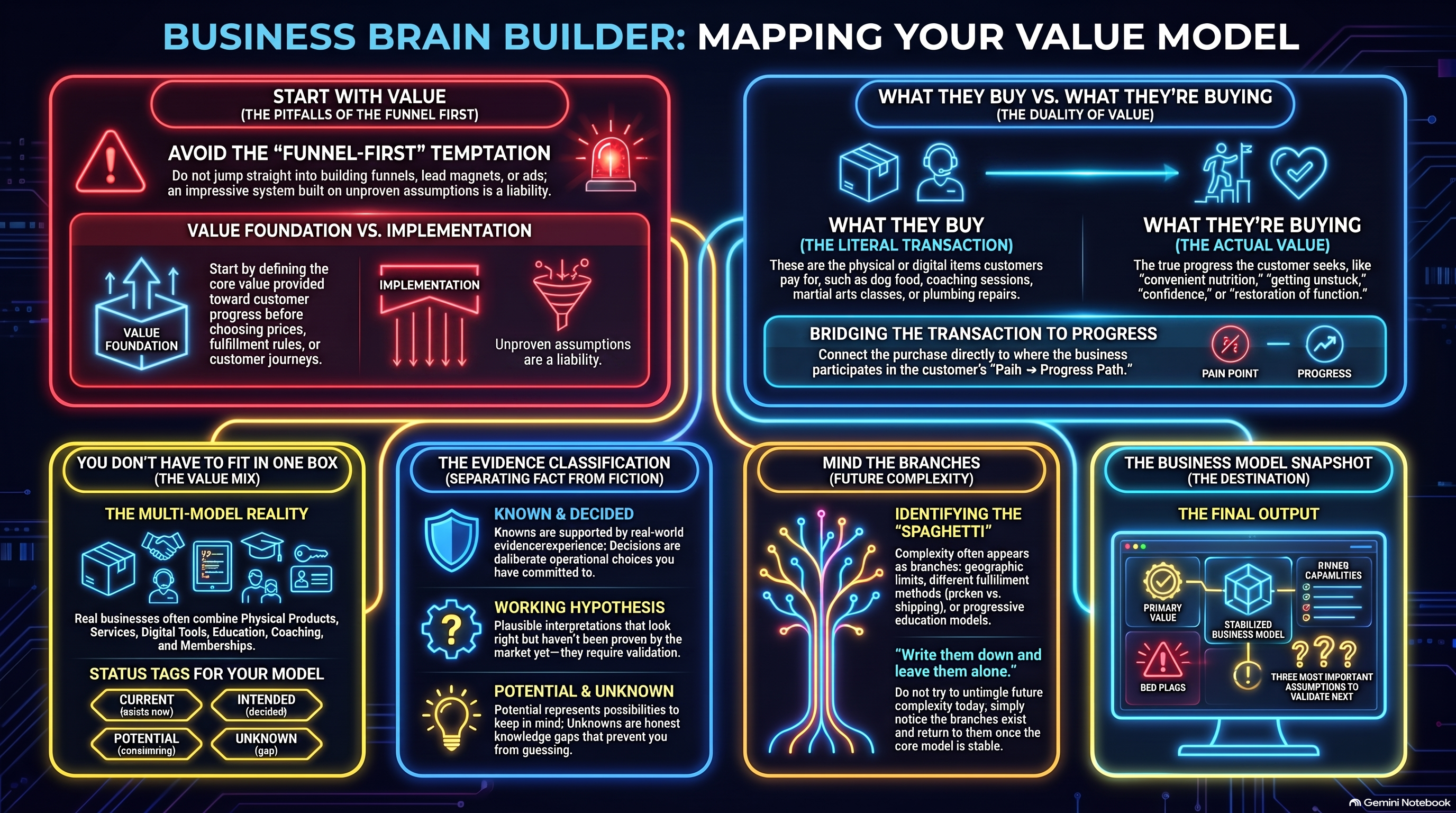
There’s a temptation at this stage to start building.
Pick an offer.
Choose a price.
Make a funnel.
Create a lead magnet.
Start running ads.
Maybe somebody tells you that you need a webinar.
Or a course.
Or a membership.
Or a high-ticket coaching program.
Those can all be perfectly good ideas.
For the right business.
The problem is that we haven’t necessarily figured out what the right business is yet.
That’s how you can end up building an impressive system around assumptions that eventually turn out not to be true.
Sometimes the problem isn’t the funnel.
The problem is that we built the funnel before asking enough of the questions that should have come first.
──────── ⚡ ────────
Start With the Value
In the last stage of the Business Brain Builder, we looked at the customer’s Pain → Progress Path.
What are they struggling with?
What do they want instead?
What might actually be underneath the symptoms they first describe?
Now we can turn around and look at the business.
Not:
What funnel should we build?
Not:
What should the lead magnet be?
Not even:
How should we deliver the product?
First:
What value can this business actually provide toward the progress that customer wants?
That’s a much smaller question.
And a much more useful one.
──────── ⚡ ────────
What They Buy Isn’t Always the Same as What They’re Buying
Someone buys dog food—but what they may really value is a convenient way to provide nutrition they believe is better for their pet.
Someone buys business coaching—but what they may really value is expertise, perspective, accountability, and help getting unstuck.
Someone buys martial arts classes—but the value may include instruction, progression, confidence, fitness, and community.
Both sides matter.
What does the customer actually buy?
and
What value does that purchase provide?
That’s where the shape of the business starts becoming clearer.
──────── ⚡ ────────
You Don’t Have to Fit Into One Box
This is where business-model exercises can become unnecessarily frustrating.
What if you sell products and services?
Fine.
What if you teach and consult?
Fine.
What if you have recurring customers but also sell one-time products?
Also fine.
Real businesses aren’t obligated to fit neatly into a worksheet.
A pet food company might provide physical food, supplements, and education.
A martial arts studio might provide memberships, private instruction, seminars, and equipment.
A consultant might offer implementation, advisory services, courses, and group programs.
We don’t have to figure out how every piece fits together yet.
For now, it’s enough to notice:
These are the ways this business creates—or could create—value.
──────── ⚡ ────────
And If You Don’t Know Yet?
That’s where this gets interesting.
If you already have an established business, we can work from reality.
If you’re building something new but know what you want to create, we can work from intention.
But what if your answer is:
“I know who I want to help. I just don’t know what the business should actually be yet.”
That’s useful too.
Because now we have something better than a blank page.
We can look at what the customer needs, what you know how to do, what resources you have, what kind of work you actually want to perform, and what would make the business worth building for you.
Now AI has something meaningful to work with.
Instead of asking:
“Give me some business ideas.”
we can ask it to explore realistic possibilities at the intersection of:
Customer Need × Your Capabilities × Your Preferences × Your Constraints
That’s a much better deck to deal from.
──────── ⚡ ────────
But Don’t Let Possibility Become Fact
This is one of the distinctions we’re deliberately building into the Business Brain.
Something can be:
KNOWN — we have reasonable evidence for it.
DECIDED — you’ve chosen it.
A WORKING HYPOTHESIS — it looks plausible, but we haven’t proven it.
POTENTIAL — it’s worth remembering.
UNKNOWN — we simply don’t know yet.
Those are not interchangeable.
If you decide:
“I’d eventually like to create an online education program.”
Great.
That’s a decision about direction.
If AI then concludes:
“People nationwide will happily pay $97 for it.”
Hold on.
That’s a hypothesis.
Customers haven’t voted yet.
One of the fastest ways to build a very impressive imaginary business is to forget the difference.
──────── ⚡ ────────
And Please Don’t Solve Everything Yet
This is probably the hardest part.
Once you start seeing the business more clearly, you’re going to discover more questions.
What if some products can ship nationwide but others can’t?
What if customers can pick something up or have it delivered?
What if one service requires you personally while another doesn’t?
What if part of the business is local but education could be sold anywhere?
What if customers could buy once, repeatedly, or eventually subscribe?
Those are good questions.
Write them down.
Then leave them alone.
Seriously.
You have just discovered branches.
You don’t need to climb every one of them today.
──────── ⚡ ────────
Build Enough Understanding to Make the Next Question Easier
That’s the larger idea behind this stage of the Business Brain Builder.
We’re not trying to finish the business.
We’re trying to understand enough about it that the next important question becomes easier to answer.
We already worked on:
Who are we trying to help?
Then:
What are they trying to move away from and toward?
Now:
What kind of business are we building to create value along that journey?
Soon we can ask:
How does that value actually reach and get delivered to them?
And eventually we’ll have earned the right to start asking questions about offers, customer journeys, funnels, campaigns, automation, and implementation.
In that order.
Because discovering halfway through a completed marketing system that one little assumption underneath it was wrong can change an awful lot.
──────── ⚡ ────────
Packet 006: What Kind of Business Are We Building?
That’s what we’re adding to the Business Brain this time.
Not a finished business plan.
Not every product.
Not every possibility.
Not the entire roadmap.
Just a useful working picture of:
what the business sells,
what value it creates,
how that connects to the customer’s desired progress,
what exists today,
what you intend to build,
what possibilities are worth remembering,
and
what we still don’t know.
That’s enough.
Because a good Business Brain doesn’t need to know everything today.
It needs to know enough to make tomorrow’s questions easier.