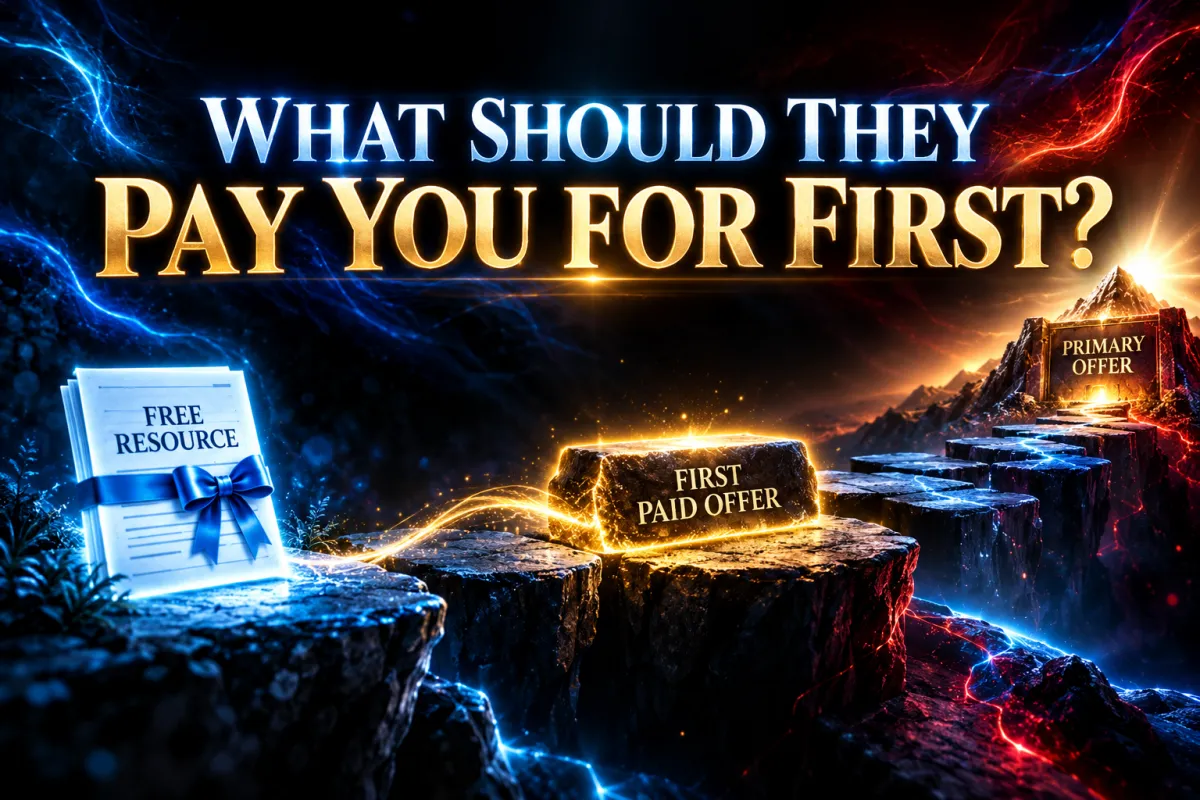
What Should They Pay You For First?
What Should They Pay You For First?
“Create a mini-course.”
Three modules. A few worksheets. Maybe a bonus or two. Put a price on it, connect the checkout page, and congratulations—you have your first little paid Offer.
Except there's a question hiding underneath all of that:
What should somebody actually pay you for first?
Somewhere between the free thing that earned someone's attention and the larger thing that might eventually solve much more of their problem, there can be a useful little stretch of road: something bigger than information, smaller than the complete solution, and meaningful enough that someone might reasonably pay to travel it.
Finding that stretch sounds like an Offer problem. I've become convinced it's also a surprisingly deep human one.
──────── ⚡ ────────
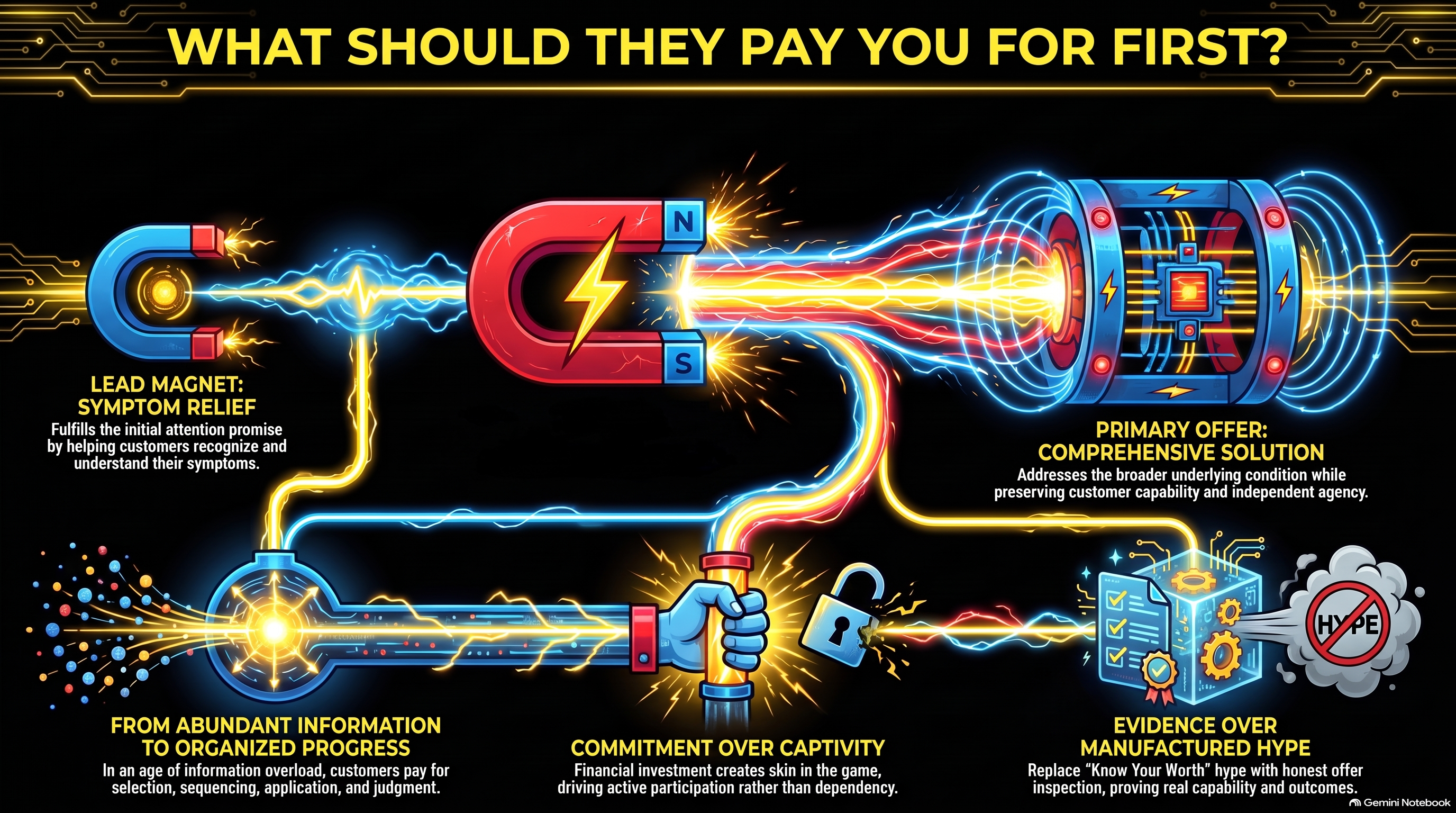
A Lead Magnet should do something useful. That's worth saying because there's an unfortunate version of marketing where the free thing is deliberately kept weak enough that the person has to buy something else to get the answer they thought they were coming for.
I don't like that.
If we promised five warning signs that your business books can't be trusted, the person should finish our free resource knowing those five warning signs and understanding them better. Promise fulfilled.
But recognition isn't necessarily resolution. Someone can finish that guide thinking, “Yep. I'm pretty sure my books can't be trusted.” That's useful progress, but it also leaves a very reasonable next question: Now what?
Perhaps our first paid Offer helps them audit their current books, identify where the most serious problems are coming from, and leave with a prioritized correction plan. Now we've crossed an important boundary. The free resource helped them recognize a condition; the paid experience helps them diagnose it in their situation and begin doing something about it.
The boundary isn't really free information versus paid information. It's the kind of progress each promise creates. The free resource promised recognition, so recognition needs to be complete. The paid Offer promises diagnosis and an actionable next step, so that's where its responsibility begins. We aren't charging the Customer to finish yesterday's promise. We're making a new promise.
They don't need to hire us afterward for that purchase to have been worthwhile. They bought a useful transformation and received one.
That's what I've started thinking of as the first treatment worth paying for. Not the entire cure, and not another pamphlet about the symptoms, but a complete small transformation inside an incomplete larger one.
Then we have to name the damn thing.
Suppose yesterday I gave you 5 Reasons Your Marketing Isn't Working. Today I email you an Offer for The 5 Reasons Your Marketing Isn't Working Mini-Course — Only $27!
You'd be forgiven for wondering whether I had just discovered a price tag overnight.
Maybe the course really is dramatically more useful. Perhaps it contains hours of instruction, exercises and implementation guidance. But I've made you do the detective work necessary to figure out why yesterday's free promise has become today's paid promise. Worse, I may have made yesterday's gift retroactively feel like bait.
Compare that with something like The Marketing Message Checkup. You already learned some of the reasons marketing can fail. Now we're going to examine your messaging, find the largest gaps between what you're saying and what your Customers need to understand, and leave you with a prioritized correction plan.
Different job. Different outcome. Recognizable progression.
Free should fulfill the promise that earned the attention. Paid should introduce a new promise worth purchasing.
If we can't describe that new promise without making it sound suspiciously like the free one, we may not merely have a naming problem. We may have discovered that our Offer boundary isn't very good yet.
That's useful information.
──────── ⚡ ────────
Unfortunately, making the distinction clear doesn't eliminate the uncomfortable part, because sometimes the next response is, “If you really cared about helping people, you'd make this free too.”
I've watched versions of this hit businesses particularly hard when their work touches health, spirituality, education, coaching, personal development or other areas where the Customer may already be hurting. It's a powerful accusation because it doesn't say the price is too high. It says the existence of a price reveals something ugly about the person charging it.
For a conscientious business owner, that can land hard.
There certainly is predation in business. Human suffering can be profitable. Fear can be exaggerated, dependency can be cultivated, and sometimes a Customer who keeps needing treatment is more economically attractive than one who becomes capable of moving forward without us. Pretending those incentives don't exist isn't the answer.
But neither is concluding that receiving money for helping someone makes the help corrupt.
A plumber gets paid when your house floods. A veterinarian gets paid when your animal is sick. A therapist gets paid when someone is struggling, and a mechanic benefits economically from the fact that cars break. The moral question can't simply be whether the provider benefits from the existence of a problem. A much better question is what they're doing to earn that benefit.
Are we helping resolve the problem honestly, or exaggerating it? Are we hiding a simpler solution? Are we manufacturing dependency? Would we still recommend what was best for the Customer if doing so meant they bought less from us?
Those questions should make us uncomfortable when the answers aren't good. That's what conscience is for. But conscience isn't supposed to make every difficult exchange impossible. It's supposed to make us pay attention to how we conduct it.
There's another side to charging that gets lost in this conversation too. Sometimes the Customer needs to put something into the exchange.
Anyone who has ever downloaded a fascinating free PDF and sentenced it to life in the Downloads folder probably knows where I'm going with this. Information doesn't create transformation merely by arriving. People abandon free courses, inexpensive courses, and even college courses they paid thousands of dollars to attend.
Money certainly doesn't guarantee participation, but deliberately investing something can change our relationship with what we've purchased. There's a decision behind it now, something has been put at stake, and there's another reason to open the course, do the exercise, attend the session, finish the implementation and extract the value we believed was there when we bought it.
For many transformations, the provider can only do part of the work. I can't exercise for you. A coach can't practice the skill for you. A teacher can't make you study. A consultant can build an extraordinary roadmap and still cannot force you to walk it. Sometimes charging isn't merely how the provider sustains the work; the exchange itself can help the Customer commit to doing theirs.
That idea can be abused too. “If you were REALLY committed, you'd max out another credit card!” is not an ethical pricing model. Financial pain isn't proof of commitment, and charging more doesn't magically make an Offer better.
Skin in the game should create commitment, not captivity.
In fact, that distinction has become increasingly important to me. A healthy progression should create increasing Customer capability rather than increasing Customer captivity. The free resource shouldn't be crippled to force the paid Offer, the paid Offer shouldn't be crippled to force the Primary Offer, and the Primary Offer shouldn't deliberately preserve dependency merely because dependency produces recurring revenue.
That doesn't mean every purchase has to solve the Customer's entire problem. Our bookkeeping audit doesn't need to rebuild someone's books. A fitness coach doesn't have to permanently eliminate the usefulness of fitness coaching. An accountant has yet to discover a cure for taxes.
Some problems continue. Some skills require practice. Some relationships create legitimate ongoing value. The standard I'm interested in is simpler: Did this exchange honestly produce the progress we said it would? If the Customer stops here, do they still possess something worthwhile?
If yes, wonderful. If they want to continue because the next stage creates additional progress, we can make another Offer.
No hostage-taking required.
──────── ⚡ ────────
All of this also changes how I think about the business owner's confidence.
Marketing has plenty of answers for imposter syndrome. Know your worth. Charge what you're worth. Believe in yourself. Raise your prices. Somebody probably has a $997 course teaching you to confidently charge $2,997.
But what if the uncomfortable voice is occasionally right?
What if the Offer isn't good enough, the evidence isn't there, we're promising too much, or we're charging for something that barely advances the Customer beyond what we already gave them? I don't want to teach someone to silence that voice. I want to give it better evidence.
That's one of the reasons I've become so interested in building a Business Brain. Instead of asking an owner to manufacture confidence, we can inspect the Offer. Who is it for? What problem are we treating? What does the Customer know or possess before, and what can they understand, decide, create, correct or do afterward? What does the experience actually contain? What are we deliberately not promising? What evidence supports our belief that it will work, and what remains hypothesis? What does the Customer have to contribute for the transformation to occur? Would the purchase still be worthwhile if they never bought anything from us again?
Sometimes that examination should tell us, don't sell this yet. Good. That's not failed confidence; that's judgment. Other times we may finish the same examination and realize that, yes, this really does help. In that case we haven't manufactured confidence through another round of Know Your Worth! affirmations. We've earned some by understanding what we're actually offering and why it deserves to exist.
The Business Brain doesn't need to convince the owner that they're valuable. It can help the owner determine whether the Offer is valuable.
And that matters because the ethical problem cuts in both directions. Human beings are perfectly capable of rationalizing predatory behavior when survival, status or money is involved. We're also capable of becoming morally paralyzed by standards nobody could sustainably satisfy.
An AI shouldn't simply reassure us in either direction. Give it enough real business context and it can challenge both. If we're making claims our evidence doesn't support, hiding a simpler answer, manufacturing fear or building unnecessary dependency, it should be able to point at the problem. If the free Offer fulfilled its promise, the paid transformation is genuinely distinct, the Customer retains agency and the evidence supports what we're claiming, it doesn't need to shout, YOU'RE WORTH IT! It can simply help us see that there isn't evidence of predation merely because money changed hands.
That feels like a much healthier use of the technology.
Ethical review should challenge both rationalization and unnecessary guilt.
──────── ⚡ ────────
Then, after all that work, we finally put the Offer in front of people.
Nobody buys it.
Well, crap.
“The market has spoken.”
Maybe. But what exactly did it say?
A sale is evidence. A lack of a sale is evidence too. Neither automatically tells us what the evidence means. Maybe the transformation wasn't valuable. Maybe the price was wrong, or the Customer couldn't recognize the value before experiencing it. Perhaps we named it too similarly to the free resource, hadn't earned enough trust yet, packaged information they can already find everywhere when what they actually need is application, or simply showed the right Offer to the wrong people.
Or perhaps we've entered a market where enormous amounts of useful information have become culturally expected for free.
That's real too.
We live in an astonishing information environment. Articles, videos, templates, communities, free software and now AI can place more knowledge in front of someone before breakfast than earlier generations might have encountered on a subject in months. That doesn't necessarily make the knowledge less useful. It makes information less scarce.
Which may mean the thing worth paying for is increasingly something else: selection, diagnosis, application, sequencing, feedback, accountability, personalization, implementation and judgment.
Perhaps the scarce resource isn't information anymore. Perhaps it's organized progress.
That's why I don't think “the market decides what you're worth” is quite right either. The market gets an extremely important vote on whether a business can sell something sustainably, but it doesn't get sole authority over whether something is true, useful, ethical or humanly valuable. At the same time, I don't get to declare something commercially valuable merely because I worked very hard on it or sincerely believe people need it.
Both sides have something to teach us.
If people don't buy, investigate. Don't immediately surrender, but don't immediately blame them either. “They didn't buy” is an observation. “They didn't buy because the Offer has no value” is an interpretation.
What, exactly, did reality just teach us?
──────── ⚡ ────────
That question is one of the reasons I've taken such an absurdly deep dive into all of this.
I've worked with people I could help and encountered people I couldn't. There are Offers that work, Offers that don't, Customers who act, Customers who don't, things we understand immediately and things we only understand years later.
It seems incredibly wasteful for all of those lessons to disappear into memory while the next business decision starts again from a blank page.
I want the Business Brain to remember enough that we can ask better questions next time. Not so AI can tell us we're brilliant, manufacture a justification for whatever price we wanted to charge, or teach us to become a little more sociopathic about asking for money. Quite the opposite.
I want enough accumulated intelligence that when conscience starts asking difficult questions, we have something better to give it than fear.
Before deciding what somebody should pay you for first, then, perhaps the useful test isn't What can I put behind a checkout page? Ask what the Customer will be able to understand, decide, create, correct or do afterward that they couldn't before. Ask whether the free promise has already been completely fulfilled, whether this new promise can stand on its own, whether the Customer leaves more capable than they arrived, and whether you'd still recommend what's best for them if that meant they never bought the thing after it.
Then ask the uncomfortable commercial question too: Is that additional progress important enough that these Customers will actually exchange money for it?
We don't know that merely because we built something useful. That's where reality gets its vote.
Modern life insulates us from an awful lot of difficult exchange. Most of us don't grow our food, butcher the animals we eat, build our homes or personally generate our electricity. A grocery store, an employer, a utility company and thousands of specialized businesses stand between us and much of the machinery that keeps us alive.
Money helped make that specialization possible. Jobs abstract the exchange even further.
Then somebody starts a business, and suddenly part of the abstraction disappears.
There's another person in front of you with a problem. You believe you can help. Helping costs you time, knowledge, effort and resources, and continuing to help requires your business to survive. Eventually you have to look across that exchange and say, “I have something that may help you. This is what I'm asking in return.”
That can feel uncomfortable. Maybe some of that discomfort is worth keeping.
The goal isn't to stop caring enough that selling becomes easy. It's to understand the exchange well enough to know when it's honest. Give something useful for free if that's what you promised, and fulfill the promise. Find the next meaningful piece of progress and make sure it can stand on its own. Ask the Customer to participate. Charge something that makes sense. Watch what happens, learn from it, and improve.
If the Customer chooses to go no further, make sure they can leave with what they paid for.
Maybe that's what somebody should pay us for first.
Not three modules, a tripwire, or a $27 box in a funnel diagram, but a meaningful piece of progress that both sides can feel good about exchanging.
Then we can worry about Module 2.