
What We Do: The Difference Between What You Can Do and What You Should Sell
What We Do: The Difference Between What You Can Do and What You Should Sell
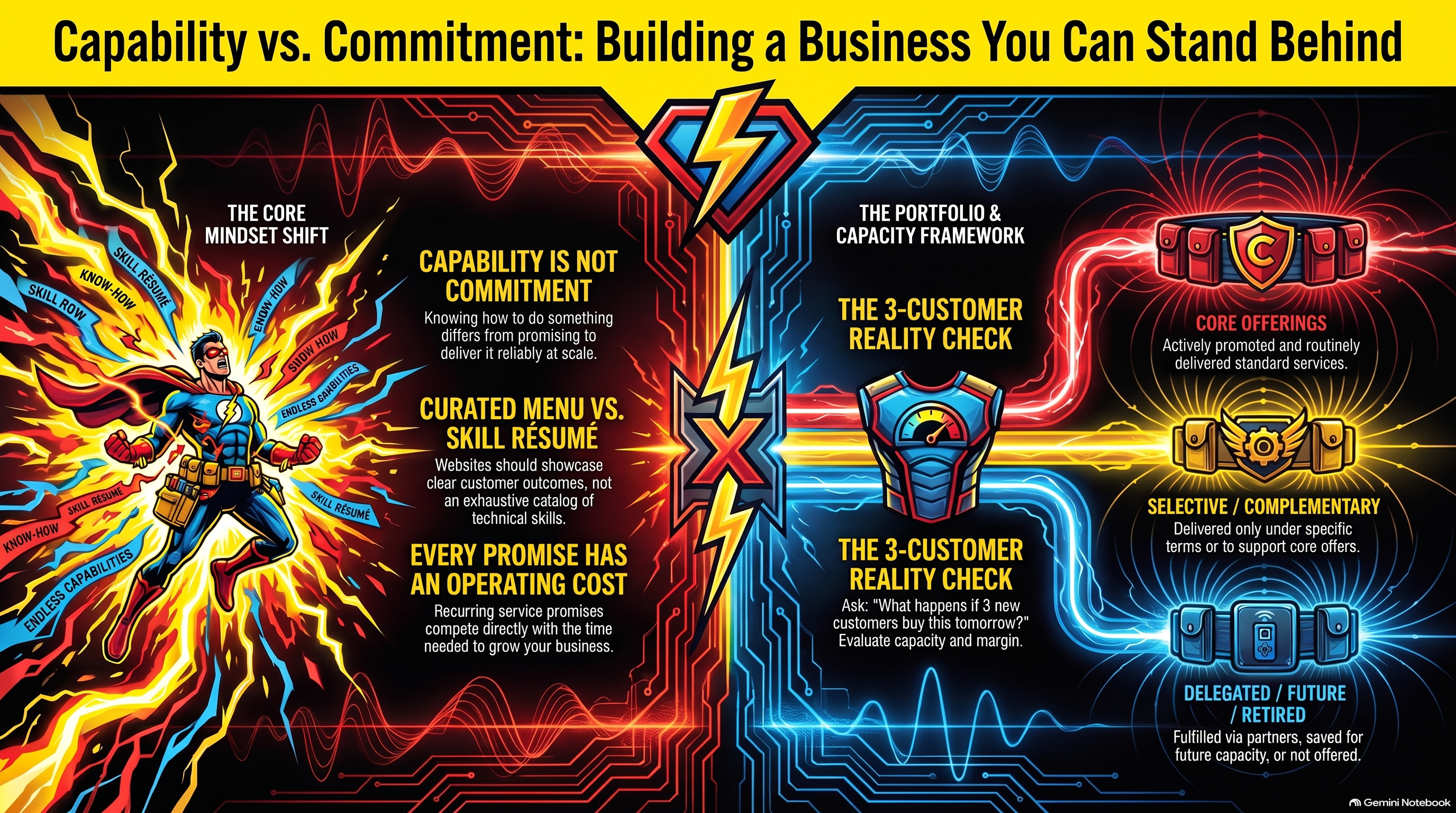
Your business may be capable of far more than it should promise. Learning the difference can change how you grow.
Somewhere along the journey of building a business, somebody asks a perfectly reasonable question.
"So, what do you do?"
In the beginning, you might have a pretty straightforward answer. You're a web designer. A business coach. A landscaper. A photographer. You sell handmade candles, build marketing funnels, or help people organize their finances.
Simple enough.
Then you get better at what you do.
You learn new tools. Customers ask for things you hadn't considered. You discover that one service naturally leads to another, and before long, you're solving problems that weren't even on your radar when you started.
Eventually, somebody asks that same innocent question again.
"So, what do you do?"
And suddenly you need a whiteboard, three cups of coffee, and approximately forty-five minutes to explain.
Welcome to the wonderful world of business growth.
The more things you become capable of doing, the harder it can become to decide what your business should actually offer.
When Your Skills Outgrow Your Business Model
I know this one from experience.
When I began developing Magnetix Marketing, the possibilities seemed to multiply every time I learned something new. Marketing funnels led to customer relationship management. CRM systems led to automations. Automations led to appointment booking, email campaigns, follow-up sequences, and increasingly sophisticated ways to help businesses connect with their customers.
And that was before we started talking about advertising, courses, memberships, websites, and social media content.
Each capability made sense. Each had potential value.
But there's a dangerous little assumption hiding inside that kind of growth:
If I know how to do something, I should probably offer it.
It sounds generous. Entrepreneurial, even.
Sometimes it's exactly the right instinct.
Other times, it's how you accidentally build yourself a job with seventeen departments, no employees, and a boss who refuses to acknowledge that weekends exist.
The problem isn't learning too many skills. Those skills can make you a better problem-solver, even when you never sell them individually.
The problem is confusing capability with commitment.
Knowing how to do something is one thing. Promising customers that your business will reliably deliver it is something else entirely.
The Service That Taught Me the Difference
Social media content became one of those lessons for me.
I could create graphics, develop messaging, organize content, and help businesses maintain a more professional presence online. I had someone helping me deliver that work, and it seemed like a reasonable service to include among Magnetix Marketing's offerings.
Then I lost that support person.
I also lost a customer who reasonably expected more regular content than I could personally keep up with. Without the extra help, what had been a manageable service became another recurring obligation competing with everything else I was trying to build.
Meanwhile, I was experimenting with social media across my own projects, and the differences were remarkable.
Some subjects naturally invited discussion and sharing. The Supreme Being of Light Project, for example, had produced excellent engagement when I was spending roughly an hour a day participating, sharing, and interacting with people.
Other projects, particularly those with a more conventional business focus, struggled to gain traction.
Same person. Similar tools. Very different audience responses.
That experience made it difficult to pretend that social media success could be packaged into a predictable formula.
And the project that was working so well came with its own lesson: I was personally investing significant time to make that engagement happen. As the platforms increasingly encouraged video content and other forms of participation, maintaining momentum demanded even more attention.
None of this meant organic social media was ineffective. Quite the opposite. I'd seen what it could accomplish when the subject, audience, and sustained participation came together.
But I was also learning how much work those results could require.
Then there was another uncomfortable realization.
Even when I attracted attention, I wasn't always directing it toward a clear commercial destination. In some cases, I hadn't yet developed enough sellable offers that I felt confident promoting.
Growing an audience is one challenge.
Giving that audience a meaningful next step is another.
Eventually, I had to acknowledge that maintaining social media for clients could become nearly a full-time occupation. It was also pulling my attention away from developing the less labor-intensive programs and systems I wanted Magnetix Marketing to grow around.
So I stopped treating ongoing social media content as a standard service.
Not because it lacked value.
Because I wasn't prepared to keep making that particular promise under the conditions I was operating in.
Today, if a client asks me for help with social content, I'm happy to explain what it can accomplish and why results vary so widely. I can discuss the work on an hourly basis, where the scope and value of my time remain clear.
If demand eventually justifies dependable delegated support, I can reconsider a more standardized offering.
In the meantime, I would rather teach business owners how to approach their own social presence than build another production department around managing it for them.
That distinction has become increasingly important to the business I'm trying to create.
Your Website Is Not Your Résumé
Imagine a business owner visiting a marketing agency's website.
They aren't necessarily wondering whether the agency offers webhook configuration, conditional workflow logic, CRM pipeline customization, and multichannel nurture architecture.
They're thinking, "We're getting leads, but nobody's following up with them properly."
The technical capabilities matter. They're how the agency solves the problem. But they aren't necessarily the best way to introduce the solution.
A website shouldn't require visitors to interpret a catalog of everything you've learned. It should help them recognize what you can do for them.
Sometimes a dozen technical capabilities belong beneath one customer-friendly offering. Sometimes a specialized service deserves its own page. And sometimes a capability is best kept behind the scenes, ready to be used when a particular situation calls for it.
The point isn't to hide your expertise.
It's to organize it around promises customers can understand and your business can fulfill.
What Belongs on the Menu?
When we developed Packet 042 of Business Brain Builder, we needed a way to make these decisions without treating every skill as another product waiting to happen.
Some offerings are obvious candidates for the center of the business. They're the things you're prepared to promote, deliver consistently, and build your reputation around.
Others make more sense as selective engagements. You may be perfectly capable of handling them, but only when the scope, timing, and economics justify the commitment. That is where social media assistance currently sits for me.
Some capabilities complement your primary offerings without needing to become standalone purchases. Others can be delivered through established partners or dependable delegated support, provided those arrangements actually exist.
And then there are the possibilities.
The service you might introduce once you've trained someone to handle it. The product you could develop when demand becomes clearer. The offering that would make sense if technology or automation eventually reduced the workload.
Those ideas deserve consideration, but they don't have to appear on today's public menu.
There are also things you can deliberately choose not to offer at all.
These distinctions aren't meant to become labels plastered across your website. They're decisions you make behind the scenes so the customer sees a clear, coherent business rather than a collection of unrelated capabilities.
And they can change.
An offering that doesn't make sense today may become an excellent opportunity when your resources, customers, or business model evolve.
Every Promise Has an Operating Cost
Before adding something to your public offerings, try asking yourself a deceptively simple question:
What happens if three new customers purchase this tomorrow?
Would you be delighted?
Could you deliver the work well, alongside your existing commitments?
Would the price still make sense once you accounted for the time involved?
Or would you spend the next week desperately trying to fulfill something that looked wonderful in a sales description?
A business can sell a service profitably on paper and still discover that the delivery model consumes the very resources it needs to grow.
This is especially relevant for solopreneurs. Your time isn't merely a production resource. It's also the time available for improving your systems, developing offers, serving existing customers, and deciding where the business goes next.
Every recurring commitment competes for some of that capacity.
Automation, artificial intelligence, better processes, and eventually additional team members can change the equation. But a capability you hope to delegate someday isn't the same as one you can reliably delegate today.
That's not pessimism. It's the difference between planning for growth and borrowing capacity from a future that hasn't arrived yet.
Return to the Mission, Not the Starting Line
One of the benefits of building a reusable Business Brain is that you don't have to rediscover your business every time you make a new decision.
Earlier in Business Brain Builder, we explored the foundations: mission, customers, problems, desires, positioning, and capabilities.
Now that work begins paying dividends.
When you're deciding what belongs on your website, you can revisit your mission and ask whether it still fits the business you're building.
Perhaps it does. Keep it.
Perhaps you've found better language to express the same purpose. Refine it.
Or perhaps experience has revealed that your direction genuinely needs reconsideration.
What you don't need to do is rebuild everything from scratch merely because you're working on a new page.
The same applies to your understanding of customers, offers, and delivery constraints. Those earlier decisions become useful context for the next one.
Instead of starting with a blank page and asking AI to invent a convincing collection of services, you can begin with what you've already established about the business and make more informed choices.
Then comes the practical work of explaining those choices to customers.
You might have twenty capabilities behind the scenes but need only four clear categories on your website. Or perhaps you have one product, one program, or one specialized service that doesn't require a separate offerings page at all.
The objective isn't to create more pages.
It's to help visitors understand what you offer, recognize whether it's right for them, and find a sensible next step.
What Are You Prepared to Stand Behind?
Early in business, every possible opportunity can feel like one you can't afford to miss.
You want to help people. You need revenue. You're learning what customers value, and each new capability opens another door.
But experience eventually teaches you that opening a door and inviting customers through it are two different decisions.
That's the work we're doing in Business Brain Builder Packet 042: What We Do. We're taking the capabilities, customer understanding, and business direction developed in earlier workshops and deciding which offerings deserve a place in the promises we make publicly.
Not because the other capabilities are worthless, but because a business needs to be more than an inventory of its owner's skills.
The next time somebody asks, "So, what do you do?" you shouldn't need forty-five minutes and a whiteboard.
You should be able to tell them what your business is prepared to deliver.
And behind that answer sits a more important question:
What are you prepared to stand behind?
Business Brain Builder is part of Magnetix Marketing's Powerful Progress Program, where we connect business strategy with practical implementation, one useful step at a time.