
When “Better” Becomes the Enemy of What’s Next
When “Better” Becomes the Enemy of What’s Next
There is something uniquely dangerous about noticing how something could be better.
Not bad, exactly.
Better.
The website works, but now that you're looking at it, the About page could use some attention.
Your follow-up emails are doing their job, although you can already see three ways you'd improve them.
The booking process works. The offer makes sense. Customers are getting through.
But none of it is quite where you'd eventually like it to be.
And suddenly you've found yourself surrounded by projects.
The strange part is that none of them are imaginary.
They really could be better.
That's what makes them dangerous.
──────── ⚡ ────────
“Good Enough” Has a Bad Reputation
I've never particularly liked the phrase good enough.
It sounds like surrender.
Like somebody shrugged halfway through the job, dropped the screwdriver and decided nobody would notice.
But I've started thinking there are actually two very different versions of good enough.
There's:
I don't care enough to make this better.
And then there's:
This is doing the job I currently need it to do, and something else deserves my attention more.
Those aren't remotely the same decision.
A website might not be the website you want three years from now.
That doesn't necessarily mean you should rebuild it today.
If it explains what you do, establishes enough credibility and gets the right person to the right next step, perhaps it has earned the right to sit quietly for a while.
You can know its limitations without immediately turning those limitations into a project.
That's been an interesting distinction for me.
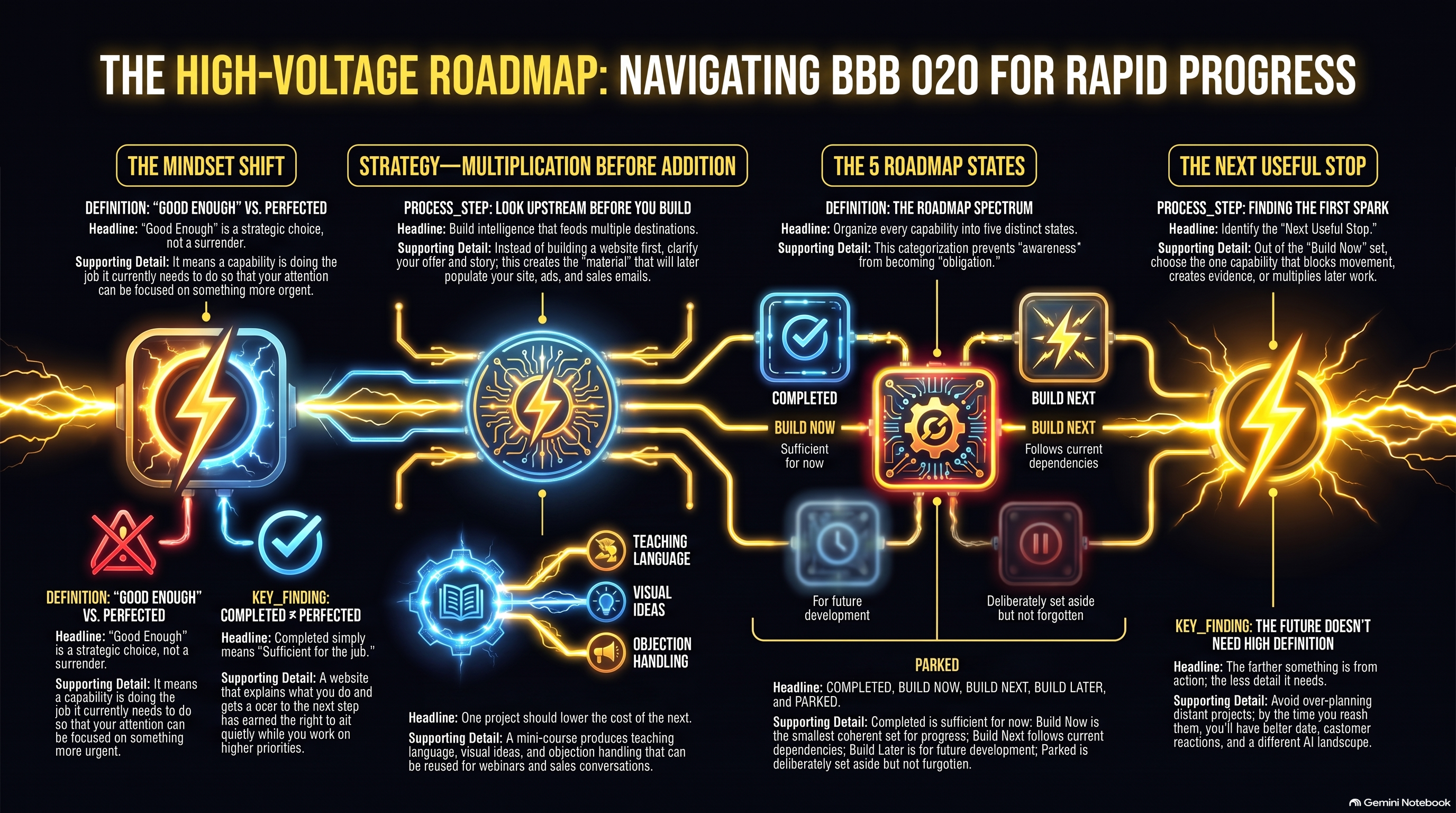
COMPLETED doesn't have to mean perfected. It can simply mean sufficient for the job it currently needs to perform.
──────── ⚡ ────────
Everything Can't Be “Now”
This becomes particularly important once AI enters the picture.
AI has made it ridiculously easy to notice opportunities.
Give it enough information about a business and it can happily identify twenty-seven things you could improve before you've finished your coffee.
And some of them will be excellent ideas.
That's the problem.
If everything useful becomes a current priority, we've basically recreated the giant to-do list with better reasoning behind it.
So I've been playing with a much stricter question:
What is the smallest coherent set of things that actually needs our attention now?
Not everything that would help.
Not everything we'll eventually want.
Not everything that happens to be imperfect.
What actually needs to move for the business to move?
That's a surprisingly different list.
──────── ⚡ ────────
Sometimes the First Thing You Need Isn't the First Thing You Build
Here's where this gets even more interesting.
Suppose you decide you need a website.
Seems straightforward.
Build the website.
Except... what are we going to put on it?
Maybe we still need to get clearer about the offer.
Maybe we need to organize the proof we've accumulated.
Maybe the founder story is scattered across seventeen conversations and three old documents.
Maybe we haven't articulated the process customers actually go through.
Maybe the objections we need to answer are sitting in somebody's head.
Suddenly “build the website” isn't necessarily the first project.
The website may be where all that material eventually lands.
Something else may be where that material gets created.
That's a principle we've been using throughout the Business Brain Builder:
Multiplication before Addition.
Build something that solves one problem and leaves useful material behind for several others.
Imagine a local training business that decides it needs a better website.
We could start building pages immediately. Or we might first clarify the programs it offers, organize the instructor's story, collect the strongest proof, work through the questions prospective students keep asking and define what should happen when someone is interested.
We haven't built the website yet.
But we've just created much of the material the website will need—and quite a bit of material that can later feed ads, follow-up, sales conversations and other projects too.
The website was one destination for the work. It wasn't the only reason to do the work.
That's the multiplication.
Good offer intelligence doesn't only help a sales page. It can help the website, ads, sales conversations, emails and follow-up.
A mini-course doesn't necessarily produce only a mini-course. It can produce teaching language, examples, explanations, objections and visual ideas that become useful elsewhere.
A sales process can teach you things about customers that eventually improve the marketing that sent them there.
One useful piece of work can lower the cost of several pieces that follow it.
That's worth noticing before we start building.
──────── ⚡ ────────
The Future Doesn't Need to Be in High Definition
There's another trap I've become increasingly suspicious of.
Planning too far ahead.
I like planning.
Possibly more than is medically advisable. 😄
But there's a point where additional planning stops reducing uncertainty and starts decorating it.
If I know what needs attention now, I should understand it pretty well.
The thing immediately after that deserves some thought too.
But something six moves away?
Maybe I just need to remember that it's there.
Because by the time I reach it, I'll know things I don't know today.
I'll have results.
Customer reactions.
Failures.
Better questions.
Maybe a completely different AI landscape.
So why pretend I can design that distant project today with the same clarity as something I'm about to start tomorrow?
The farther something is from action, the less detail it needs.
That isn't poor planning.
It leaves room for future evidence to matter.
──────── ⚡ ────────
A Roadmap Should Make the Business Feel Smaller
I think that's the part I've been trying to get right.
A useful roadmap shouldn't reveal forty-seven things and leave you feeling responsible for all of them.
It should do almost the opposite.
It can acknowledge all forty-seven.
Then it should let most of them wait.
Some things are already good enough.
Some belong next.
Some belong later.
Some are interesting ideas that deserve to be remembered without being allowed anywhere near today's calendar.
And somewhere among all of that is the thing that actually deserves your attention.
One next useful stop.
That's a very different feeling from staring at a giant list of everything your business could someday become.
The future can stay big.
Today's job can stay small.
──────── ⚡ ────────
Maybe That's What a Roadmap Is Really For
We're taught to think of roadmaps as ways of laying out everything we're going to do.
I'm starting to think their more valuable job may be showing us everything we don't need to do yet.
The ideas aren't lost.
The imperfections aren't ignored.
The future isn't forgotten.
We've simply stopped treating awareness as obligation.
And that gives us enough room to work on the thing that matters now, learn what happens when we do, and come back to the map with better information than we had before.
Because a living roadmap shouldn't change every time another interesting possibility appears.
It should change when reality gives us a reason.
So maybe the question after choosing the road isn't:
How much can we build?
Maybe it's:
What's the smallest coherent thing we can build next that makes the rest of the road easier to travel?
That feels like a much better place to start.
──────── ⚡ ────────