
When Everything Is a Good Idea, What Do You Build Next?
When Everything Is a Good Idea, What Do You Build Next?
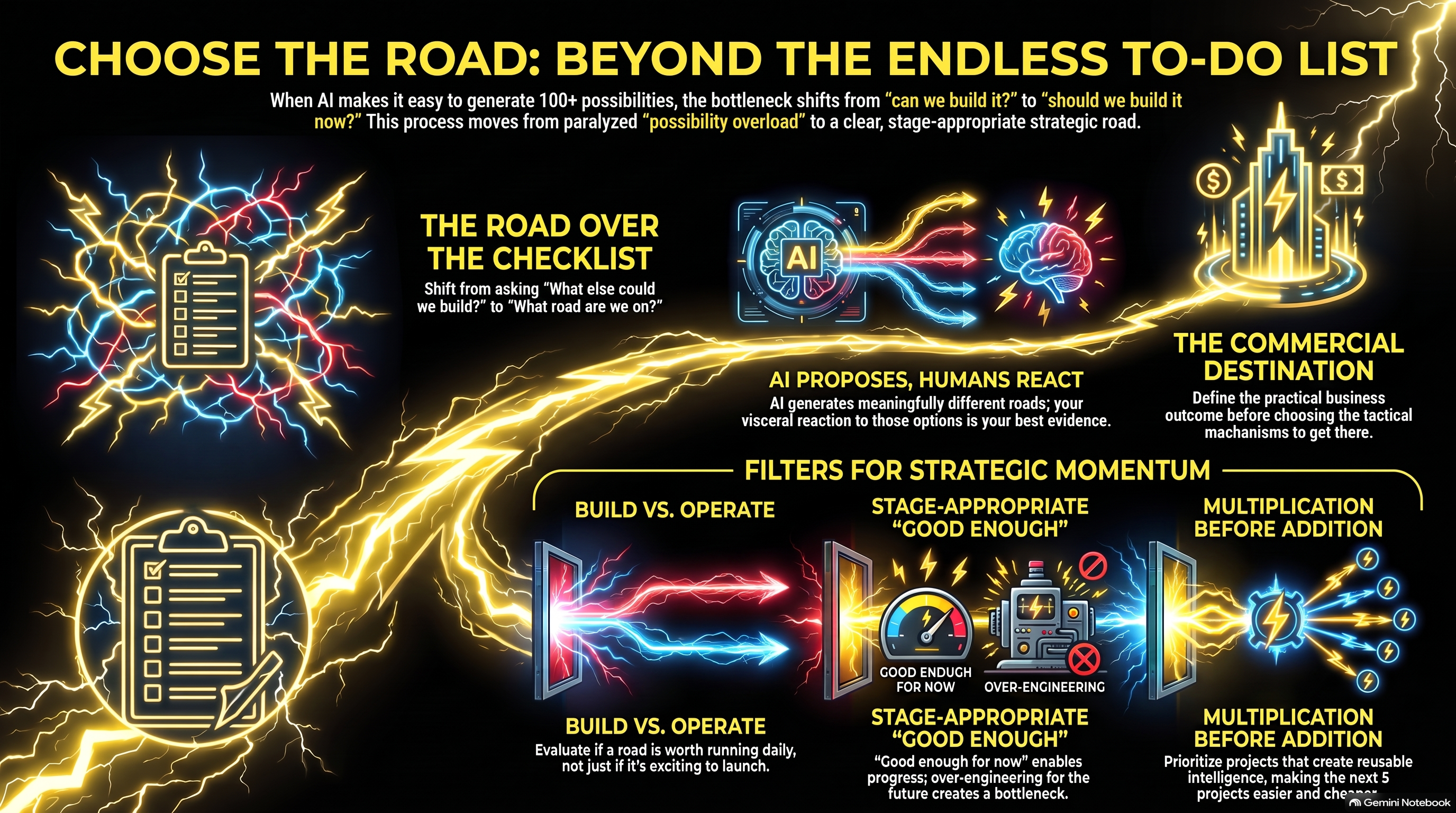
Too many good ideas can become a surprisingly effective way to stop building anything.
You need a website. Good idea.
You should probably be posting more consistently. Also a good idea.
Maybe you need a webinar. Or a mini-course. Or a community. You could improve your sales process, start a newsletter, work on SEO, collect more reviews, create a referral program, finally make those videos you've been talking about...
And somewhere along the way, a productive Monday morning turns into staring at a list while wondering which of these supposedly important things you're actually supposed to do.
The frustrating part is that the list isn't necessarily wrong.
Most of those things really might help.
That's the problem.
A bad idea is fairly easy to eliminate.
A good idea that isn't a good idea yet is much harder.
──────── ⚡ ────────
The To-Do List Eventually Stops Helping
There was a stage in building the Business Brain Builder where a fairly linear progression made sense.
We needed to understand the business before asking AI to do much with it.
Who are we trying to help? What are they struggling with? What change are they looking for? What kind of business are we actually trying to build? How should that business sound and look?
Each answer gave us something useful to build on.
Eventually we had enough intelligence to stop merely describing the business and start using that understanding to make things.
That worked too.
But eventually you hit another problem.
There isn't just one reasonable thing to make next.
And the more capable AI becomes, the easier it becomes to generate possibilities faster than we can make good decisions about them.
Twenty years ago, deciding to create a course, redesign a website or produce a pile of campaign concepts represented enough labor that the cost itself forced some prioritization.
Now I can have AI help me explore all three before lunch.
That doesn't mean I should build all three before dinner.
AI didn't create the problem of prioritization. It just removed enough friction to make the problem much easier to see.
The bottleneck begins moving. It becomes less about whether we can make something and increasingly about whether we should be making it now.
──────── ⚡ ────────
Where Are We Actually Going?
Imagine getting into your car and asking the navigation system:
"What's the best road?"
There isn't one.
Best road to where?
A highway might be wonderful if you're driving across the state and completely useless if you're trying to get to the grocery store three blocks away.
Business development isn't much different.
A local martial arts school may need nearby families moving from discovery into a trial experience, enrollment and long-term membership. A $10,000 consultant may need education, qualification and a human conversation before anybody should reasonably be expected to buy. A $197 digital product might work better when customers can educate themselves and purchase without talking to anybody at all.
None of those roads is inherently better.
They're going different places.
That sounds painfully obvious when written down. It becomes considerably less obvious when somebody says:
"You really need a webinar."
Maybe.
Where are we going?
──────── ⚡ ────────
The Business You Have to Operate Matters Too
Every successful strategy eventually becomes something somebody has to operate.
That's easy to miss while we're still imagining the build.
A community sounds attractive because recurring revenue sounds attractive. But if the community succeeds, congratulations—you now operate a community.
People have to receive continuing reasons to join, participate and remain.
A sales-call strategy can make tremendous sense for a complicated or expensive offer. If it succeeds, somebody now has to conduct those conversations.
An education-heavy strategy can build enormous trust and produce material that gets reused all over the business. It also means somebody has to create and maintain the educational experience.
None of that is an argument against communities, sales calls or education. It simply means the exciting outcome and the recurring responsibility belong in the same picture.
So before choosing a road, there's another question worth asking:
Is this a road worth operating—not merely a road worth building?
That question changes things.
It asks us to evaluate not only the result we want, but the recurring business we would have to become good at running in order to keep producing it.
Sometimes the answer is still an enthusiastic yes.
Good.
Now we know a little more about why.
──────── ⚡ ────────
You Don't Need to See Every Road
There's another trap here, especially when AI is involved.
Once we ask what the possibilities are, AI is perfectly capable of giving us all of them.
Wonderful.
Now instead of seventeen things on the to-do list, we have 143.
Progress!
What I've been finding much more useful is asking for a handful of meaningfully different roads.
Maybe one depends heavily on education. Another gets people into conversation sooner. Another lets customers purchase directly. Another uses a community as part of the relationship.
Now I have something I can react to.
"I like that one, but I don't want to run live webinars."
"That one makes sense, but I don't want every customer talking to a salesperson."
"I hadn't considered putting the community there."
"We could do that, but I don't want to build that business."
Those reactions are useful information too.
You don't always discover what you want by answering another questionnaire. Sometimes you need to experience a few possibilities and notice your response to them.
That's become a recurring theme throughout the Business Brain Builder:
The AI proposes. You react. Your reaction is evidence.
──────── ⚡ ────────
Good Enough Can Actually Be a Strategic Decision
This also changes how I think about things we've already built.
Suppose a business has a website.
It's not perfect.
Maybe it was generated quickly with AI. Maybe editing the underlying structure is annoying. Maybe we already know that eventually we'd prefer something more controllable.
Does that automatically make "Build a Better Website" the next project?
Not necessarily.
If the current site does the job required of it right now, we may have enough website to keep moving.
Maybe it clearly explains the business, gives people somewhere credible to land and gets interested visitors to the appropriate next step. That's enough to support the road we're traveling today—even if we already know we'd eventually like something easier to edit, expand and optimize.
We can improve it later. And by then we'll probably know considerably more about what the better version actually needs to do.
That's different from settling for bad work.
Bad work prevents progress. Stage-appropriate work enables progress without pretending the work is finished.
It's recognizing that something can be:
good enough for this stage
without being:
finished forever.
The same principle can apply to a sales process, course, reporting system, funnel or dozens of other things.
Sometimes the strategically mature decision is not to improve something simply because you can see how it could be improved.
There may be another stop that matters more.
──────── ⚡ ────────
Some Roads Make Other Roads Cheaper
This is probably my favorite part.
Business development doesn't behave like a checklist where every completed item disappears forever. Building one thing often changes the cost of building several others.
Create a good mini-course and you may develop explanations, examples, methodology language, objections, teaching structures and visual concepts that later make a webinar or VSL dramatically easier.
Build a real sales process and you may learn how customers describe their hesitation, what separates qualified prospects from poor fits and which questions repeatedly appear before somebody buys.
Work through a website and you may finally force scattered thoughts about the company into a coherent public explanation.
The first thing still has to justify being built. But good work often leaves lumber lying around for the next project.
And that gives us a much better filter than simply asking what else we could add:
Multiplication before Addition.
Before adding another isolated thing, look for the work that creates something useful now and makes several useful things easier later.
That's not just efficiency.
It changes the economics of the road ahead.
──────── ⚡ ────────
Maybe You Don't Need a Bigger List
This is where we've arrived with the Business Brain Builder.
The early journey needed a shared path because there were foundational things nearly every business needed to understand.
But eventually that common path has to end.
Otherwise I haven't built a Business Brain.
I've built a 300-step course.
And sooner or later somebody is going to ask why their neighborhood dog-food company is completing the same Packet as a national software company preparing for enterprise sales.
Fair question.
So the next evolution isn't to keep extending the universal checklist.
It's to let what we've already learned about the business help us draw its map.
Where are we trying to go?
What are a few sensible roads from here?
What would each one require us to become good at?
What do we already have?
What could wait?
What might we learn along the way?
And once we have enough confidence to choose, we take the road.
Experience may eventually give us a reason to redraw the map. That's fine. What we don't need to do is change direction every time somebody mentions another good idea.
There will always be another website we could improve, another campaign we could launch, another funnel we could build, another clever thing AI suddenly makes possible.
The goal isn't to eliminate those possibilities. It's to stop letting every possibility become a priority.
So instead of asking What else could we build?, maybe the more useful question is:
What road are we on—and what's the next useful stop?