When the Pieces Start Talking to Each Other
When the Pieces Start Talking to Each Other
How Custom Values, AI, and Your Business Brain Turn Generic Marketing Into Something Genuinely Yours
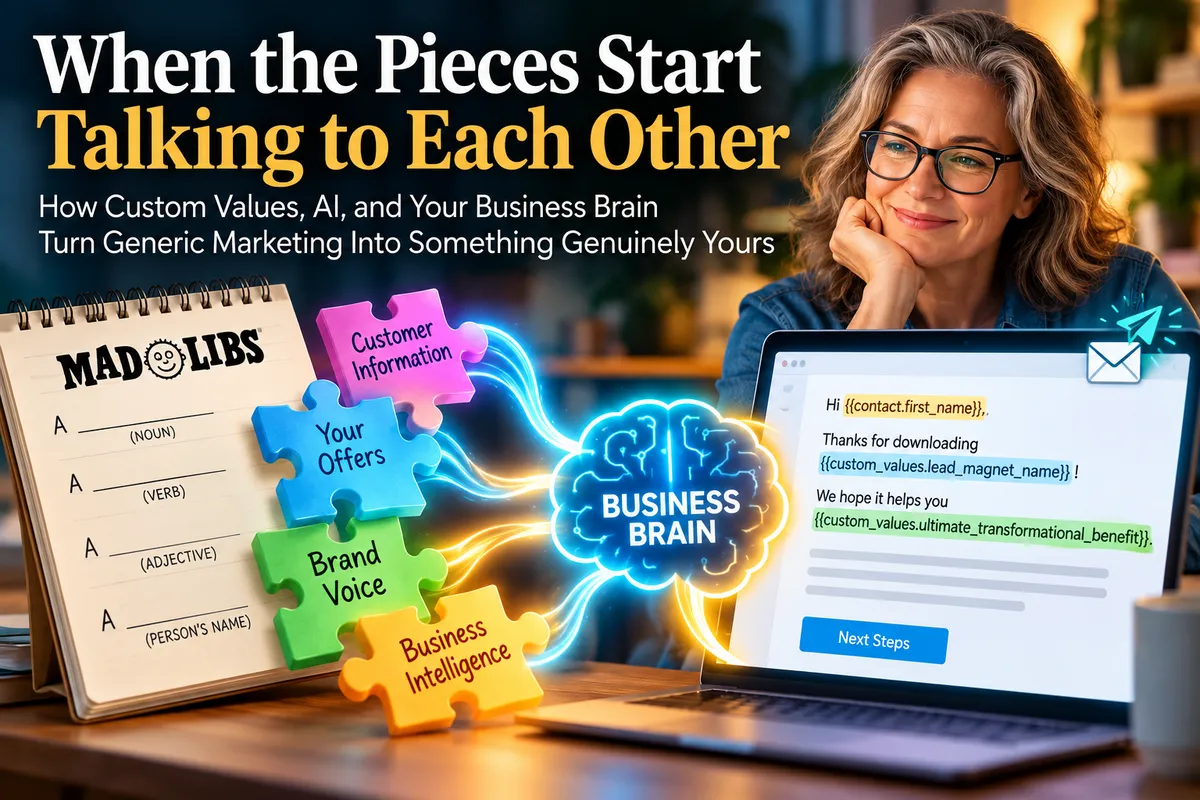
Remember Mad Libs?
Those little books where someone would ask you for a noun, a verb, an adjective, and maybe the name of your third-grade teacher, then plug your answers into a story that usually ended up being completely ridiculous?
You didn't have to write the story. Someone had already done the heavy lifting, and you just filled in the blanks.
Now imagine that instead of creating a story about a purple elephant dancing on your kitchen table, you were creating an entire collection of emails, sales pages, and Customer communications for your business.
That's essentially what Custom Values allow us to do.
And yet, for something built on such a wonderfully simple idea, Custom Values have a remarkable ability to make otherwise capable business owners stare at their screens as though someone has asked them to reprogram a satellite.
I understand why. The moment a simple concept gets wrapped in unfamiliar terminology, curly brackets, and software configuration screens, it can start looking considerably more complicated than it actually is.
But there's something much more exciting hiding underneath those brackets, especially now that we have AI.
──────── ⚡ ────────
The Magic of Leaving Blanks
Imagine you have an email that says:
Hi Sarah,
Thanks for downloading The Beginner's Guide to Better Gardening! We hope it helps you grow a healthier, more productive garden.
Perfectly reasonable.
But what if you wanted to reuse that same email for a dog trainer, a business consultant, or someone teaching people to bake sourdough bread? Would you have to rewrite it every time?
Not necessarily.
What if the email looked more like this?
Hi {{contact.first_name}},
Thanks for downloading {{custom_values.lead_magnet_name}}! We hope it helps you {{custom_values.ultimate_transformational_benefit}}.
Those strange-looking expressions are simply placeholders.
The first asks the system to insert the recipient's first name, while the others retrieve information we've stored about the business and its Offer.
Change the stored information, and the same email can serve a different business.
Write something once. Make the important pieces interchangeable. Reuse the structure without rebuilding everything.
It's Mad Libs with a business purpose.
Of course, there is one important difference. Unlike our childhood word games, we generally don't want the results to be ridiculous.
And that's where things get interesting.
Just Because the Blanks Are Filled Doesn't Mean the Message Is Finished
Let's say we have a generic follow-up email that encourages someone to book an appointment.
It uses Custom Values for the business name, the Offer, and the transformation we're hoping to help Customers achieve. We fill in the blanks, and technically, we've personalized the message.
But does it actually sound like the business?
Perhaps the email was originally written for an energetic business coach who loves exclamation marks and big promises. Now we're using it for a thoughtful financial educator whose Customers need reassurance, clarity, and a sense of control.
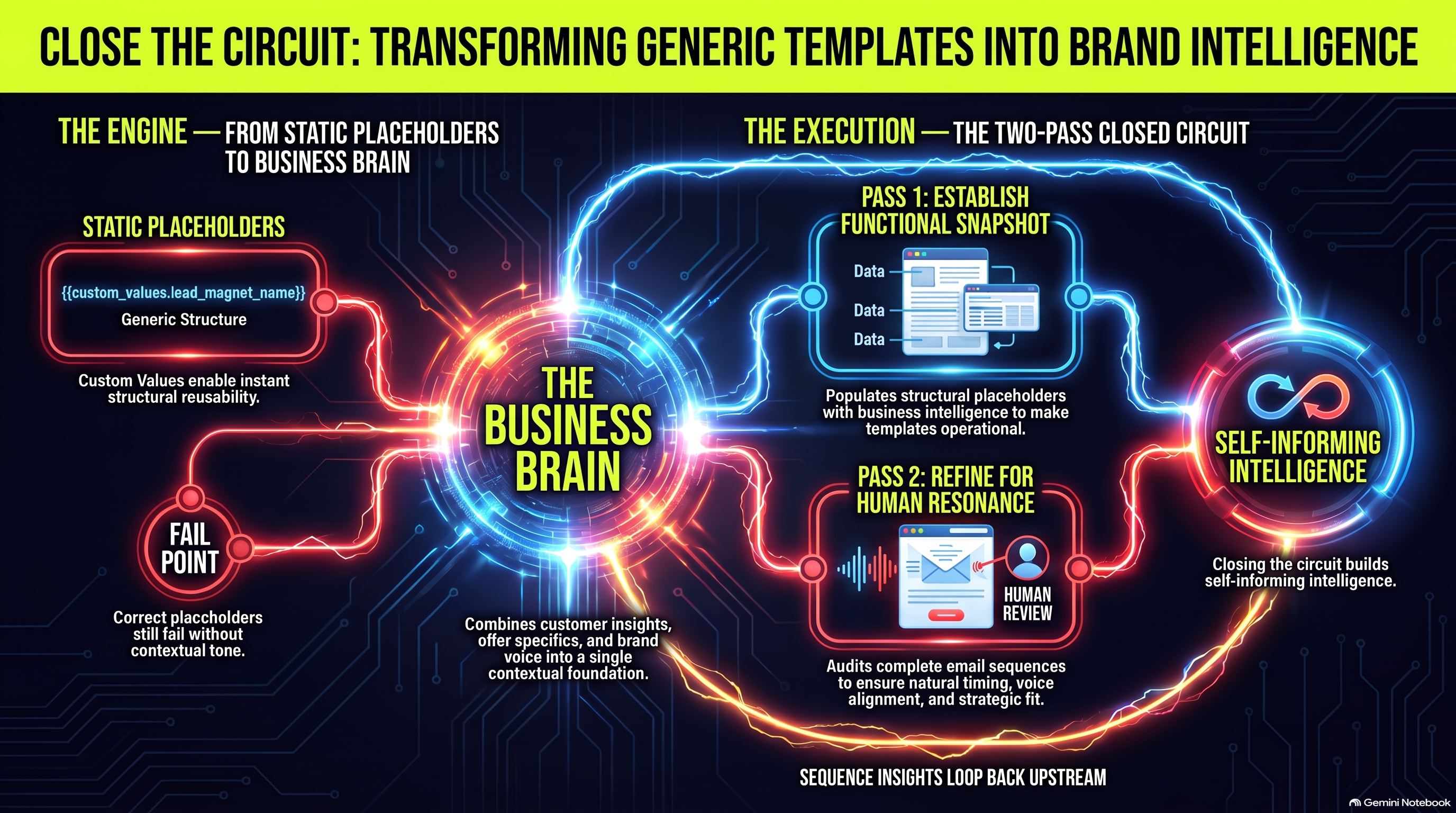
The placeholders might all be correct, yet the message could still feel completely wrong.
Or perhaps our Custom Value says:
Build a stronger, more confident business.
And the original sentence reads:
Are you ready to build a stronger, more confident business with our proven system to help you build a stronger, more confident business?
Whoops.
The information is correct. The sentence is dreadful.
Custom Values make a message adaptable. They don't automatically make it good.
For years, that meant someone still had to go through every email, inspect the results, and rewrite whatever didn't work. Across a collection of interconnected sequences, that could become a fairly substantial project.
Today, we have another option.
──────── ⚡ ────────
Enter the Business Brain
This is where our Business Brain Builder journey begins to pay off in a much bigger way.
Think about everything we've been gathering and developing: who our Customers are, what they're experiencing, what they want to change, and what might prevent them from moving forward.
We've developed our Brand Voice, examined the problems our business addresses, and explored the transformation our Offers can realistically deliver. Along the way, we've created materials, messaging, and strategies that all draw from the same growing body of business intelligence.
Each piece has been useful on its own, but something new happens when we bring them together.
Our Business Brain doesn't merely know the name of our Lead Magnet. It understands why someone might want it.
It doesn't just know what our Small Paid Transformation is called. It understands the problem that Offer is intended to address, the Customer it's designed for, and the next step that makes sense afterward.
And rather than simply knowing whether we prefer a friendly or professional tone, it has accumulated context about how we want our business to communicate and what we want people to experience when they interact with us.
So when we give it a collection of generic follow-up emails, we can ask it to do considerably more than fill in blanks. We can ask it to think about the entire conversation.
Suddenly, all those pieces we've been building begin working together.
Two Passes, One Much Better Result
In Packet 036 of Business Brain Builder, we're putting this idea to work.
We begin with the follow-up emails from an existing GoHighLevel funnel snapshot. A snapshot is essentially a reusable starting structure; instead of building every page, workflow, and message from scratch, we can begin with something already designed to perform a particular job.
But reusable doesn't mean finished.
So we approach the communication in two passes.
The first pass is about getting the pieces into place.
We examine the existing messages and identify the Custom Values they need. Then we use the Business Brain intelligence we've already developed to propose the appropriate contents.
The Lead Magnet gets its real name, the Offer gets its real description, and the Customer transformation reflects what the business can honestly help someone accomplish.
We can now assemble the messages and see what the original templates look like with our business information inserted.
And then comes the second pass.
This time, we stop looking at placeholders and start looking at people.
Does the first email make sense for someone who just purchased? Does the next message assume they've already watched a course when they might not have opened it yet? Are we sending the same invitation over and over, or is there a useful question we haven't answered?
Would an additional email help someone take the next step with more confidence? Does the wording actually sound like us?
Our Business Brain can evaluate the complete sequence, recommend improvements, and then produce the revised messages for our approval. It might even suggest changing some of those original Custom Values because we've discovered that they don't work particularly well in context.
That's not a failure of the first pass. It's the reason we have a second one, and a lovely example of what happens when AI becomes part of an iterative business-building process rather than a one-shot content generator.
──────── ⚡ ────────
The Real Breakthrough Isn't the Email
Here's the part I find most exciting.
We didn't have to start over.
The intelligence we developed while exploring our Customers helped us create an Offer. The work we did on that Offer helped us develop our sales messaging, while the Brand Voice we established earlier helps us evaluate how all of that communication sounds.
Now those same decisions can improve the emails that guide Customers through the experience.
One body of intelligence, multiple applications.
Better yet, the process can work in reverse.
Suppose we discover during our email review that we don't have a good answer to a common Customer objection. That's useful information, and it might reveal a gap in our Offer explanation, our sales page, or even our understanding of the Customer.
We can bring that discovery back into the Business Brain, preserve what we've learned, and use it to strengthen future work.
The pieces aren't merely being reused. They're beginning to inform one another.
That's the synergy we've been working toward: not a pile of unrelated AI-generated documents or a collection of prompts that each start from zero, but a growing foundation of business intelligence that makes each new application more informed than the last.
You Don't Need to Fear the Curly Brackets
If Custom Values have always seemed intimidating, I'd encourage you to look past the syntax for a moment.
You don't need to memorize every technical detail to understand the principle. Think of a Custom Value as a labeled container: the label tells your system which information to retrieve, and the contents tell it what to insert.
That's it.
There are some practical rules, of course. The label has to match the actual field, and the content has to make sense wherever it's used. Some placeholders retrieve information about the Customer or the software system rather than business-wide Custom Values.
But those are details we can learn and verify as we go. The underlying concept remains simple, and now AI can help us handle much of the work that used to make reusable messaging feel so cumbersome.
It can identify placeholders, propose contents based on our Business Brain, examine the resulting messages, and recommend ways to make them more natural and effective.
We still make the decisions, verify the implementation, and remain honest about what our business can actually deliver. What changes is that we no longer have to treat every adaptation as an entirely new writing project.
From Reusable Templates to Reusable Intelligence
There's a reason we're calling this packet Close the Circuit.
We've spent a considerable amount of time connecting individual pieces. Now we're beginning to see the current flow between them.
A reusable snapshot provides the structure, Custom Values make that structure adaptable, and our Business Brain supplies the understanding. AI helps us bring those elements together, evaluate the results, and improve them, while the business owner decides what actually belongs in the finished experience.
That's a much more interesting proposition than simply asking AI to write a few emails.
Because once you've learned how to do this with a follow-up sequence, you start noticing all the other places the same approach could help: Customer onboarding, newsletters, appointment reminders, educational sequences, sales pages, and future Offers.
We don't have to build all of them today, but we can begin to see how the work we've already completed makes those future projects easier.
The next time you encounter a pair of curly brackets in your marketing software, perhaps they won't look quite so mysterious.
They might just look like an opportunity.
After all, sometimes the smartest way to build something new is to teach the pieces you already have how to work together.
──────── ⚡ ────────
Business Brain Builder is part of the Powerful Progress Program from Magnetix Marketing, where we turn business intelligence into practical progress—one useful circuit at a time.