Why Are There Always Three of Everything?
Why Are There Always Three of Everything?
Human beings have been teaching each other for considerably longer than we've been building online courses.
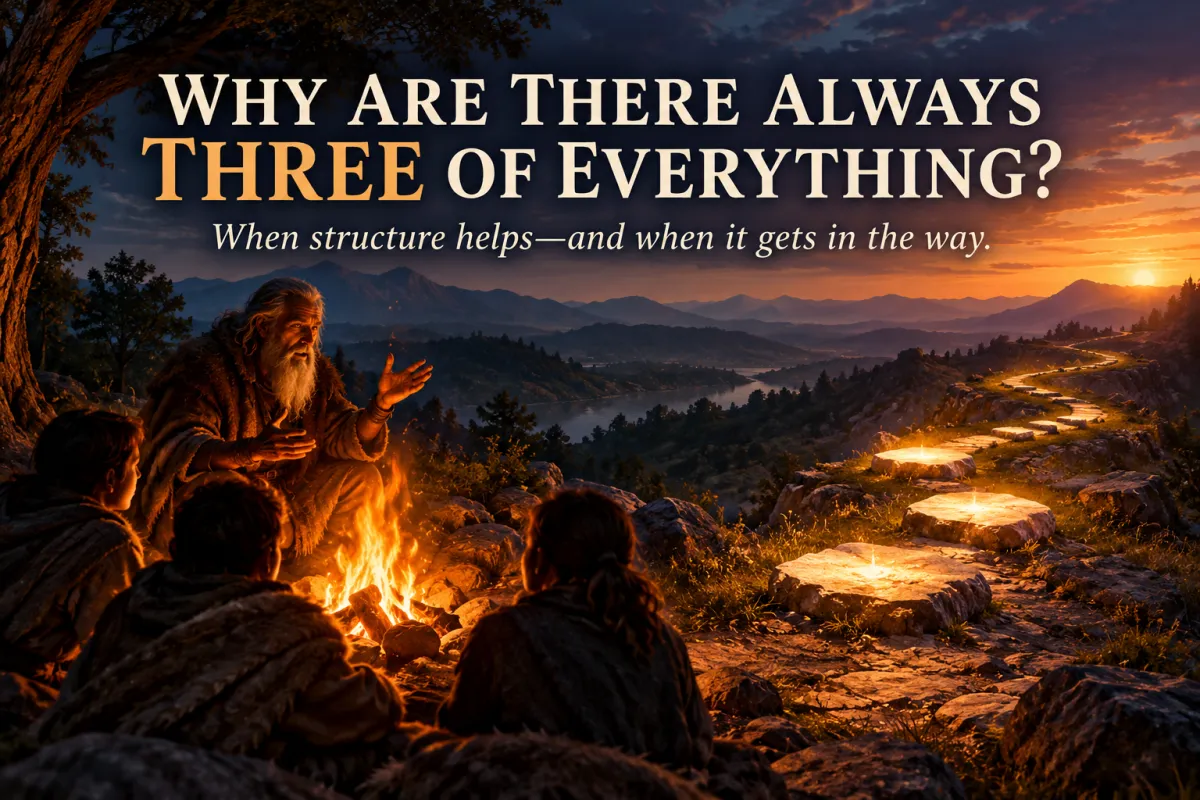
Before the webinar, before the PowerPoint deck, before the workbook, before somebody discovered that a PDF could apparently be worth $297, there was probably somebody sitting near a fire telling the rest of the tribe what happened beyond the hill.
And the story mattered.
Not merely because everybody needed entertainment after dinner.
A story could carry information.
Where the danger was. What somebody tried. What went wrong. What they discovered. What finally worked.
You didn't have to meet the bear to remember what happened when somebody else met the bear.
Thousands of years later, we've become considerably more sophisticated.
Now we call it Module 2.
──────── ⚡ ────────
There is something remarkably useful about giving information a story.
A collection of disconnected facts asks us to remember each fact independently. A story gives those facts relationships.
This happened, which caused that.
Someone believed this, until they discovered that.
They wanted to get there, but something stood in the way.
Something changed.
And once it changed, what happened next made sense.
That's probably part of why some version of beginning, middle and end feels so natural to us.
Modern storytelling often formalizes that further into a three-act structure.
The first act establishes the world. We learn who we're following, what matters, what they want and enough about the situation to understand why we should care.
Then something changes.
The second act is usually where the real mess lives. The character tries things. Assumptions collide with reality. Complications appear. Information is discovered. Capabilities develop. What seemed like the problem at the beginning may turn out not to be the real problem at all.
Eventually, enough has changed that the final confrontation becomes possible.
The third act gets to use what the first two earned.
The hero can face the antagonist. The mystery can be solved. The decision can finally be made.
Then we usually need a little room afterward to understand what changed because of it.
Beginning.
Middle.
End.
Three.
No wonder marketers love the number.
──────── ⚡ ────────
Three secrets.
Three keys.
Three steps.
Three modules.
Three bonuses.
Three reasons you absolutely need whatever is being sold before the countdown timer reaches zero and civilization collapses.
Apparently four is chaos.
But there really is something useful hiding underneath the marketing habit.
Teaching has a lot in common with storytelling.
Not because every lesson needs an antagonist, dramatic music and a surprise revelation that your accountant was your father all along.
It's because learning also involves movement.
A learner begins somewhere.
They know some things and don't know others. They can do certain things and can't yet do something else.
Then we introduce an idea.
That idea changes what they understand.
Perhaps they try something.
The attempt exposes another problem.
Now they need a distinction they couldn't have appreciated earlier.
They learn it.
Try again.
Something becomes possible that wasn't possible before.
That's a story.
And importantly, the learner is the protagonist.
The instructor isn't.
The instructor may know the road. They may provide the map. They may warn about the bear.
But the meaningful transformation belongs to the person making the journey.
──────── ⚡ ────────
This is one reason I actually like the familiar three-part course structure.
Sometimes.
A short introduction can orient someone to the journey.
Three substantial movements can be enough to take them somewhere meaningful without creating an experience so sprawling that nobody remembers where they started.
Then a conclusion can help them recognize what they've accomplished, tie together what might otherwise remain disconnected, and decide what to do with it.
That's a perfectly respectable structure.
I've used it.
I'll undoubtedly use it again.
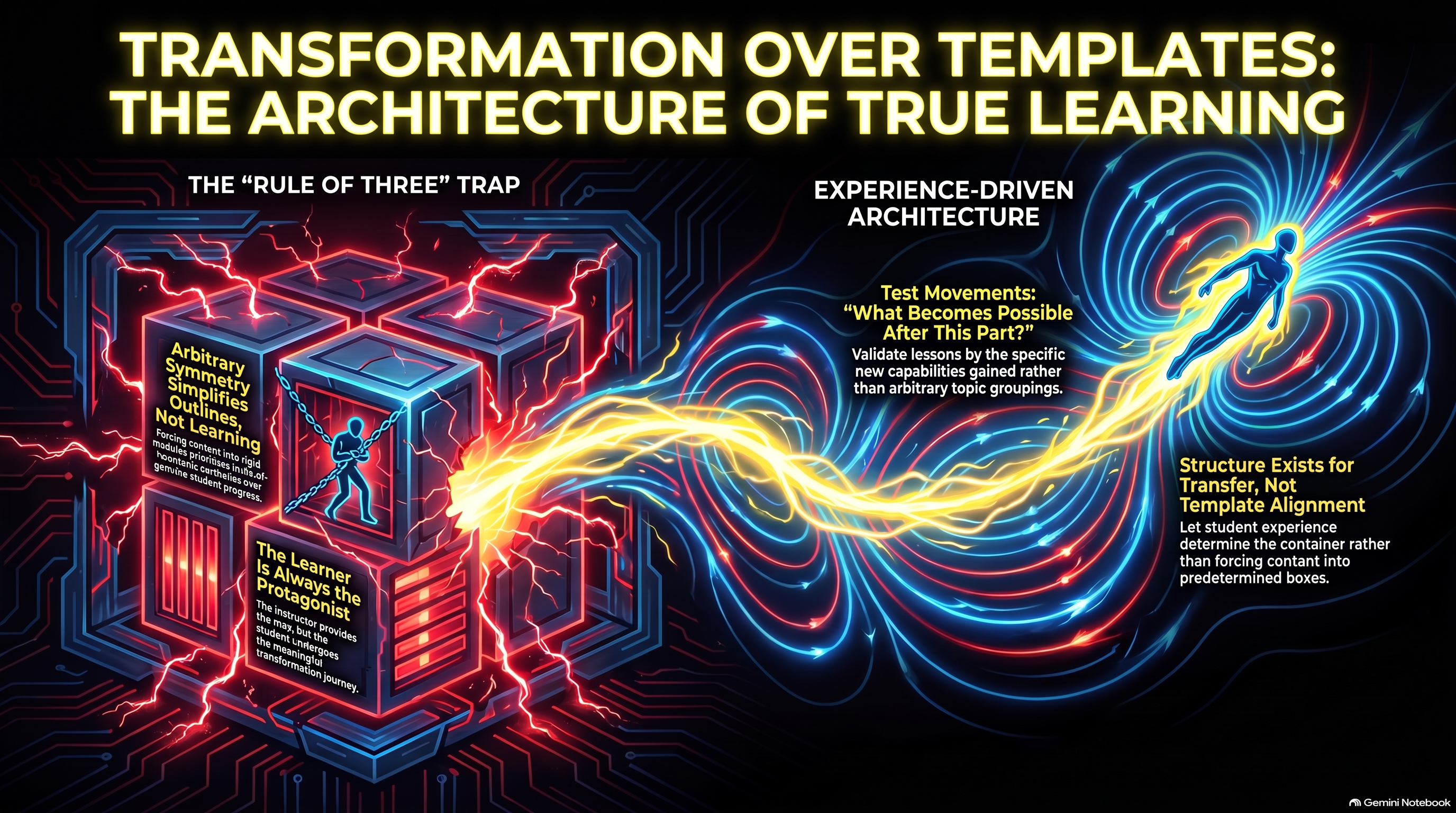
The trouble starts when a useful way of organizing an experience becomes a requirement imposed upon the experience.
Because reality has never shown much respect for our templates.
──────── ⚡ ────────
Suppose I'm teaching something that genuinely requires five meaningful changes in understanding.
I can still call it a three-module course.
Nothing is stopping me.
I can shove Changes 2, 3 and 4 into Module 2, put a nice photograph over it and declare the architecture complete.
But I haven't simplified the learning.
I've simplified the table of contents.
Those aren't the same thing.
The reverse happens too.
Maybe the transformation really contains two substantial movements.
But my template has three boxes.
So now I'm staring at the third one thinking:
Surely there must be another secret.
This is how perfectly innocent information gets promoted to Module 3.
Its principal educational function is maintaining symmetry.
──────── ⚡ ────────
While working on curriculum architecture recently, I stumbled into a question I like much better than:
How many modules should this have?
The question is:
What becomes possible after this part that wasn't possible before it?
That changes the conversation.
Maybe after the first part, the learner can recognize the problem accurately for the first time.
After the second, they can diagnose their own situation.
After the third, they can make a decision they couldn't responsibly make before.
Beautiful.
We may have ourselves a three-part experience.
But perhaps the diagnosis requires four distinct skills before the decision becomes possible.
Then we probably have more work to do.
Or perhaps Parts 2 and 3 don't actually change anything independently. We separated them because they looked like different topics, not because the learner experiences meaningful progress between them.
Maybe they belong together.
The structure begins to emerge from the transformation instead of the other way around.
──────── ⚡ ────────
There's another distinction hiding in there that I think matters.
The structure we use to organize an experience and the experience someone actually has inside it aren't necessarily the same thing.
We can make three modules roughly the same length.
The learner may breeze through the first one, spend twice as long on the second and discover that one sentence halfway through the third completely changes how they understood the first.
We can make every lesson exactly twelve minutes long.
Understanding remains stubbornly uninterested in our production schedule.
We can put five people through exactly the same experience and discover that the most important moment was different for every one of them.
That's not necessarily a failure of the structure.
It's a reminder of what the structure is for.
Reality doesn't experience the boxes we use to organize it. Our boxes are there to help us navigate reality.
And that's where storytelling becomes both extraordinarily useful and a little dangerous.
──────── ⚡ ────────
Stories make messy reality easier to understand.
Real experience isn't always so cooperative.
We backtrack.
We misunderstand.
We discover something halfway through that changes what the beginning meant.
We learn things in the wrong order.
Sometimes we don't recognize the lesson until years after the event that taught it.
The storyteller can straighten some of those bends so another person can follow the path.
The teacher often has to do the same thing.
That's part of the craft.
But straighten it too much and eventually you're no longer simplifying the experience.
You're misrepresenting it.
Structure helps us make experience understandable. But structure can also tempt us to simplify experience until it stops being true.
The trick isn't to reproduce every bit of mess.
The old storyteller probably didn't need to tell everyone what he had for breakfast, which bush he stopped behind or the seventeen uneventful minutes before the bear appeared.
He needed to understand which parts of the experience mattered enough to carry forward.
That's what makes teaching more than information delivery.
You're deciding what another person needs to encounter, in what order, so that an understanding you possess has a reasonable chance of becoming an understanding they possess too.
Structure isn't the purpose. Transfer is.
──────── ⚡ ────────
I've started applying the same suspicion to bonuses.
Three modules?
Naturally.
Three bonuses?
Of course.
Why three?
Because careful examination of the Customer's needs revealed precisely three supplementary resources required to enhance the experience?
Or because somebody built three attractive bonus cards into the funnel template?
Those are very different reasons.
If the Customer needs the worksheet to complete the transformation I promised, I have trouble calling it a bonus.
It's a worksheet.
It's part of the treatment.
If a checklist meaningfully helps them apply what they've learned, perhaps that's simply a good supporting resource.
And if there are five genuinely useful optional additions, I don't know that we need to sacrifice two of them to appease the ancient gods of Internet Marketing.
The same rule applies.
The experience should determine the structure. The structure shouldn't determine the experience.
──────── ⚡ ────────
Maybe that's one reason storytelling has survived every change in the technology we use to communicate.
The fire became the stage.
The stage became the page.
The page became the screen.
Now the screen can generate words, images, voices and entire presentations for us.
But the underlying problem hasn't changed very much.
One person has experienced, discovered or understood something.
Another person hasn't.
How do we get it across?
Facts can do some of the work.
Instructions can do some of the work.
Examples help.
Practice helps.
Diagrams help.
Sometimes a worksheet helps.
But story gives all of those things somewhere to live.
It gives us sequence.
Cause and effect.
Expectation.
Surprise.
Consequence.
Change.
And perhaps most importantly, a reason to remember what came before because we need it to understand what happens next.
The person listening around the fire didn't meet the bear.
But if the story was told well enough, what happened to the person who did could become useful knowledge for everyone listening.
Their experience had become, in some small but meaningful way, transferable.
──────── ⚡ ────────
So I'm not giving up on three.
Three is great.
Three acts can tell a wonderful story.
Three modules can create a wonderful course.
Three steps can make a complicated idea approachable.
Sometimes the path really does have three major turns.
Just don't paint a third turn onto the map because the brochure already went to the printer.
A good teacher doesn't merely organize information.
They give understanding a path.
Sometimes that path has three major turns.
Sometimes it has five.
Sometimes you have to circle back because something you learned halfway through changes what the beginning meant.
That's okay.
The old storyteller around the fire didn't need the experience to have happened neatly.
They needed to understand it well enough to tell it in a way somebody else could carry with them.
I suspect we're still trying to do much the same thing.
The story exists to help us navigate the experience.
The experience does not exist to satisfy the story.