Why ChatGPT Keeps Forgetting Your Business (And Why It Isn't Actually Its Fault)
Why ChatGPT Keeps Forgetting Your Business
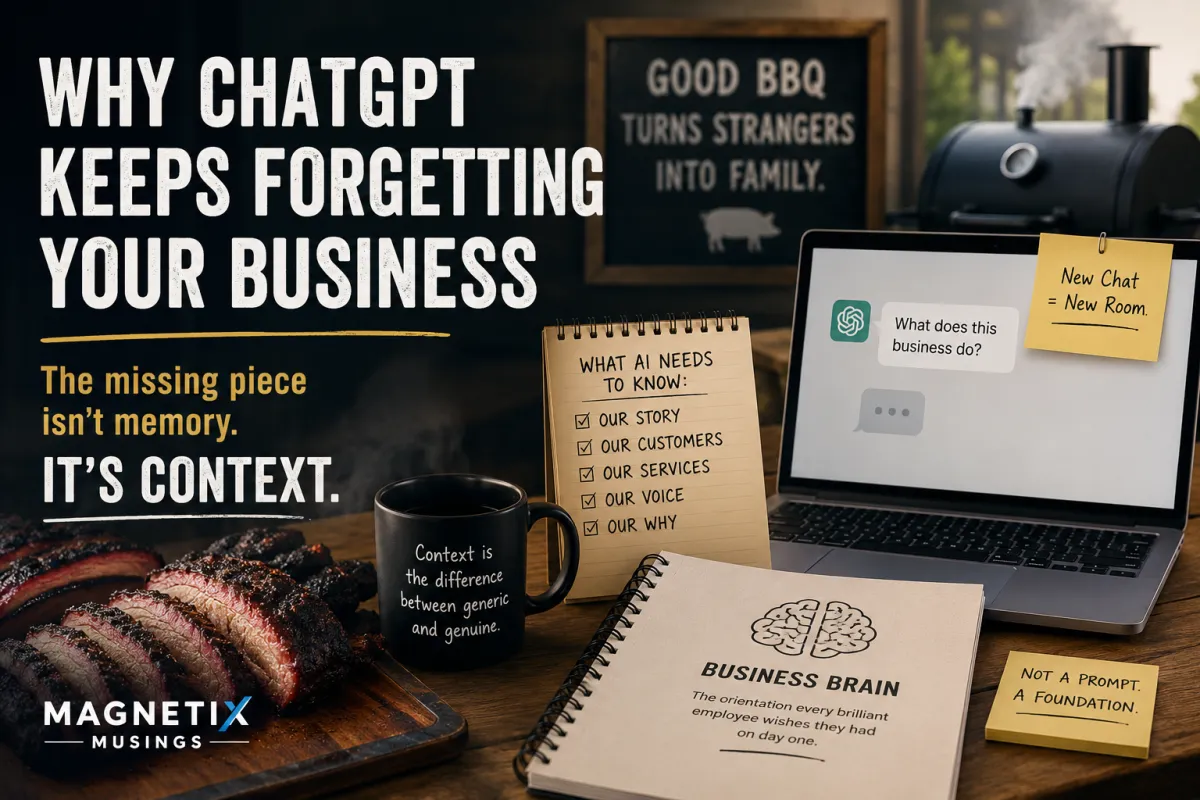
The missing piece isn't memory. It's context.
"The smartest employee you'll ever hire may also be the one who needs the longest orientation."
Have you ever caught yourself apologizing to ChatGPT?
"Sorry... I know I already explained this yesterday."
Then, a moment later, you realize...
It wasn't yesterday.
It was another conversation.
So here you are again.
Explaining your company.
Your customers.
Your products.
Your services.
Your goals.
Your voice.
Your audience.
Again.
If that feels familiar, you're in good company.
Nearly everyone who spends enough time with AI eventually arrives at the same conclusion.
"This thing is brilliant... but it keeps forgetting my business."
It's a reasonable conclusion.
It also turns out to be the wrong one.
The Smartest Employee You'll Ever Hire
Imagine hiring the smartest employee you've ever met.
They never get tired.
They can write.
Research.
Analyze.
Teach.
Brainstorm.
Organize information faster than anyone you've ever worked with.
...
Okay.
I realize that description sounds suspiciously like AI writing its own performance review.
Fair enough.
Stay with me.
Because here's the part that matters.
Every morning this employee wakes up in a different hotel room.
They still know accounting.
Marketing.
Psychology.
Sales.
Programming.
History.
They haven't forgotten any of that.
What they have forgotten...
...is whether they're helping a plumbing company today.
A law office tomorrow.
Or a BBQ caterer with a legendary brisket recipe on Friday.
Not because they're forgetful.
Because no one brought yesterday's project binder into today's room.
That's a very different problem.
The Brisket Test
Let's imagine you own a BBQ catering company.
You've spent twenty years perfecting your brisket.
Your grandfather built the first smoker out of an old propane tank.
Half your business comes from weddings.
The other half comes from people saying...
"You have to try their brisket."
Now open a brand-new AI conversation and ask:
"Write the homepage for my BBQ catering company."
Odds are, you'll get something like this:
"We provide delicious BBQ, exceptional customer service, and unforgettable catering experiences."
There's nothing technically wrong with that.
There's just one problem.
It could describe almost every BBQ company in America.
Your grandfather disappeared.
The smoker disappeared.
The weddings disappeared.
The stories disappeared.
The brisket—the one people drive two hours to eat—became...
"delicious BBQ."
AI didn't lose your story.
It never had it.
The Wrong Question
For the last couple of years, many of us have been asking questions like:
"What's the best prompt?"
"How do I make ChatGPT write better?"
"Which AI tool is smartest?"
They're good questions.
But after thousands of conversations, I think they all hide a much better one.
How do I help AI understand my business before I ask it to help grow my business?
That subtle shift changes almost everything.
Because prompts are instructions.
Understanding is context.
And context compounds.
Every Business Leaves Fingerprints
This was the realization that changed the way we work.
Every business leaves fingerprints.
On its website.
Inside customer reviews.
Across old proposals.
In email conversations.
In social media posts.
In photographs.
In little stories the owner tells without realizing they're telling them.
Your business already has an identity.
It's simply scattered across a hundred different places.
Most businesses aren't suffering from an information shortage.
They're suffering from information living everywhere except together.
It's a little like the kitchen junk drawer.
Everything you need is probably in there somewhere...
...assuming the whisk hasn't wedged itself diagonally and become Supreme Keeper of the Drawer.
You laugh...
because you've fought that whisk.
And somehow, that tiny moment explains business information better than a flowchart ever could.
Nothing is missing.
It's just impossible to reach until things become organized.
Context Changes Everything
Let's try something.
Imagine we hand AI a little more of the story.
Not everything.
Just enough to understand who it's helping.
Now the request becomes:
"Write the homepage for a third-generation family BBQ catering company. Their grandfather built the first smoker out of an old propane tank. Their brisket is the menu item customers recommend most often. Weddings and company picnics are their specialty. Their philosophy is that great barbecue turns strangers into family for an afternoon."
Now we're asking the same AI.
The same model.
The same prompt.
The only thing that changed...
...was understanding.
That's the moment people usually realize:
"Oh..."
"It wasn't forgetting."
"It simply didn't know me yet."
We Eventually Gave It a Name
For a long time, we didn't call this anything.
It was simply an observation.
Businesses that gave AI richer understanding consistently received better results.
Eventually, that observation became a process.
Then a habit.
Then something we found ourselves teaching over and over again.
Eventually...
We gave it a name.
The Business Brain.
Not because it makes AI smarter.
Because it helps AI become better acquainted with the business it's trying to serve.
Think of it as the orientation every brilliant employee wishes they'd received on their first day.
This Is Where the Journey Begins
If you've been searching for better prompts...
You weren't wrong.
They're useful.
But they're only part of a much larger picture.
Every business already has stories.
Experiences.
Patterns.
Principles.
Customers.
Language.
History.
Most of it has simply never existed together in one place before.
Perhaps the real challenge isn't teaching AI who your business is.
Perhaps it's discovering how much of your business already has a voice...
...waiting to be recognized.
And once you begin gathering those pieces together...
Something unexpected happens.
Your AI starts understanding your business better.
But so do you.
Coming Next
Most businesses already have far more of their Business Brain than they realize.
The first step isn't creating something new.
It's learning how to recognize what already exists.