You Can't Design the Empty Space Yet - Some decisions only become obvious after you start making the thing
You Can't Design the Empty Space Yet
Some decisions only become obvious after you start making the thing
There was a point while working on a Lead Magnet recently when I caught myself trying to solve a problem that didn't exist yet.
We had the concept. We had the copy. We knew the brand. We knew roughly how the finished piece should look.
So naturally, the next question seemed to be:
What images should go inside it?
Perfectly reasonable question.
Except we didn't have any pages yet.
The copy hadn't been placed. The headlines hadn't been sized. Nothing had wrapped unexpectedly. No section had landed three lines too long for the page where I imagined it would live. There weren't any awkward gaps, beautiful openings or places where a wall of text was obviously begging for something visual.
We were trying to design the empty space before the empty space existed.
It's a surprisingly easy trap to fall into.
AI may actually make it easier.
Give it a finished piece of copy and ask for ten supporting-image ideas and it'll happily give you ten. Ask where each one should go and it'll probably answer that too.
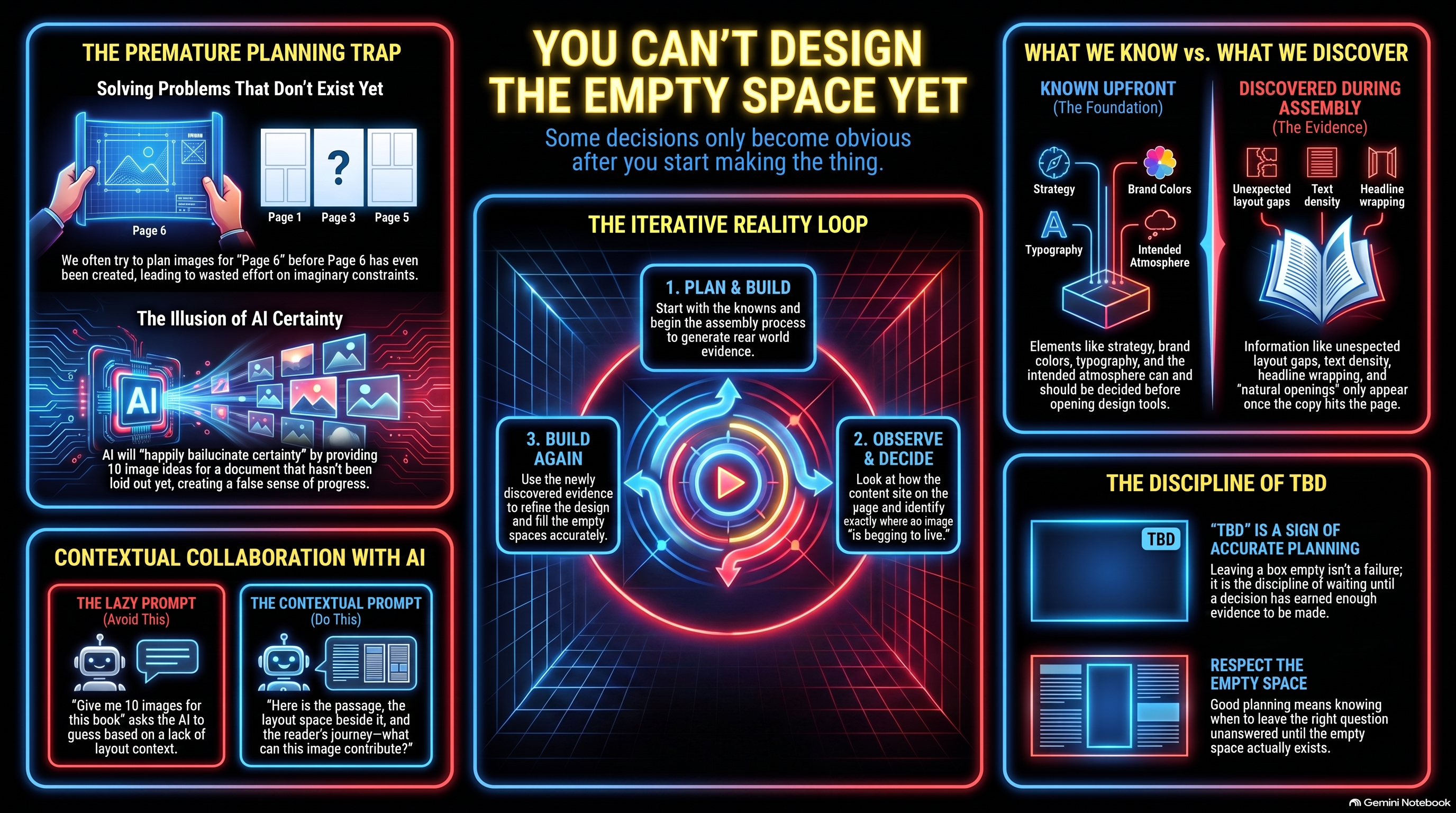
It can sound remarkably certain about Page 6 for something that doesn't have a Page 6.
That doesn't make the ideas bad. It means we're asking the work to reveal information it hasn't produced yet.
And I think there's a useful distinction hiding in there.
Some decisions can be made from what we already know.
Others depend on what happens when we start building.
Those aren't the same kind of decision.
We can know what the cover should communicate before opening Canva. We can know what colors and typography belong to the brand. We can decide what kind of atmosphere should carry through the interior. We can even know roughly how we want somebody to feel when they reach the end.
But where should the supporting image beside section three go?
Maybe we should actually make section three first.
Once the copy hits the page, new information appears.
A headline takes more room than expected. Two paragraphs that seemed substantial in a document suddenly leave half a page open. Another section becomes unbearably dense. Something you thought needed an illustration turns out to read beautifully without one.
And somewhere in the middle of arranging all of that, you look at a page and think:
An image belongs right there.
Now we have a much better question for AI.
Not:
Give me ten images for this Lead Magnet.
But:
Here's the passage. Here's the space beside it. Here's what the reader has experienced up to this point. What could this image contribute?
That's a very different conversation.
──────── ⚡ ────────
I've been noticing this pattern in more than design.
We often want planning to eliminate uncertainty before we begin. If we think hard enough, document enough and ask enough questions, maybe we can work everything out before reality gets involved.
But reality is annoyingly productive.
Making something generates information.
A draft teaches you things the outline couldn't.
A sales page reveals weaknesses in an offer that sounded perfectly coherent in a strategy document.
A conversation with a customer can expose a distinction that fifty brainstorming prompts never surfaced.
A piece of software behaves differently once people actually start using it.
Sometimes the next answer isn't hiding somewhere in the planning.
Sometimes you have to build far enough to create the question.
That's been changing how I think about AI too.
One of the temptations with increasingly capable AI is to hand it a problem and ask it to think all the way to the end. And sometimes that's exactly what we should do. If it can solve something reliably in one pass, I'm not particularly interested in preserving unnecessary labor for ceremonial purposes.
But there are other times when the better use of AI is iterative.
Take what we know now.
Make the decisions that knowledge supports.
Build something.
Look at what happened.
Then bring the new evidence back.
Plan → Build → Observe → Decide → Build again.
That isn't a failure to plan thoroughly enough. The later decisions simply have information available to them that the earlier decisions didn't.
──────── ⚡ ────────
It also makes me wonder how often we make bad decisions simply because we feel uncomfortable leaving a box empty.
There's an odd satisfaction in a complete plan.
Every question answered. Every field populated. Every future step assigned. Nothing left dangling there looking accusingly unfinished.
Unfortunately, “answered” and “answerable” aren't synonyms.
Sometimes TBD is the most accurate answer available.
Not because nobody knows what they're doing, but because we've correctly identified that the decision belongs to a later stage of the work.
That became the solution to our little Lead Magnet problem.
We'd decide the cover before assembly.
We'd decide the recurring background before assembly.
We'd establish the visual rules and prepare possible calls to action.
Then we'd put the copy onto actual pages.
Only after the layout revealed where supporting images belonged would we generate them.
Suddenly the whole process got easier because we stopped demanding that one stage know things only the next stage could discover.
And that may be the larger lesson I'm carrying away from it.
Good planning doesn't necessarily mean making every decision early.
Sometimes good planning means knowing when a decision has earned enough evidence to be made.
There's a strange kind of discipline in leaving the right question unanswered.
Not forever.
Just until the empty space exists.