You Might Be Our Customer If…
You Might Be Our Customer If…
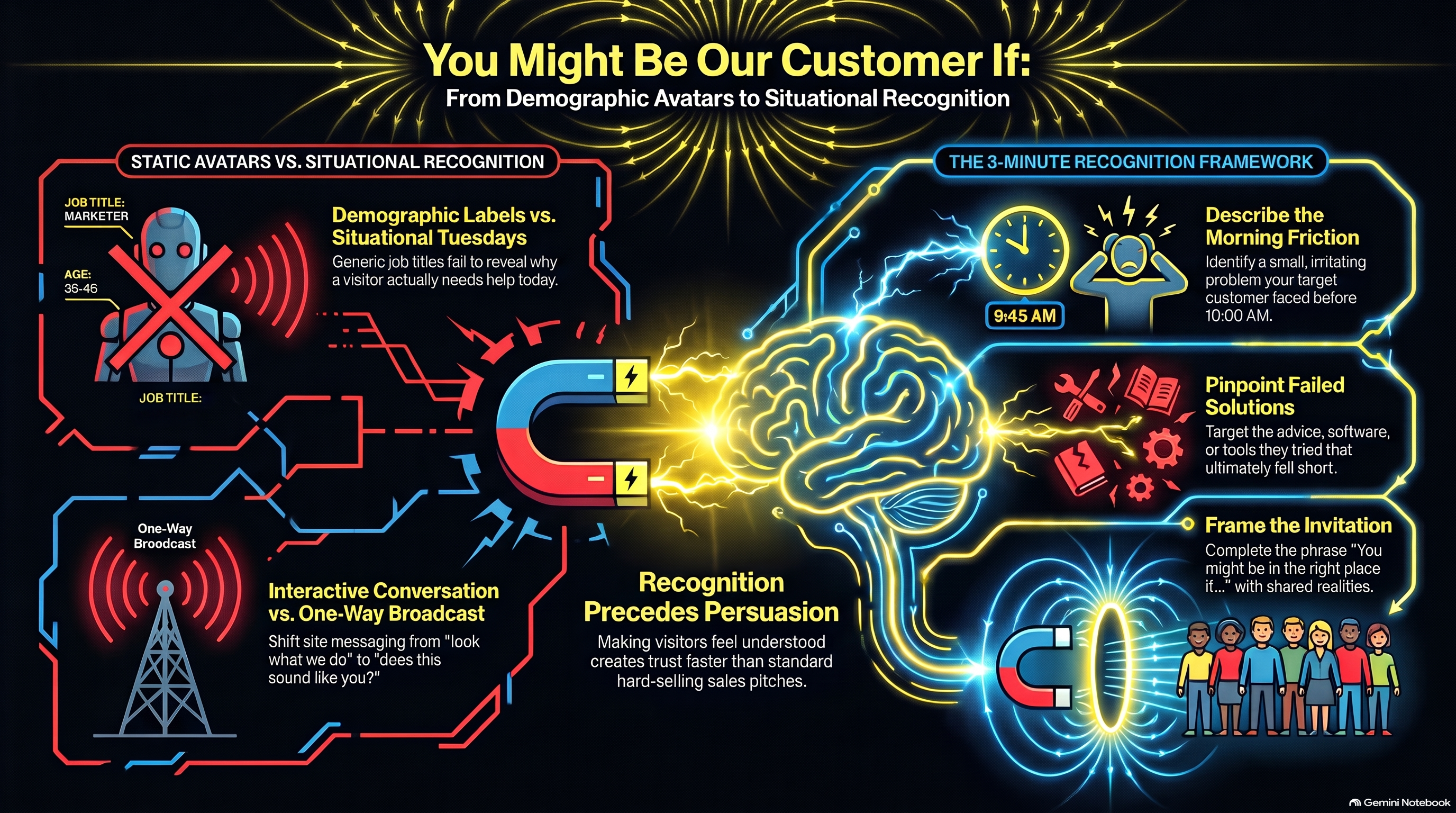
Why the best “Who We Serve” pages don't just describe an audience. They help people recognize themselves.
You might be our customer if you've spent more time trying to connect your marketing software than actually marketing your business.
You might be our customer if your follow-up strategy consists of remembering that you were supposed to follow up.
You might be our customer if you've purchased three different courses about growing your business and haven't quite finished the first lesson of any of them.
And you definitely might be our customer if you've ever opened your CRM, stared at the dashboard for a while, and quietly closed the browser tab.
Sound familiar?
Somewhere, Jeff Foxworthy is probably wondering what happened to his comedy routine.
But there's a surprisingly useful marketing lesson hiding inside that familiar formula. When someone hears a description of an experience they've actually had, something interesting happens.
They recognize themselves.
Not because somebody assigned them to a demographic category or constructed a detailed customer persona with an imaginary name and a suspiciously specific annual income.
They recognize themselves because somebody just described their Tuesday.
──────── ⚡ ────────
The Trouble With Knowing Your Audience
Most businesses have been told that they need to know their target audience.
That's good advice. Understanding the people you hope to serve is fundamental to building something useful for them.
So we do our research. We identify customer segments, study industries, examine common problems, and build profiles of the people most likely to benefit from what we offer.
Then we take all that valuable understanding and build a website with a page titled Who We Serve.
And what do we put on it?
Contractors. Coaches. Consultants. Entrepreneurs. Small Business Owners.
Maybe we add a few attractive photographs of smiling professionals and a paragraph explaining that we're committed to excellence.
There's nothing necessarily wrong with any of that. Industry categories can help visitors find relevant information quickly. A contractor may appreciate knowing that we understand the challenges of running a contracting business.
But knowing what someone does for a living isn't the same as understanding what brought them to your website.
Two contractors might have completely different needs. One is trying to attract more customers. Another has more business than they can handle and desperately needs a better way to manage appointments, communications, and follow-up.
Meanwhile, a course creator and a plumbing contractor might have surprisingly similar problems with disorganized systems.
Their industries are different.
Their Tuesdays look remarkably alike.
And that's where the more interesting conversation begins.
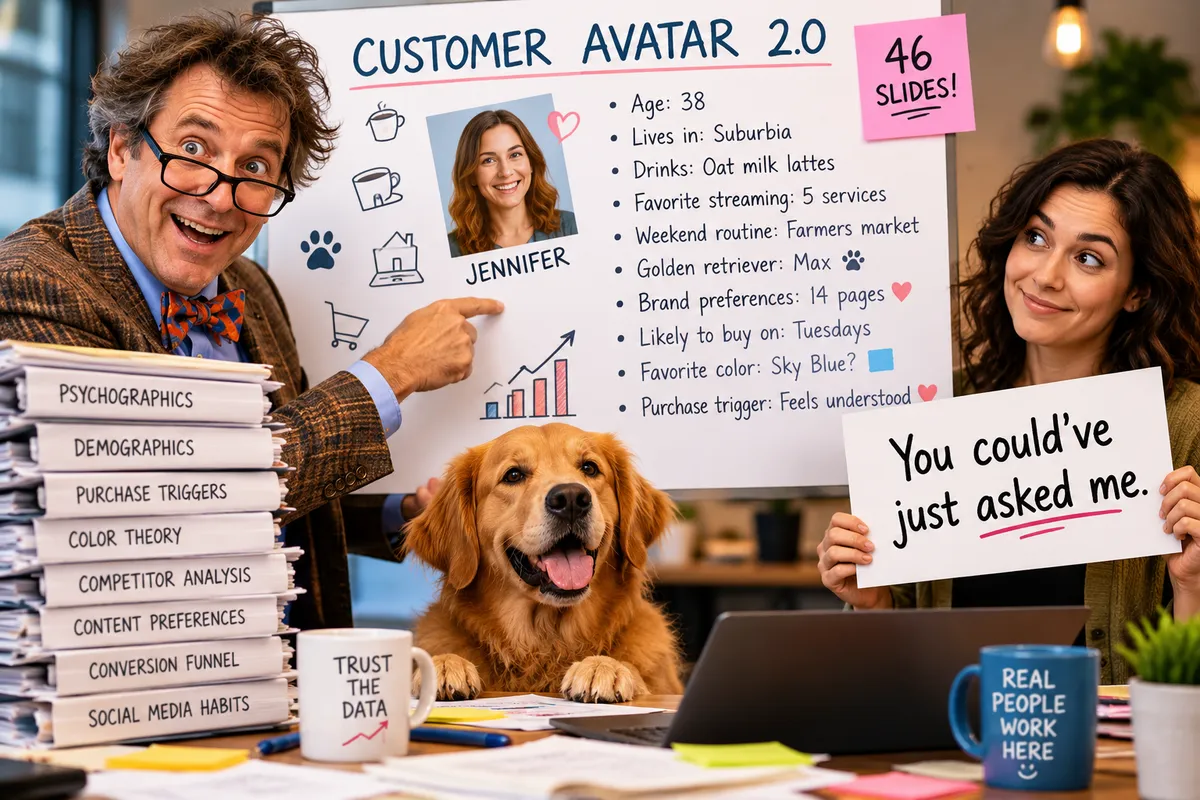
Enter Henderson, Lord of the Customer Avatar
Henderson, our occasionally overenthusiastic imaginary marketing consultant, has prepared a customer persona for us.
Her name is Jennifer.
Jennifer is 37 years old, lives in a suburban neighborhood, enjoys artisanal coffee, owns a golden retriever, and earns $83,500 annually.
Henderson has also identified her favorite streaming services, her weekend coffee routine, and the precise shade of blue most likely to inspire her to purchase a marketing automation package.
He has a 46-slide presentation explaining why.
There's just one small problem.
We don't know whether Jennifer actually needs anything we're selling.
Demographics aren't useless—knowing income or company size helps determine budget and scope. But we know an extraordinary amount about her imaginary life, and almost nothing about the circumstances that would make our business relevant to her today.
Now suppose we asked a different question.
What might Jennifer be experiencing that would make her genuinely grateful to discover us?
Suddenly, we have somewhere useful to go.
Maybe she's exhausted from manually reminding customers about appointments. Maybe she's losing inquiries because nobody responds while she's busy working. Maybe she's frustrated that the expensive software she bought to simplify her business has become another part-time job.
We don't need to know her dog's name to understand those situations.
Although Henderson insists that golden retriever ownership correlates with a 14% improvement in funnel conversion rates.
He has been asked to provide his sources.
──────── ⚡ ────────
Recognition Is Different From Persuasion
Much of marketing is concerned with persuasion.
We want people to understand our value, trust our capabilities, and ultimately take some kind of action.
But persuasion works differently when someone already feels understood.
Imagine arriving on a website and reading:
We provide comprehensive marketing solutions for businesses of all sizes.
Fine. Maybe that's what you're looking for.
Now imagine reading:
You might be in the right place if you're tired of paying for five different marketing tools that don't seem to talk to one another.
That's a different experience.
The second statement doesn't prove that the company can help. It doesn't replace evidence, a clear explanation, or a sensible offer.
But it gives the visitor a reason to keep exploring.
It connects something they're experiencing with the possibility that someone understands it.
And the principle extends far beyond marketing agencies.
A gardening business might recognize the homeowner who loves the idea of a beautiful yard but can't keep anything alive through August.
An educator might recognize the student who's collected plenty of information but doesn't know where to begin applying it.
A personal-development community might welcome someone who's started asking questions about their life that their old explanations no longer satisfy.
These people aren't necessarily looking for someone to tell them who they are.
They may simply be looking for somewhere their questions make sense.
That's a much more human starting point.
What If the Website Became a Conversation?
Here's where this idea gets especially interesting.
Instead of treating a Who We Serve page as a static list of customer categories, imagine treating it as a discovery hub.
Visitors could explore industries, situations, aspirations, or challenges that sound familiar.
Each might open into a more detailed page explaining why that particular circumstance matters, what the business understands about it, and what resources or offerings might be relevant.
And perhaps, eventually, visitors could participate.
They might click a simple “That's me!” option.
They might answer a few voluntary discovery questions.
They might explore a short quiz that helps them identify which resources are most relevant to their current situation.
Not because every visitor needs another quiz. The internet has plenty of those already, and Henderson has volunteered to build one containing 87 questions and a mandatory webinar.
But because some visitors might genuinely appreciate a little guidance.
There's also an opportunity for the business to learn something.
A business owner can spend months imagining what their customers need. Voluntary feedback from real visitors can offer useful clues about which situations, questions, and interests deserve more attention.
Of course, clicking a page doesn't prove who someone is, and expressing interest isn't the same as agreeing to receive marketing messages. Any actual information collection needs a clear purpose and appropriate permission.
Nor should a handful of responses be mistaken for a definitive portrait of an entire market.
But used thoughtfully, customer participation can help turn a one-way marketing message into an ongoing conversation.
And conversations have a wonderful habit of teaching us things we didn't know we needed to learn.
──────── ⚡ ────────
One Audience at a Time
At this point, you may be imagining a website with forty-seven audience pages, twelve interactive quizzes, and enough personalized content to keep a small publishing company busy for the next decade.
Henderson certainly is.
Fortunately, we don't have to build the entire universe before inviting someone into it.
Start with a few audiences that genuinely matter to the business.
Explore what those people might recognize about their circumstances. Identify where your offerings or resources can honestly help. Then build one complete audience page that demonstrates the approach.
Once that works, the structure can grow.
Some audiences may deserve their own detailed pages. Others may fit comfortably together. Some recognition statements might become useful social media graphics, newsletter topics, FAQ entries, or blog articles.
The important thing is that each new page adds something meaningful.
Replacing the word contractor with dentist in an otherwise identical sales pitch doesn't suddenly create a valuable new resource.
But understanding the different circumstances that bring those people to your business might.
This is the thinking behind Packet 046 of the Business Brain Builder: Who We Serve — The Recognition Hub.
We're taking the customer understanding developed earlier in the Business Brain and turning it into a website experience that helps visitors discover where they fit.
One useful hub. One complete audience page. A growing collection of recognizable observations. And a repeatable way to expand when the business is ready.
No mandatory seventeen-step personality assessment required.
──────── ⚡ ────────
Try This Today: The Three-Minute Recognition Test
You don't need to redesign your website to try this.
Think about one kind of customer you'd genuinely like to help. Then ask yourself three questions:
What's a small but irritating problem they might have dealt with before ten o'clock this morning?
What advice, software, or supposed solution might they already have tried without getting the results they wanted?
What's a frustration they might quietly recognize but rarely bother explaining to anyone else?
Now finish this sentence:
“You might be in the right place if…”
Try writing three different endings. Read them aloud, and ask yourself whether someone experiencing those circumstances would recognize their own situation.
If one feels particularly promising, try it in a social post, a conversation with a customer, or a small piece of website content. Pay attention to the responses rather than assuming you've discovered a universal truth.
Congratulations. You've just taken a customer avatar out of a spreadsheet and introduced them to an actual human experience.
The Difference Between Being Seen and Being Sold To
There's a broader principle here that extends beyond website design.
People don't experience their lives as demographic profiles.
They experience mornings when everything seems to go wrong, small victories nobody else notices, problems they haven't found the words to explain, and ambitions that are difficult to share with people who don't understand them.
A business doesn't need to know everything about someone to be useful.
It needs to understand something relevant, communicate that understanding accurately, and offer a meaningful next step.
That isn't the same as pretending to know a stranger better than they know themselves. And it certainly isn't permission to exploit their insecurities.
It's an invitation.
If this sounds familiar, you might find something helpful here.
The visitor gets to decide whether the description fits.
They get to explore.
They get to raise their hand—or not.
And if the business has done its work well, the next step becomes a little easier to recognize.
Because sometimes the most powerful thing a website can say isn't “Look at everything we can do.”
It's “Does this sound like you?”
And sometimes, somewhere on the other side of the screen, someone smiles and says:
“Well, actually… yes.”
──────── ⚡ ────────
P.S. Henderson has completed his 87-question customer identification quiz. Question 43 asks whether you prefer your toast lightly browned or medium-golden. Apparently, this determines your ideal CRM subscription tier.
We're reviewing the methodology.