Your Appointment Is Still Tuesday
Your Appointment Is Still Tuesday
You booked a call with me.
Excellent.
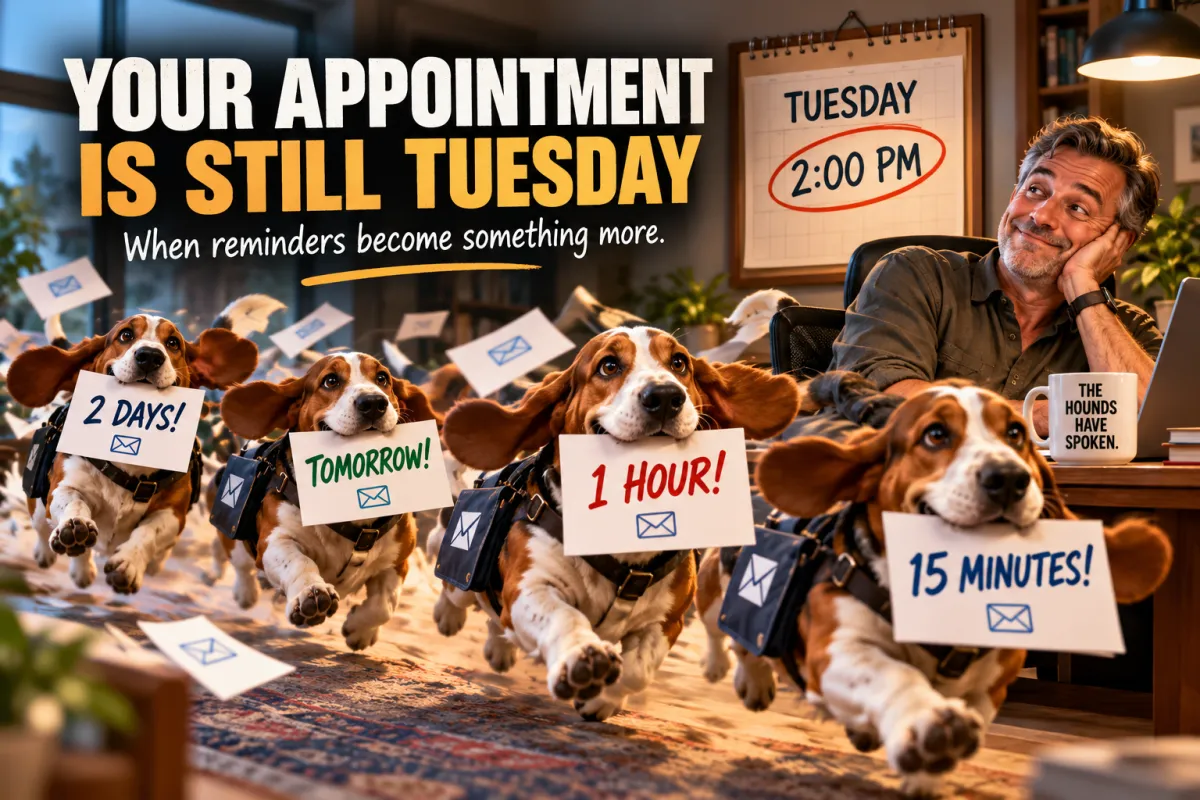
Release the hounds!
A few seconds later, an email arrives:
Your appointment is Tuesday at 2:00 PM.
Helpful.
Monday arrives and another email follows:
Your appointment is tomorrow at 2:00 PM.
Still true.
Tuesday at 1:00 PM:
Your appointment is in one hour.
Yep.
Then Tuesday at 1:45:
Your appointment begins in 15 minutes.
At this point, assuming you possess a functioning relationship with linear time, we've probably established when the appointment is.
The hounds have done their job.
──────── ⚡ ────────
Don't misunderstand me. Reminders are useful.
People get busy. Emails disappear. Calendars fill up. Something scheduled three days ago can very easily become something remembered fourteen minutes too late.
I use reminders. I teach people to build reminders. I've built systems that send reminders through more than one channel because sometimes the difference between a completed appointment and an empty Zoom room really is one little nudge at the right moment.
But while working through booking systems recently, something occurred to me.
We put enormous effort into getting someone to book. We write the page, create the offer, build the funnel, run the ad, develop the lead magnet, nurture, explain and answer questions.
Eventually somebody raises their hand and says:
Okay. I'll talk to you.
And then our marketing suddenly becomes a clock.
──────── ⚡ ────────
I've used a particular response structure for exploratory calls for quite a while.
There's an immediate confirmation, of course. Then, assuming the appointment is far enough away, there are opportunities around two days before, one day before and one hour before the conversation.
Originally, it's easy to think about those primarily as reminder positions.
But they can be something else.
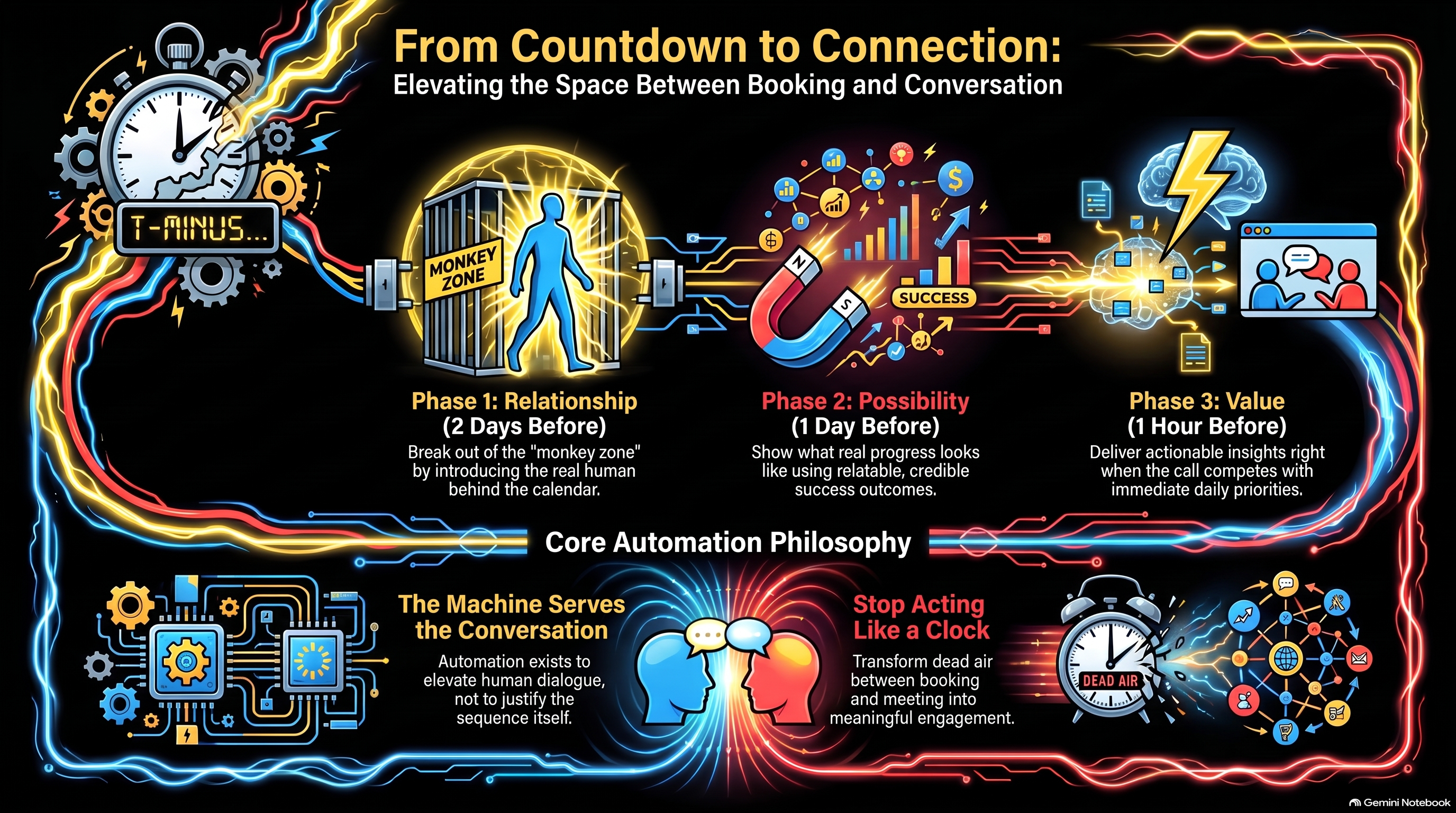
Two days before the appointment, I can tell you something about me. Not my complete autobiography. You don't need the director's cut.
But if you just shared information about yourself when you booked—what you're trying to accomplish, what's getting in the way, what you're hoping might change—there's something pleasantly reciprocal about me sharing a little too.
Why do I do this? How did I end up doing it? Why do I care about helping someone with the thing we're about to discuss?
Give me a minute or two and now I'm slightly less of a stranger.
──────── ⚡ ────────
Years ago, someone explained an idea to me that they called the “monkey zone.” I don't know whether that's the scientific term for it—and somehow I doubt it—but the idea stuck with me.
The explanation, as I remember it, was that primates can only maintain meaningful social concern for so many other individuals. Humans can apparently manage a larger circle than our monkey cousins, but we aren't unlimited either. The more we know about someone, the more real that person becomes to us and the more inclined we are to care about what happens to them.
I've thought about that idea many times while watching game shows.
They rarely just introduce Contestant Number Three and start asking questions. We learn something about her first. Maybe she's a teacher. Maybe she has three kids. Maybe she's been trying to get on the show for ten years. Maybe she wants to use the prize money to take her parents somewhere they've always dreamed of going.
None of that changes whether she knows the answer.
It changes whether we care if she does.
I think there's something useful hiding in there for appointments too.
When somebody first books with us, we may still be little more than a company name, a calendar entry and a Zoom link. Ignoring an automated appointment is pretty easy. There's nobody in particular to disappoint.
But tell them a little about who we are, why we're doing this and why the conversation matters to us, and perhaps we've moved a few inches closer to the inside of their monkey zone.
Now Tuesday at 2:00 isn't merely an appointment.
There's a person waiting on the other end of it.
──────── ⚡ ────────
A day before we meet, I can tell you something about someone like you.
Maybe there's a Customer whose situation resembles yours. Where did they begin? What changed? What did progress actually look like? If I have a real story and permission to tell it, wonderful.
If I don't, I don't need to manufacture one. I can simply explain the kind of progress I hope we're able to explore together.
Either way, I'm no longer merely telling you:
23 HOURS REMAIN.
I'm giving you a clearer picture of why the conversation might matter.
──────── ⚡ ────────
Then we're an hour away.
And I think this one may be the most important moment of all.
The person who booked the appointment made a decision when they booked it: this is worth an hour of my time.
But that decision wasn't made an hour before the appointment. It may have been made yesterday. Or three days ago. Maybe last week.
Now they're living in today.
They're working on something. Solving something. Dealing with something. Maybe they're finally making progress on the thing that's been sitting on their desk all morning.
And suddenly the calendar reminds them that in an hour they're supposed to stop.
That's when the appointment has to compete for its time all over again.
An hour that seemed worth investing when they booked can suddenly look like an hour they could get back. Whatever they're doing right now is immediate and tangible. The problem that caused them to book with us may no longer be occupying the front of their mind.
So yes, I want to remind them:
Your appointment begins in one hour.
But this is also where I want to give them something genuinely useful.
Maybe it's one important distinction. Maybe it's three quick tips. Something directly connected to the kind of problem we're about to discuss, strong enough that they can immediately see I understand the territory.
More importantly, I want those ideas to make them start thinking about their own situation again.
Because good general advice tends to create better specific questions.
Maybe Tip #1 makes them realize they haven't considered something. Tip #2 reminds them of the problem that frustrated them enough to book in the first place. Tip #3 gets them wondering which option actually makes sense for their business.
And eventually I reach the honest boundary of what a prerecorded video can tell them:
To give you more pointed advice about that, there are a few things I'd need to understand about your particular situation.
Conveniently, we're about to have exactly that conversation.
The video has provided real value, but it has also done something a plain reminder can't do. It has brought the reason for the appointment back into competition with everything else demanding their attention right when they're deciding what matters most for the next hour.
I don't need to tell them:
PLEASE ATTEND THIS CALL BECAUSE IT WILL BE VERY VALUABLE.
I've reminded them what they wanted help with, demonstrated some capacity to help with it, and given them a few new questions worth bringing into the room.
Now that reserved hour doesn't look quite so much like time waiting to be reclaimed.
It looks like time they set aside for a reason.
──────── ⚡ ────────
That's the sequence I've come to see differently:
RELATIONSHIP → POSSIBILITY → VALUE → CONVERSATION
The interesting part isn't the timing. Two days, one day and one hour are implementation details. Different appointments and different businesses may call for something different.
The interesting part is what we're doing with the space between yes, I'll talk to you and hello.
Relationship makes the person on the other end of the appointment more real. Possibility reminds us what could change. Value brings the problem—and our own questions about it—back to the front of our attention just as the appointment has to compete with the rest of our day.
Then we have the conversation.
That space doesn't have to be dead air, and it doesn't have to become another miniature sales funnel either. The person already took the next step. We don't need to spend three days trying to convince them to take the step they already took.
We can make that step increasingly worth taking.
──────── ⚡ ────────
Of course, not every appointment needs this.
If you've been my Customer for three years and you're booking our monthly review, you probably don't need another video explaining why I started the company. At some point you're allowed to know me.
If you're booking a fifteen-minute service appointment, perhaps all you need is the time, the link and whatever you should have ready.
More communication isn't automatically better communication. That's one of the hazards of automation. Once we've built a sequence, we're tempted to use the sequence.
Look at this magnificent machine! Surely everyone should go through it!
No.
The machine exists to serve the conversation. The conversation doesn't exist to justify the machine.
──────── ⚡ ────────
This is one of the places where I've become increasingly interested in what happens when a business actually preserves what it knows.
Because writing these messages can be surprisingly difficult when you start from a blank page.
Tell your story in 90 seconds. Which part?
Choose a relevant Customer success story. Which Customer?
Give three useful tips. About what?
Make it sound like you.
Apparently today I've forgotten how I sound.
Those questions become much easier when we've already done the work of understanding the business. We know the Customer and what they tend to struggle with. We know what they want. We know the Offer, the company's story, the evidence we actually have, what progress looks like, and the purpose of the conversation they just booked.
At that point, AI doesn't need to manufacture a clever reminder sequence from nothing.
It has something to work with.
And so do we.
──────── ⚡ ────────
Maybe that's the larger lesson.
Automation is very good at remembering that Tuesday comes after Monday. That's useful.
But the most interesting question isn't:
When should this message be sent?
It's:
What is worth saying when it gets there?
Because somewhere between the booking and the conversation is a person who has already decided to give us some of their time.
We can keep reminding them what time it is.
Or we can use a little of that time to make the conversation ahead more worth having.
And don't worry. We'll still remind them.
After all...
their appointment is Tuesday. 😄