Your Customer Did Something. Did Your Automation Notice?
Your Customer Did Something. Did Your Automation Notice?
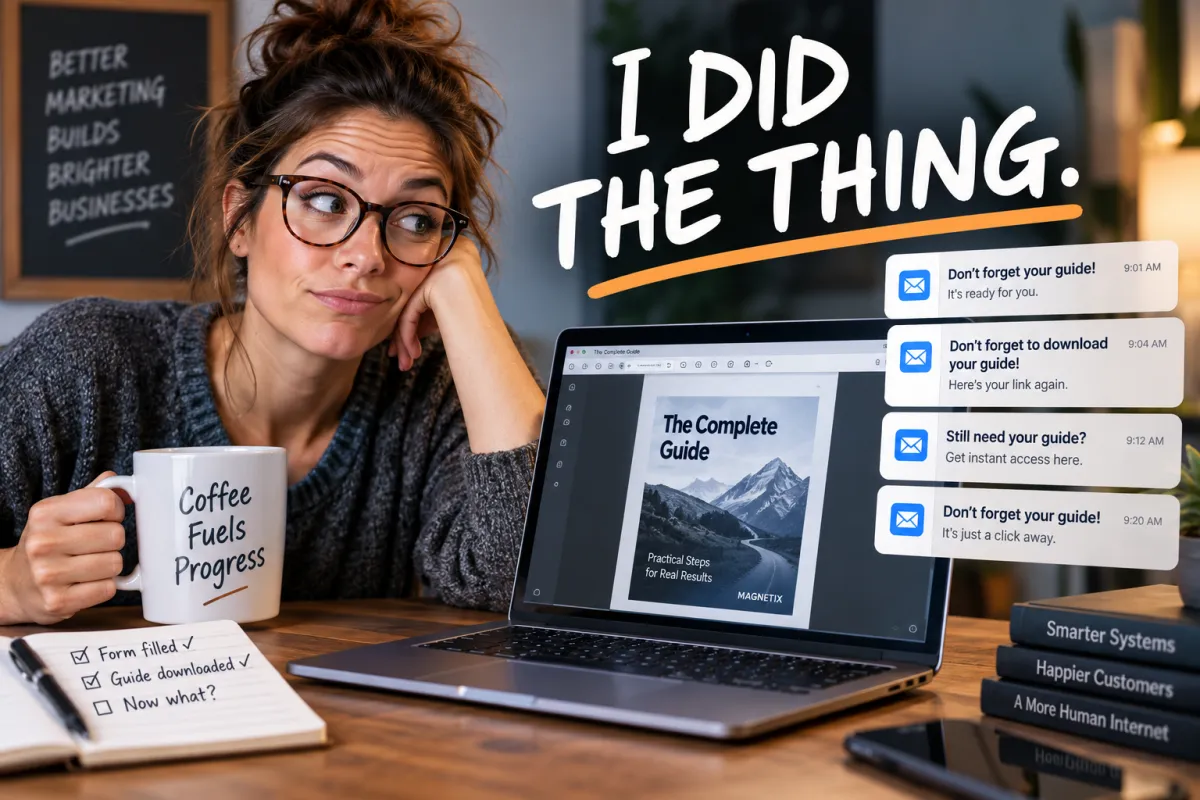
You download the guide.
Thirty seconds later, the email arrives:
Don't forget to download your guide.
You glance at the PDF already open in the next tab.
Well. This is going well.
There’s a strange thing that happens in marketing automation.
Someone sees an ad. Something about it catches their attention. They recognize themselves in the problem, click through, fill out a form, and ask you to send them something.
That’s quite a lot of information.
They didn’t merely become a “lead.”
They did something.
And then, far too often, our automation promptly forgets that part.
The workflow fires. The email goes out. Maybe an SMS follows. Another email waits patiently in line behind it. Everything is working exactly as configured.
Except the person on the other end may have already moved.
They may have downloaded the guide. They may have opened it and gotten distracted halfway through. They may have read the whole thing that evening.
They may have clicked the next link. They may have done exactly what we were hoping they would do.
Meanwhile, the automation is still standing back at the beginning yelling, “HEY! DON'T FORGET TO DOWNLOAD THE THING!”
There’s nothing technically wrong with the workflow.
It just isn’t paying very much attention.
──────── ⚡ ────────
We Know More Than “Lead Entered Workflow”
I think some of this comes from the way marketing automation grew up.
We learned to think in sequences. Email 1 goes out immediately. Wait a day. Email 2 goes out. Wait two days. Send Email 3.
Add a text message somewhere because somebody said SMS gets better response rates.
Eventually the person gets dumped into the long-term nurture sequence, where they begin receiving whatever everybody else receives.
There’s certainly nothing inherently wrong with sequences. Sometimes a simple sequence is exactly what the job requires.
But the sequence is supposed to serve the person.
The person isn’t supposed to serve the sequence.
That distinction became much clearer while we were working recently on the Business Brain Builder and trying to answer what sounded like a fairly ordinary question:
What should happen immediately after somebody requests a Lead Magnet?
At first, the obvious answer seemed to be some version of a follow-up sequence.
Then we started pulling at the thread.
And, as these things have a habit of doing around here, the supposedly simple question got more interesting.
Nurture and Nudge Aren’t Quite the Same Thing
I’ve used the word nurture for years.
Most marketers have.
It’s a useful word for the ongoing process of staying connected with someone: helping them understand a problem, sharing useful ideas, building familiarity and trust, and allowing a relationship to develop over time.
But that didn’t quite describe what we were trying to accomplish immediately after someone requested something.
They had already started an action.
Our job wasn’t necessarily to begin nurturing them. Our first job was to help them finish what they had already started.
That led us to a distinction I suspect we’ll be keeping:
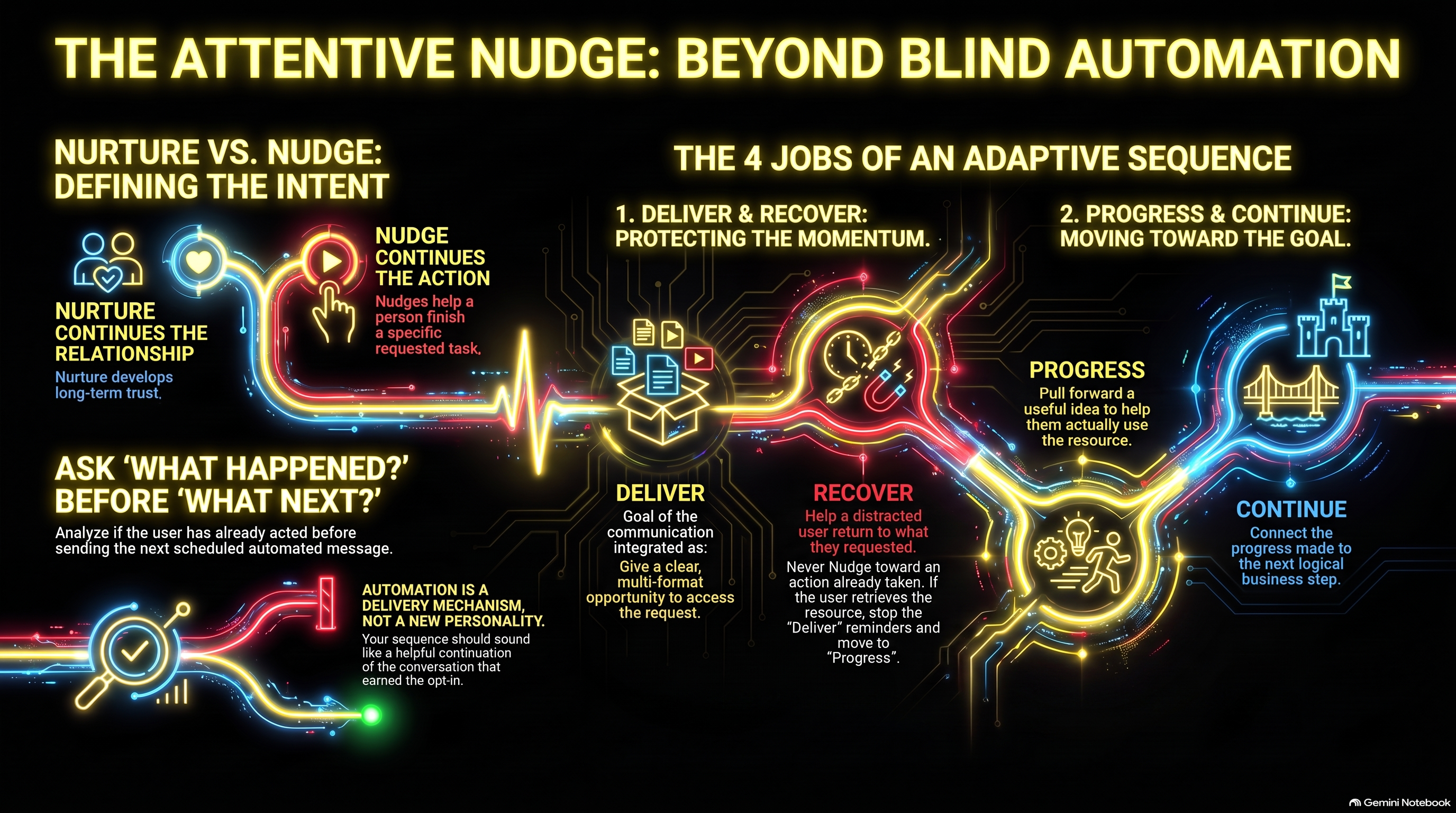
Nurture continues the relationship.
Nudge continues the action.
A Nudge might simply make sure the thing they requested is easy to find.
If life interrupted them, it might help them get back to it. Once they have it, perhaps the useful thing is no longer another reminder to download it. Maybe now we can point them toward the section most likely to help.
And once they’ve made the progress the resource was designed to create, perhaps then there’s a sensible next step.
The communication changes because the situation changed.
That seems almost embarrassingly obvious when written out.
And yet, look at your inbox.
“But We Already Sent You That” Is a Marketing Problem
We’ve probably all experienced some version of this.
You buy something and continue receiving emails asking you to buy it. You register for something and keep getting messages reminding you to register.
You complete an action and the company’s automation continues chasing you around the Internet trying to convince you to complete the action you just completed.
Occasionally you want to turn around and yell:
I DID THE THING.
The problem isn’t automation.
The problem is automation without enough awareness of the state of the relationship.
And we shouldn't overcorrect here, either. Tracking a click doesn't suddenly grant us mystical knowledge of what happened on the other side.
If someone clicks the link to retrieve a guide, we know they clicked the link.
We don't necessarily know they read the guide.
We certainly don't know they understood it, agreed with it, completed every exercise, experienced a revelation, and immediately called their mother to discuss their newfound marketing enlightenment.
We know what the evidence actually tells us.
They clicked.
That may be enough to change what we say next.
Ask “What Happened?” Before “What Next?”
This is the part I keep coming back to.
Marketing automation is usually designed around:
What should we send next?
Maybe the better question comes one step earlier:
What happened?
What did this person already do? What does that action reasonably tell us? What does it not tell us?
And given what we now know, what would actually be useful next?
Yesterday’s sequence might say, “It’s been two days, so send Email 3.”
A more attentive system might say, “They retrieved the guide, so Email 3’s reminder has already done its job. What would help them use it now?”
That produces a very different kind of automation.
Before someone retrieves the thing they requested, helping them retrieve it makes sense.
After they retrieve it, repeatedly helping them retrieve it becomes increasingly silly.
Now perhaps we help them use it.
If they take the next meaningful action, the communication should recognize that too.
Not because every funnel needs seventeen behavioral branches, twelve tags, six workflows and a small NASA control room monitoring the whole operation.
Sometimes the correct system really is simple.
But even a simple system can be built around an important principle:
Don’t keep nudging someone toward an action they already took.
──────── ⚡ ────────
Automation Should Remember Why It Exists
This may be the larger lesson hiding underneath all of this.
We automate because people cannot personally perform every repetitive action in a growing business. That’s enormously useful.
But the goal was never to automate the repetition itself.
The goal was to automate the helpful action.
Those aren't always the same thing.
An email reminding someone where to find a resource can be helpful. The fourth reminder after they've already retrieved it probably isn't more helpful simply because the workflow had four emails in it.
A text message that removes friction can be useful.
Sending the same sales pitch by text because “we need an SMS touchpoint” isn't necessarily useful.
Sometimes the best thing automation can do is recognize that its current job has been completed and move on.
Or stop.
There’s a surprisingly important difference between those two as well.
Sometimes “Stop” Doesn't Mean Goodbye
Here’s another little wrinkle we discovered.
Suppose someone has gotten everything they wanted from the immediate reminders.
Maybe they don't need another Nudge.
That doesn't necessarily mean they want to unsubscribe from the business forever.
Those are two very different decisions.
“Stop reminding me about this” can mean exactly that.
It doesn't automatically mean:
“Please erase this budding relationship from the face of the Earth and never speak to me again.”
Again, obvious once you notice it.
Less obvious when every automated communication is treated as one continuous blob called follow-up.
The more carefully we distinguish the job each communication is performing, the easier it becomes to respect what the customer is actually telling us.
Maybe Good Automation Should Feel Less Like Automation
Not because we hide it.
Not because we sprinkle fake personalization into every message and pretend somebody was sitting at a keyboard waiting specifically for Janet to download the PDF.
And definitely not because we need AI to write increasingly elaborate messages convincing Janet that the robots have feelings.
It can feel less automated for a much simpler reason:
It responds appropriately to what happened.
That's what a reasonably attentive human would do.
If I hand you a book and you tell me you've already read the first three chapters, I don't spend the next ten minutes explaining how to open the cover.
I start from where you are.
Our systems can increasingly do the same.
Not perfectly. Not omnisciently. And not by pretending that a click tells us more than a click actually tells us.
Just attentively enough to stop behaving as though nothing the customer does after the opt-in matters.
The next time you look at one of your automations, don't start by asking whether every email fired on schedule.
Pick one action you can actually observe—a link clicked, an appointment booked, a form completed—and follow what your automation does afterward.
Does it recognize that the action happened?
Or does it keep asking for the same thing?
Because the person on the other side of the automation isn't standing still.
They’re making decisions. They’re getting distracted. They’re coming back. They’re reading. They’re clicking. They’re ignoring things. They’re making progress.
And every now and then, perhaps the most useful question our automation can ask is the same one we should have been asking all along:
Your customer did something. Did you notice?