Your Customer’s Pain Point Might Not Be Their Problem
Your Customer’s Pain Point Might Not Be Their Problem
Most marketing advice tells you to identify your customer's pain points.
Fair enough.
But there's a problem hiding inside that advice.
Who decided what the pain point was?
Usually, the business owner did.
Maybe customers have actually said it. Maybe you've watched them struggle with it for years. Maybe your experience makes the answer seem obvious.
Or maybe you've repeated the same explanation for so long that it stopped feeling like an assumption.
There's an easy way to find out.
Before asking AI what it thinks, write down what you think first.
Not because you're necessarily right.
Because once you've seen someone else's answers, you can't completely unsee them.
──────── ⚡ ────────
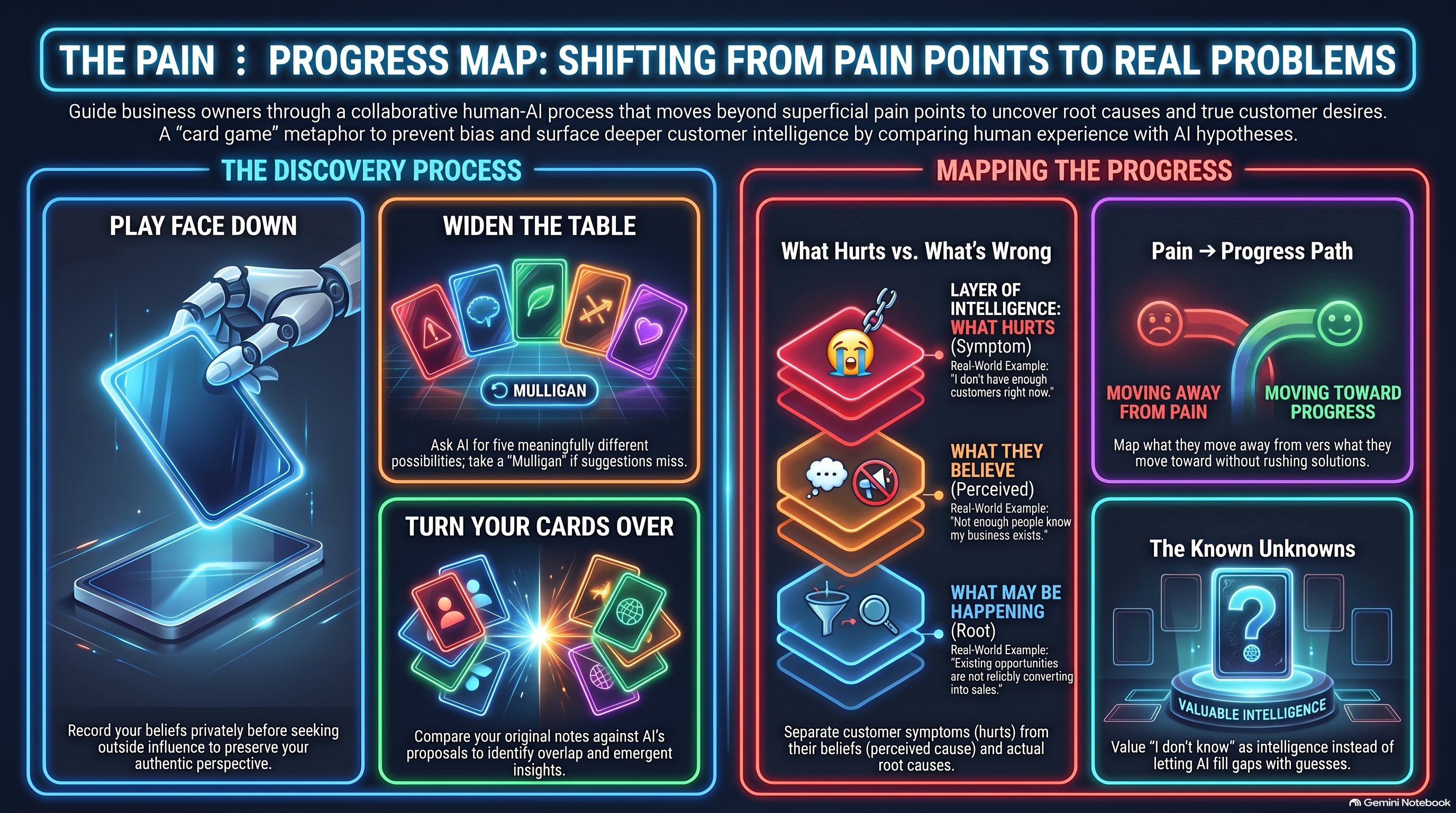
Put Your Answer Face Down
Imagine your Primary Customer Archetype sitting across the table from you.
What hurts?
Before researching, prompting, brainstorming or asking AI for suggestions, write down what you currently believe.
What would this customer say is wrong?
What are they actually experiencing?
What do they think is causing it?
Why does it matter?
What have they already tried?
What happens if nothing changes?
Don't worry about making your answers sound clever.
And don't send them to AI yet.
In the card-table metaphor we've been using inside the Business Brain Builder, you're simply putting your answer face down.
No actual cards required.
You're preserving what you believed before another perspective had the opportunity to influence it.
──────── ⚡ ────────
Now Let AI Put Five Possibilities on the Table
Here's where AI becomes considerably more interesting than a machine you ask for answers.
Don't ask:
“What is my customer's biggest pain point?”
That encourages one confident answer.
Instead, give AI the Business Brain context you've already developed and ask for five meaningfully different possibilities.
Now you have something to compare.
Maybe one sounds exactly right.
Maybe three are generic nonsense.
Maybe one catches you completely off guard:
“Huh. I've heard customers say something like that before.”
Don't automatically accept it.
That's not the point.
AI isn't the expert descending from the mountain with the answer.
It's widening the table.
──────── ⚡ ────────
Now Turn Yours Over
Only after AI has made its suggestions do you reveal what you wrote beforehand.
Now things get interesting.
Your answer may confirm something AI proposed.
Your experience may expose something AI completely misunderstood.
AI may put language around something you've noticed for years but never consciously separated from the larger problem.
And did AI completely miss something you know matters?
That's worth noticing too.
Sometimes putting several imperfect explanations beside one another makes you suddenly realize:
“Wait. THAT'S what's happening.”
That's a win.
The best answer doesn't have to be yours.
It certainly doesn't have to be AI's.
It can emerge from the comparison.
──────── ⚡ ────────
What Hurts Isn't Necessarily What's Wrong
Now we can go deeper.
Suppose a business owner believes their customer's primary pain is:
“I need more leads.”
That's certainly something a customer might say.
Their experience supports it. Revenue is inconsistent. Some weeks the phone rings; others it doesn't. They're constantly wondering where the next customer is coming from.
Ask why, and they might say:
“Not enough people know about my business.”
That matters.
It's the customer's understanding of their problem.
But it isn't necessarily the underlying cause.
Maybe they actually do generate a reasonable number of opportunities, but leads routinely disappear because nobody follows up consistently.
Now we have three different pieces of intelligence:
What hurts:
“I don't have enough customers.”
What the customer believes:
“I need more people to find me.”
What may actually be happening:
“Existing opportunities aren't reliably converting.”
Those distinctions matter enormously.
If you collapse all three into PAIN POINT: NEEDS MORE LEADS, you've thrown away most of the useful information.
──────── ⚡ ────────
Don't Forget What They're Moving Toward
Pain is only half the map.
If someone is trying to escape an unwanted condition, they're usually trying to get somewhere else.
So ask the same kind of questions about desire.
What do they want to change?
What would success actually look like?
How would they describe it?
Why does it matter?
And what becomes possible if they get there?
Again, don't immediately translate their desire into your solution.
Your customer probably doesn't wake up thinking:
“What I really need today is an automated multi-channel nurture architecture.”
They might wake up thinking:
“I wish I didn't have to remember to chase every damn lead myself.”
That's a very different sentence.
And probably a much more useful one.
──────── ⚡ ────────
The Space Between Pain and Progress
Put those two sides together:
What are they trying to move away from?
What are they trying to move toward?
Now investigate what's standing between them.
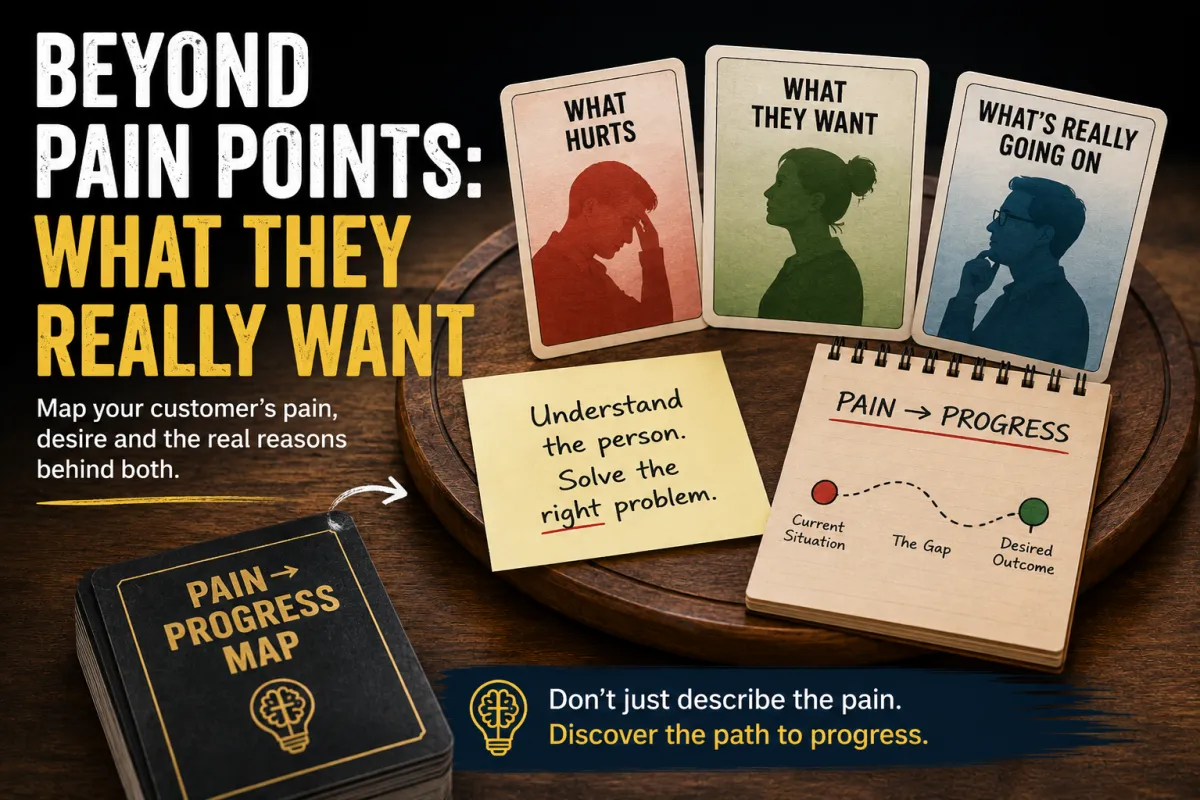
That's where a simple pain-point exercise starts becoming a Pain → Progress Map.
And this is also where you need to be suspicious of yourself.
If you're a marketer, every underlying problem can mysteriously start looking like a marketing problem.
If you're a coach, an astonishing number of people seem to need coaching.
If you're a plumber...
Well, you get the idea.
Expertise helps us recognize problems.
It also gives us a favorite hammer.
So before settling on an underlying cause, ask one uncomfortable question:
Are we diagnosing the customer's problem honestly, or defining the disease around the medicine our business happens to sell?
Sometimes your original diagnosis survives beautifully.
Sometimes it doesn't.
Sometimes the correct answer is:
We don't know yet.
That's an answer worth preserving.
──────── ⚡ ────────
“I Don't Know” Belongs in Your Business Brain
One of the easiest mistakes when building an AI knowledge base is assuming every empty field needs an answer.
It doesn't.
There is an enormous difference between:
We know this.
We currently believe this.
Our customer appears to believe this.
AI suggested this possibility.
and
We don't know yet.
A good Business Brain should preserve those distinctions.
If you realize you don't actually know whether customers feel frustrated or resigned, don't let AI confidently choose one because the box looks lonely.
Record the question.
If you're unsure whether customers have already tried the obvious alternative, record that.
If two explanations seem equally plausible and you don't have enough evidence to distinguish them, record that too.
Those belong in your Business Brain too.
They're Known Unknowns.
And someday they can become customer interview questions, survey questions, research projects, campaign tests or things you simply start paying attention to.
Knowing where you're guessing is valuable.
──────── ⚡ ────────
And If AI Completely Misses?
Throw the hand back.
Card players sometimes call that taking a Mulligan—but you don't need to know anything about cards to use the idea.
If AI gives you five possibilities and all five fundamentally misunderstand your customer, don't choose the least-wrong one because the exercise told you to choose.
Say:
No. Here's what you're misunderstanding. Start fresh.
Then get five new possibilities.
That's one of the most useful habits you can develop when working with AI:
You are never obligated to work with a bad premise just because AI produced it confidently.
──────── ⚡ ────────
AI Doesn't Need to Know Better Than You
That's not the relationship we're trying to build.
You bring experience, observations, intuition, customer conversations and knowledge of your business.
AI brings an extraordinary ability to rapidly generate alternative interpretations and explore possibilities.
Either one can be wrong.
The interesting part happens when you put those perspectives beside one another and think.
Write what you believe.
Let AI widen the field.
Compare.
Explore.
Challenge what seems strongest.
Keep what survives.
And preserve what you still don't know.
That's how a Business Brain becomes more than a database filled with whatever answers the owner happened to type on Tuesday afternoon.
Building the Business Brain should improve the thinking that goes into it.
Otherwise, we're just giving AI a better-organized collection of our assumptions.
And those aren't necessarily worth remembering.